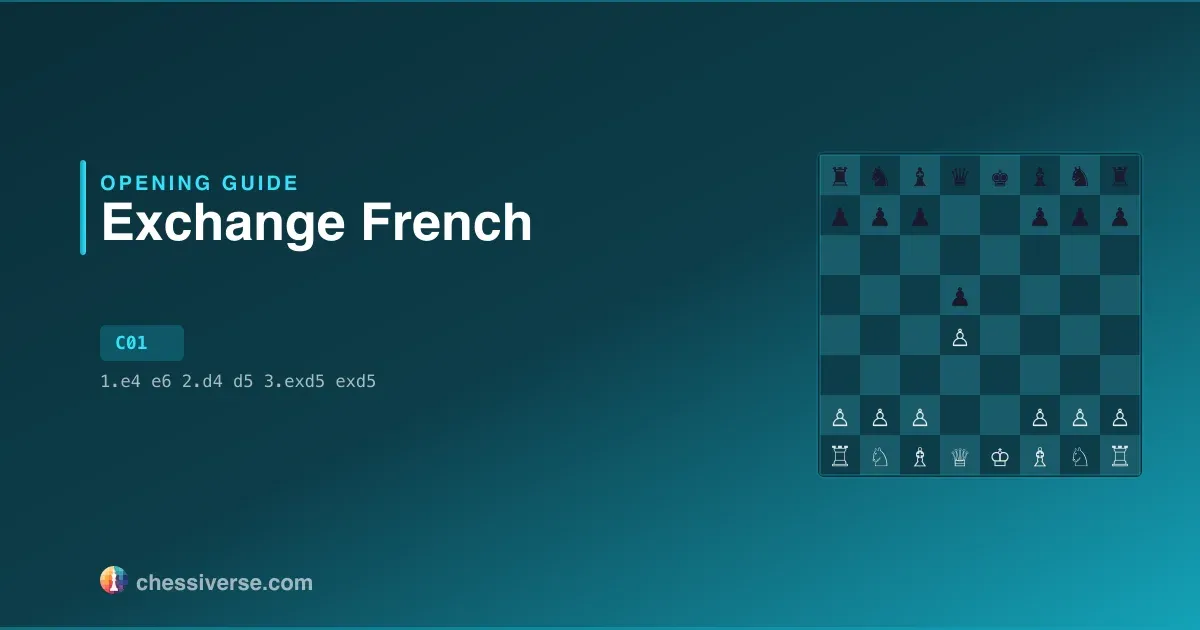
The French Defense: Exchange Variation arises after 1.e4 e6 2.d4 d5 3.exd5 exd5 and falls under ECO code C01. The recapture produces a symmetrical pawn structure in which Black can often neutralize any advantage White seeks simply by mirroring moves. While this symmetry gives the Exchange Variation a reputation for being dry and drawish, both sides have discovered ways to create imbalances. White can voluntarily accept an isolated d-pawn by playing 4. c4, gaining a spatial edge in return, or take a more traditional path with rapid development through moves like 4. Bd3, 4. Nf3, or 4. Be3 if queenside castling is the plan. With 27.4 million Lichess games across all rating levels, it is a well-established opening choice.
- The pawn structure is completely symmetrical, so whoever wants to win must be the first to break the mirror with an unbalancing plan
- Black's queen's bishop is freed at once, and the mirrored pawns give the line its reputation for handing Black instant equality
- Because neither side has a structural edge, it is a favourite of players steering for a draw
History and Notable Players
It arises from the French Defense. Among the most prolific practitioners on the White side are Viesturs Meijers (82 games), Inna Gaponenko (40 games), Luis Galego (35 games). On the Black side, notable exponents include Evgeny Gleizerov (44 games), Dragan Kosic (43 games), Wolfgang Uhlmann (36 games).
Until the mid-1800s this symmetrical line was the standard way to meet the French, and Howard Staunton was among its advocates. The variations after 3.Nc3, 3.Nd2 and 3.e5 became popular in the 1860s and 1870s, and the Exchange has been out of fashion ever since. Garry Kasparov gave it a brief trial in the early 1990s before switching to 3.Nc3.
Notable players: Howard Staunton, Garry Kasparov
The line is so famously dry that Wilhelm Steinitz claimed he had never once played the French Defence in his life because of its tedium.
Statistics
Based on 27.4 million Lichess games across all rating levels:
- White wins: 47.1%
- Black wins: 47.3%
- Draws: 5.6%
The statistics show a roughly balanced opening where both sides have equal chances.
Common Mistakes to Avoid
- Being too passive: While this opening is solid, playing without a plan can lead to a cramped position. Look for the right moment to break with a central pawn advance and free your pieces.
Practice on Chessiverse
The best way to learn the French Defense: Exchange Variation is through practice. On Chessiverse, you can play chess against computer opponents that specialize in this opening. Our AI bots range from beginner to grandmaster level, each with unique playing styles — from aggressive attackers to solid defenders. Choose a bot that matches your rating and work your way up as you master the opening's key ideas.
Performance Across Rating Levels
How well the French Defense: Exchange Variation works depends on what level you're playing at. Among 1200-rated players, it appears in 0.25% of games — 1,705,997 of them on record — with White winning 48.1% and Black 47.8%. Move up to 1800 Elo and the share shifts to 1.00%, with White winning 46.7% versus Black's 47.4%. Among 2500-rated players the line appears in 0.43% of games and draws spike to 12.4%, indicating tight preparation. Relative to what's typical at each level, positions also become less sharp as rating rises.
Time Control Patterns
Look at the same opening across time controls and blitz stands out. In bullet, it appears in 0.61% of games (16,213,089); White wins 47.7%. Blitz shows 0.62% adoption across 22,378,048 games, White scoring 47.2%. In rapid, the share rises to 0.45% — 5,015,985 games, White 46.8%.
Move Diversity and Theory Depth
Move choice is far from uniform in the French Defense: Exchange Variation. At 1200 Elo (1,705,997 games), the top reply is Nc3, played 32.6% of the time. Three other moves each take at least 5% of games, and the top three moves account for 77.7% of games. Entropy: 2.53. By 2500 (58,669 games), Nf3 takes over as the top reply at 51.2%; only two other moves still reach 5% and the top three moves account for 90.1% of games. Entropy drops to 1.96. The narrowing is significant — strong players consolidate around a small set of best moves, while amateurs scatter across many plausible-looking options.
Historical Trends
Year-over-year data tells you whether this opening is a contemporary fixture or a fading one. Adoption peaked in 2018 at 0.64% (1,205,123 games). By 2025 it sits at 0.61%, 5% below the peak but still 17% above its 2013 level, so the line is up over the full period despite easing from the high.