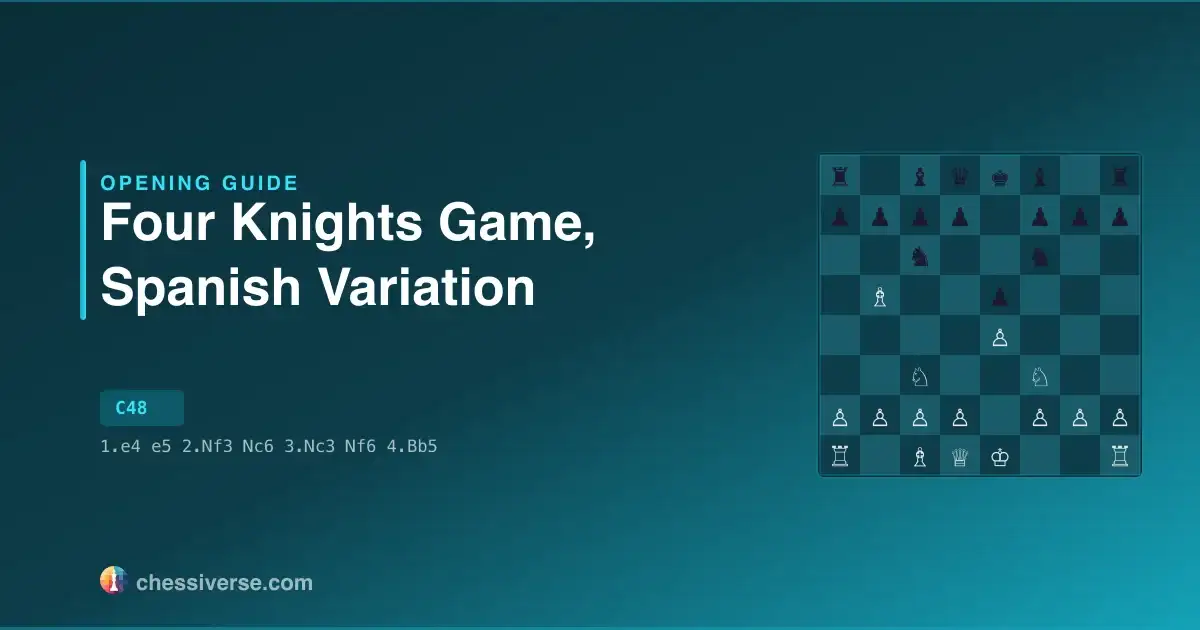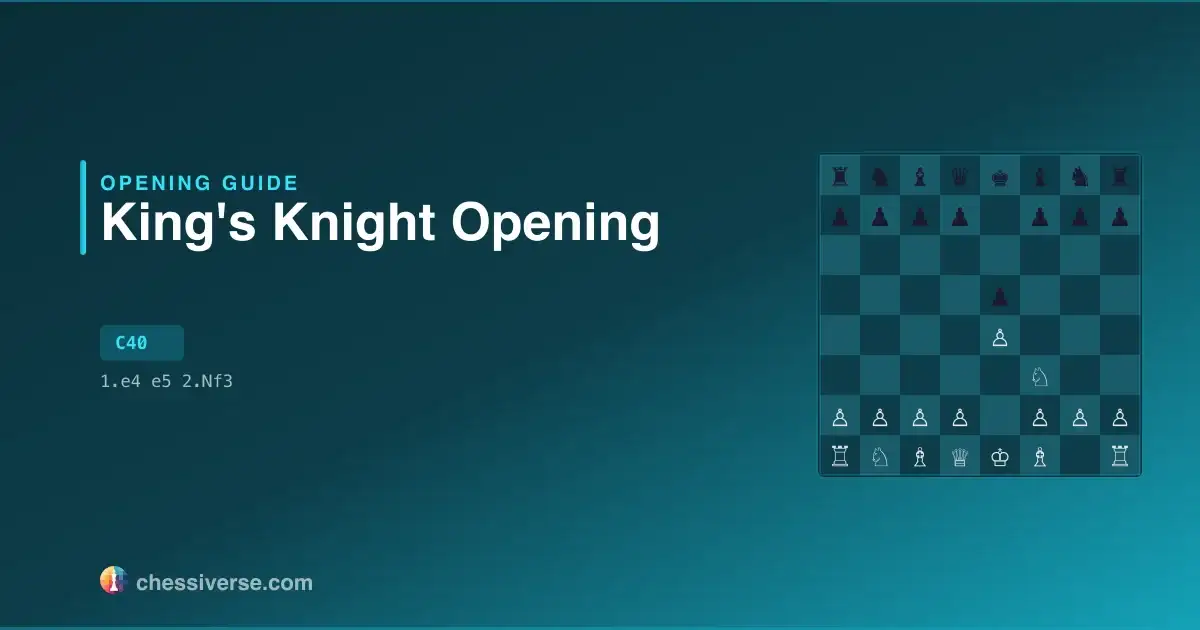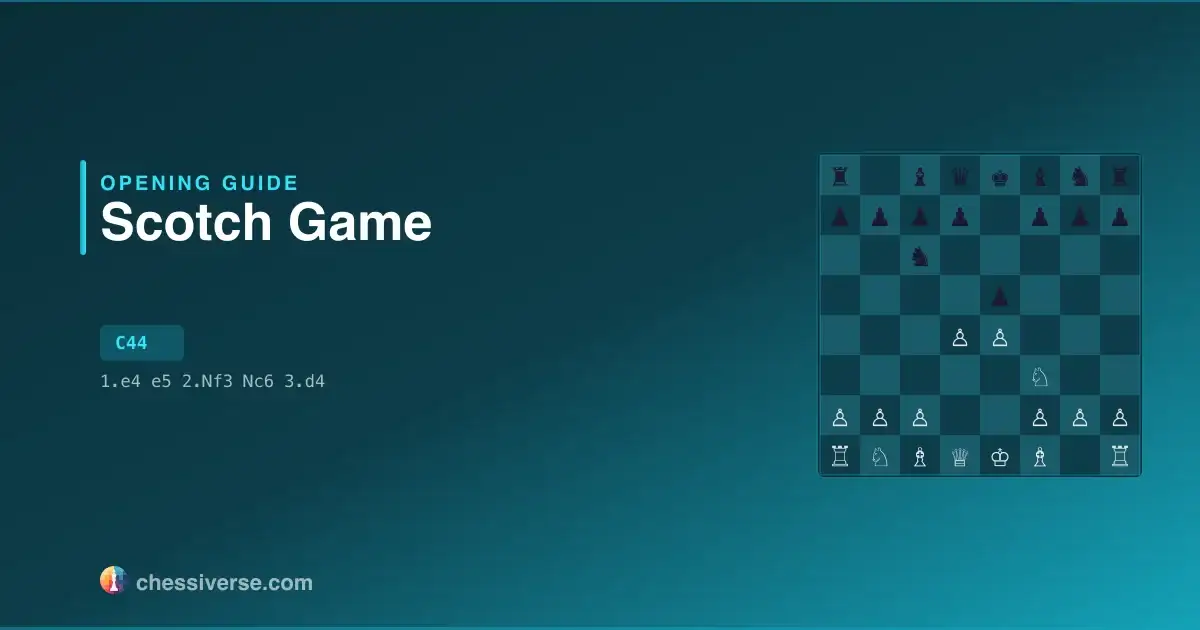




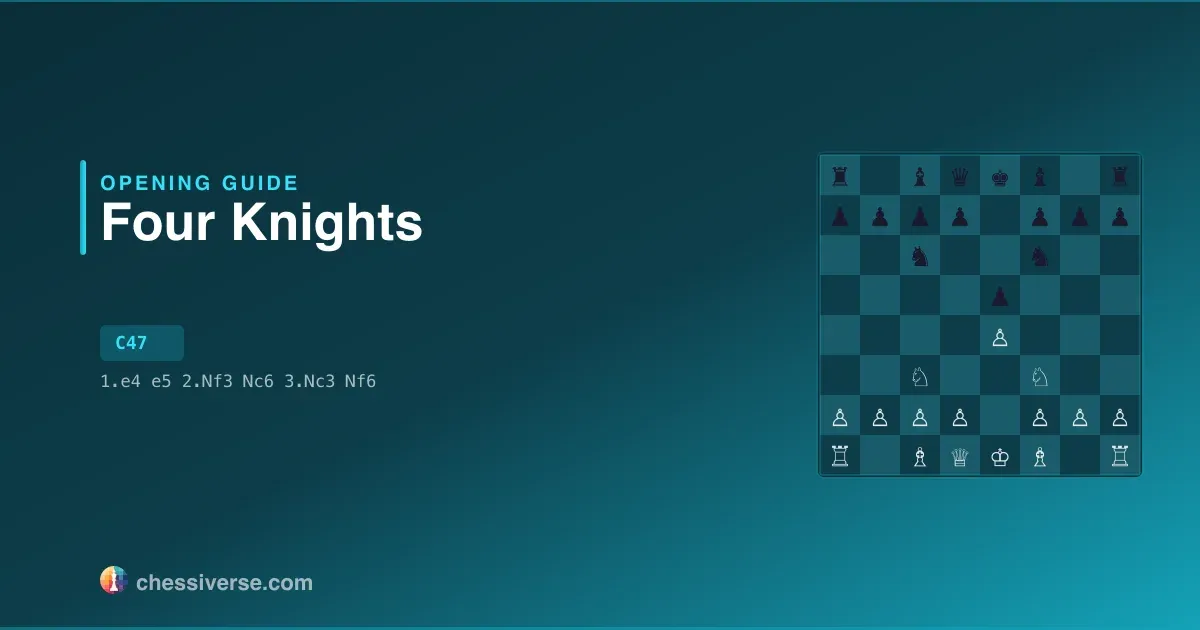
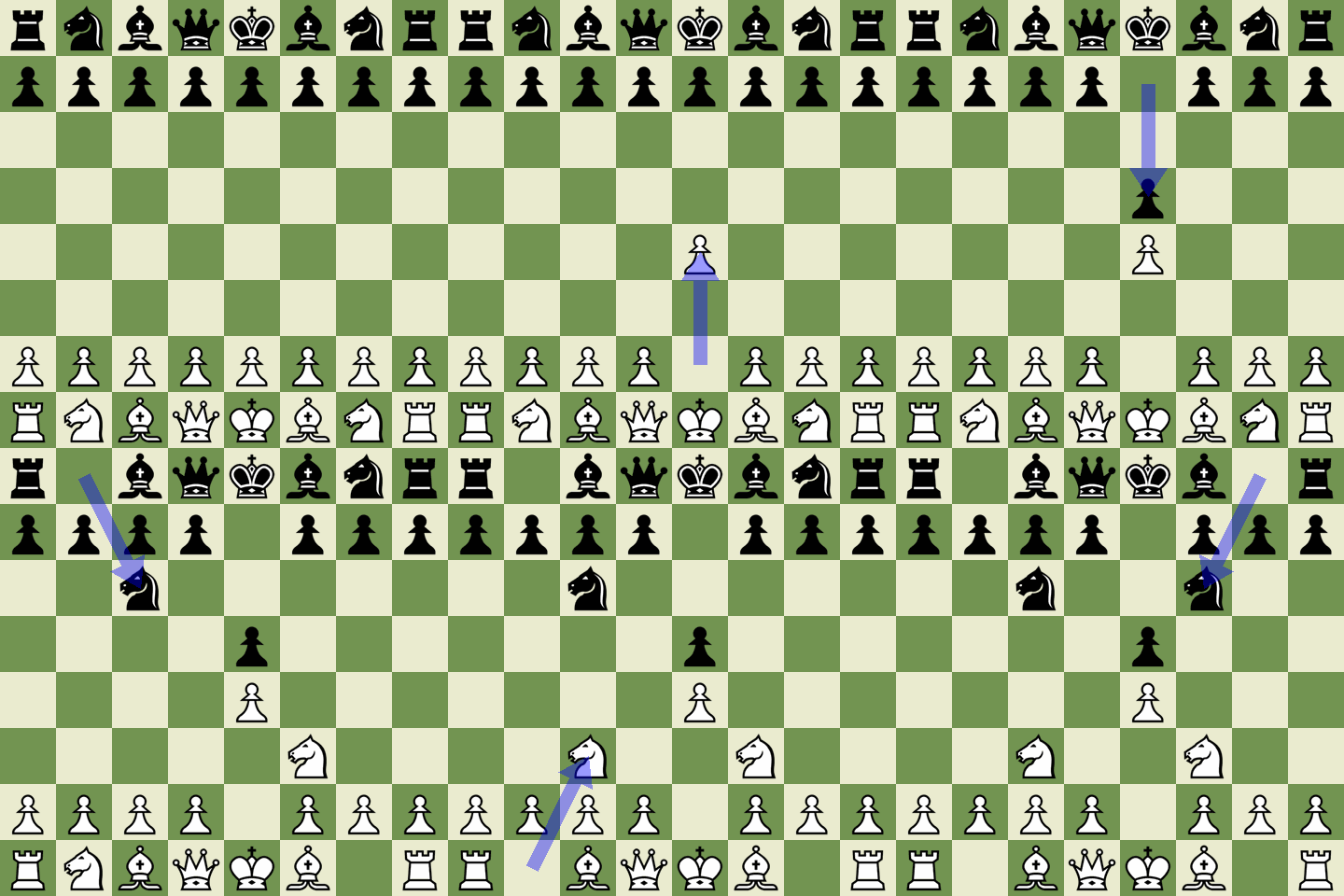
The Four Knights Game arises after 1.e4 e5 2.Nf3 Nc6 3.Nc3 Nf6 and falls under ECO code C47. The resulting position is perfectly symmetrical, which tends to produce somewhat drawish play. The two most important continuations are 4. Bb5, which develops the bishop while targeting the centre, and 4. d4, which opens the position and transposes into a Scotch Game variation. With all four knights in play, White's next priority is the king's bishop, after which castling becomes available. The main line, 4. Bb5, is called the Spanish Variation, and like the standard Ruy Lopez, the bishop on b5 creates indirect pressure on Black's centre by threatening to remove the knight that guards e5. However, key differences exist: the knight on c3 blocks the c-pawn, ruling out White's usual c3-d4 plan, and because e4 is already defended by the knight, the response 4...a6?! leads to a different outcome after Bxc6 dxc6 Nxe5. Black's two principal replies are 4...Bb4 and 4...Nd4. With 56.2 million Lichess games across all rating levels, it is a well-established opening choice.
- Both sides develop all four knights before the bishops, textbook classical play, which makes it a natural choice for improving players
- The two main continuations are 4.Bb5, the Spanish Variation, where play often stays symmetrical, and 4.d4, the Scotch Variation
- It lets White reach an open game while sidestepping the Petrov's Defence
History and Notable Players
It arises from the Open Games (1...e5). Among the most prolific practitioners on the White side are Yochanan Afek (30 games), Moshe Czerniak (30 games), Pavel Potapov (28 games). On the Black side, notable exponents include Oleg Korneev (19 games), Svetozar Gligoric (19 games), Peter Lukacs (18 games).
A favourite of the 19th-century Open Game era, it lost ground by World War I as ambitious players turned to the Ruy Lopez to press White's first-move edge. In the 1990s it enjoyed a renaissance and returned to grandmaster repertoires. It even featured in game five of the 1996 Deep Blue versus Kasparov match.
Named after: Not named for a person: by move three all four knights have been developed, giving the opening its name.
Notable players: Nigel Short, Michael Adams, Alexei Shirov
Its drawish reputation can deceive: in a 1916 match game Emanuel Lasker beat Siegbert Tarrasch with Black in just 23 moves, and the Scotch Four Knights appeared in the 1996 Deep Blue vs Kasparov match.
Statistics
Based on 56.2 million Lichess games across all rating levels:
- White wins: 49.1%
- Black wins: 46%
- Draws: 4.9%
The statistics show a roughly balanced opening where both sides have equal chances.
Main Lines and Variations
After 1.e4 e5 2.Nf3 Nc6 3.Nc3 Nf6, the main continuations include:
Each of these lines leads to distinct types of positions and requires its own understanding of the resulting pawn structures and piece placements.
Practice on Chessiverse
The best way to learn the Four Knights Game is through practice. On Chessiverse, you can play chess against computer opponents that specialize in this opening. Our AI bots range from beginner to grandmaster level, each with unique playing styles — from aggressive attackers to solid defenders. Choose a bot that matches your rating and work your way up as you master the opening's key ideas.
Performance Across Rating Levels
Popularity and results vary sharply by rating level. Among 1200-rated players, it appears in 1.77% of games — 11,914,269 of them on record — with White winning 49.1% and Black 46.3%. At 1800 the opening surfaces in 0.65% of games; White wins 49.1%, Black 45.6%, draws 5.2%. Among 2500-rated players the line appears in 0.85% of games and draws spike to 12.6%, indicating tight preparation.
Time Control Patterns
Time control matters here: rapid players reach for this opening more than others. In bullet, it appears in 0.77% of games (20,594,133); White wins 51%. Blitz shows 1.04% adoption across 37,320,509 games, White scoring 49.5%. In rapid, the share rises to 1.71% — 18,928,181 games, White 48.3%. White's score swings 2.7pp across formats, so time control isn't just a stylistic choice here — it shifts the actual results.
Move Diversity and Theory Depth
What players actually play after the opening moves depends heavily on rating. At 1200 Elo (11,914,269 games), the top reply is Bc4, played 39% of the time. Three other moves each take at least 5% of games, and the top three moves account for 81.7% of games. Entropy: 2.38. By 2500 (116,238 games), d4 takes over as the top reply at 33.6%; four other moves reach 5% and the top three moves account for 74.6% of games. Entropy rises to 2.53. Even elite players don't fully agree on the best continuation here, which keeps the position dynamic.
Historical Trends
Tracking the Four Knights Game year over year shows a clear story. Adoption peaked in 2020 at 1.30% (7,477,197 games). By 2025 it sits at 1.21%, 7% below the peak but still 39% above its 2013 level, so the line is up over the full period despite easing from the high.