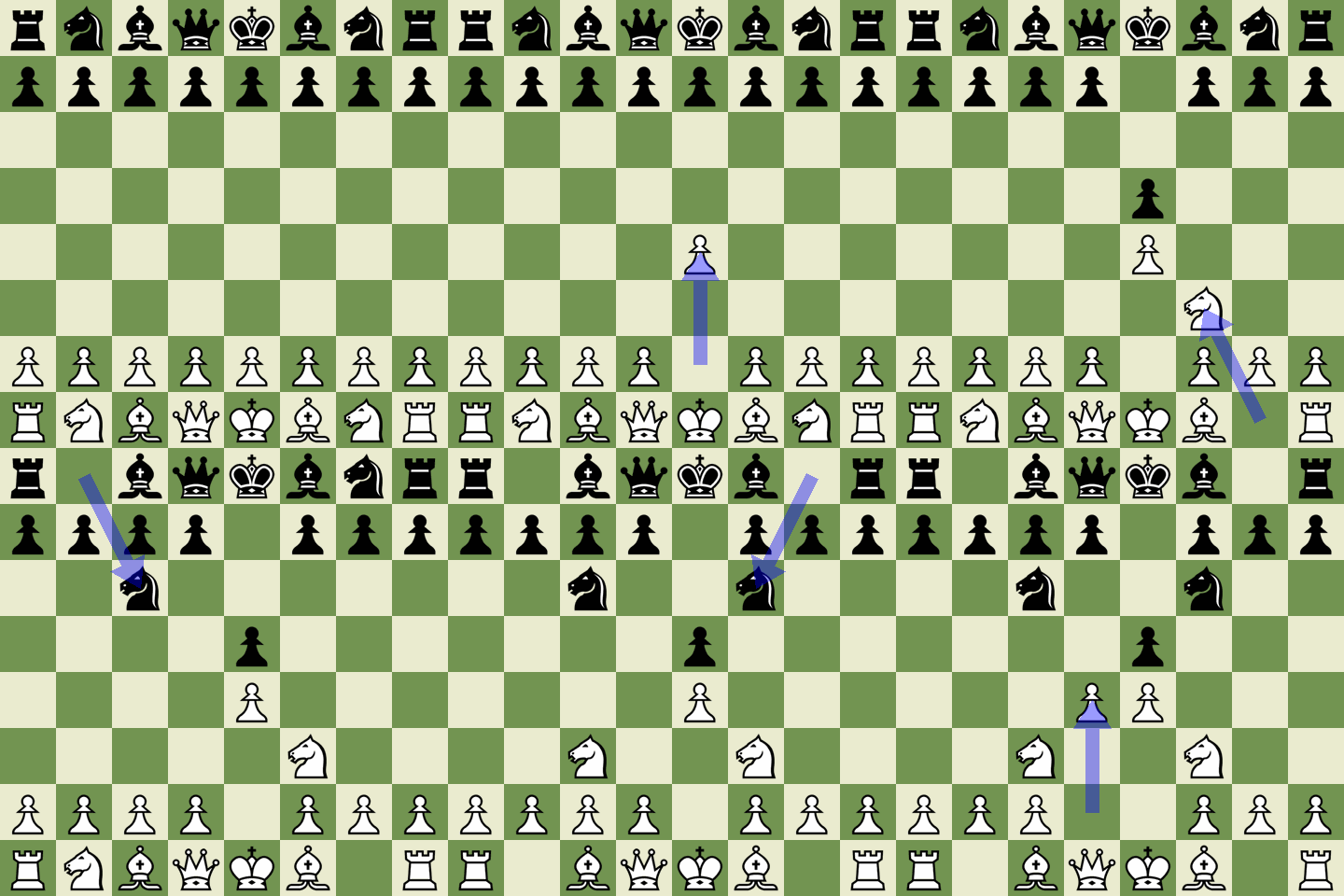
Starting from 1.e4 e5 2.Nf3 Nc6 3.Nc3 Nf6 4.d4, players enter the Four Knights Game, Scotch Variation — ECO C47. White breaks the symmetry by punching the centre open, refusing to let the Four Knights settle into a quiet positional game.
Strategic Overview
The Scotch Four Knights is the aggressive way to play the Four Knights opening. By pushing d4, White challenges Black's e5 pawn directly and forces a structural decision rather than continuing the symmetric piece development that defines the rest of the system. The natural reply 4...exd4 lets White recapture with 5.Nxd4, and the position becomes essentially a Scotch Game with both pairs of knights developed. After 5...Bb4 6.Nxc6 bxc6 7.Bd3, we land in a standard Scotch structure: Black has the bishop pair and the half-open b-file, White has the better pawn structure and central control. The sharper alternative is 5.Nd5, the Belgrade Gambit, where White offers a pawn for active piece play and a lead in development. The Belgrade is a serious surprise weapon but theoretically respectable on both sides, with lines leading to tactical scrambles that reward concrete preparation. Strategically, the Scotch Four Knights is the choice for White players who want an active, open game out of 1.e4 e5 without committing to deeper Ruy Lopez or Italian theory. Black has a fully sound game with normal development but must be ready to handle either the Scotch transposition or the Belgrade complications.
Key Ideas
When players succeed in this line, they usually do so by leaning on the following themes:
- Punch the centre open with d4 — Pushing in the centre on move four refuses the slow Four Knights game and forces immediate concrete decisions. The position becomes Scotch-flavoured rather than symmetric.
- 5.Nxd4 transposes to the Scotch — The standard recapture leads to mainstream Scotch Game structures with both knight pairs already developed. Bishop pair versus structure is the usual long-term trade.
- 5.Nd5 Belgrade Gambit — The sharp sideline offers a pawn for active piece play. It is a legitimate weapon at club level and requires concrete preparation from Black to navigate safely.
- Active and theory-light for White — Compared to the Ruy Lopez or Italian, the Scotch Four Knights gives White a clear, principled opening plan without deep memorisation. Easy to learn, harder for Black to handle on sight.
History and Notable Players
It arises from the Four Knights Game. Among the most prolific White practitioners are Yochanan Afek (30 games), Moshe Czerniak (30 games), Pavel Potapov (28 games). Black-side regulars include Oleg Korneev (19 games), Svetozar Gligoric (19 games), Peter Lukacs (18 games).
Performance Across Rating Levels
The picture changes a lot as you climb the rating ladder. The 1200 bracket has 2,514,137 games (0.37% of all games at that level); White wins 52.1%, Black 43.3%, 4.6% are drawn. At 1800 the opening surfaces in 0.17% of games; White wins 52.3%, Black 42.2%, draws 5.6%. At the top end (2500+ Elo), popularity is 0.29% with 15.5% draws — a clear sign of how much theory rules the line at master level. White's edge erodes by 7.1pp from 1200 to 2500 Elo, suggesting Black's counterplay is easier to find with experience.
Time Control Patterns
Time control matters here: rapid players reach for this opening more than others. In bullet, it appears in 0.23% of games (6,241,360); White wins 52.8%. Blitz shows 0.26% adoption across 9,205,568 games, White scoring 52%. In rapid, the share rises to 0.34% — 3,718,240 games, White 51.5%.
Move Diversity and Theory Depth
What players actually play after the opening moves depends heavily on rating. At 1200 Elo (2,514,137 games), the top reply is exd4, played 65.2% of the time. Two other moves each take at least 5% of games, and the top three moves account for 88.1% of games. Entropy: 1.76. By 2500 (39,151 games), exd4 dominates at 87.9% of replies; only one other move still reaches 5% and the top three moves account for 99.7% of games. Entropy drops to 0.59. That entropy collapse is the signature of a line where preparation pays off: at the top, players know the best move and play it.
Historical Trends
Tracking the Four Knights Game, Scotch Variation year over year shows a clear story. Adoption peaked in 2020 at 0.29% (1,670,131 games). By 2025 it sits at 0.27%, 6% below the peak but still 23% above its 2013 level, so the line is up over the full period despite easing from the high.
Common Mistakes
- Drifting away from main theory — At 400 Elo, the three most-played moves cover 78.6% of games, against 97.1% at 2000. The most popular deviation is d6 (played 16.8% of the time at 400, much less so up top). It looks fine but quietly hands the better-prepared side an edge.
- Neglecting development — It can feel productive to make extra pawn moves early, but falling behind in piece development is what loses most amateur games — especially in open positions where active pieces find squares fast.
- Playing without a plan — Each Four Knights Game, Scotch Variation middlegame demands a specific approach. Decide whether the position calls for attack, manoeuvre, or simplification before reaching for a move.
Practice on Chessiverse
Ready to try the Four Knights Game, Scotch Variation against a bot? Pick an opponent at your level and play a game.