



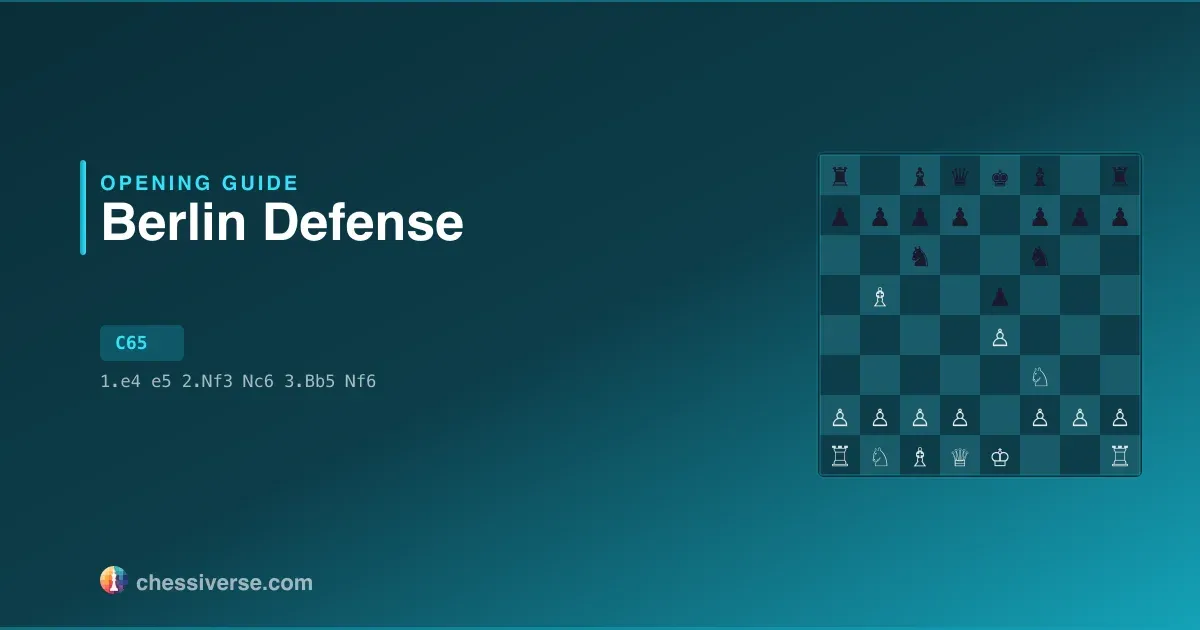
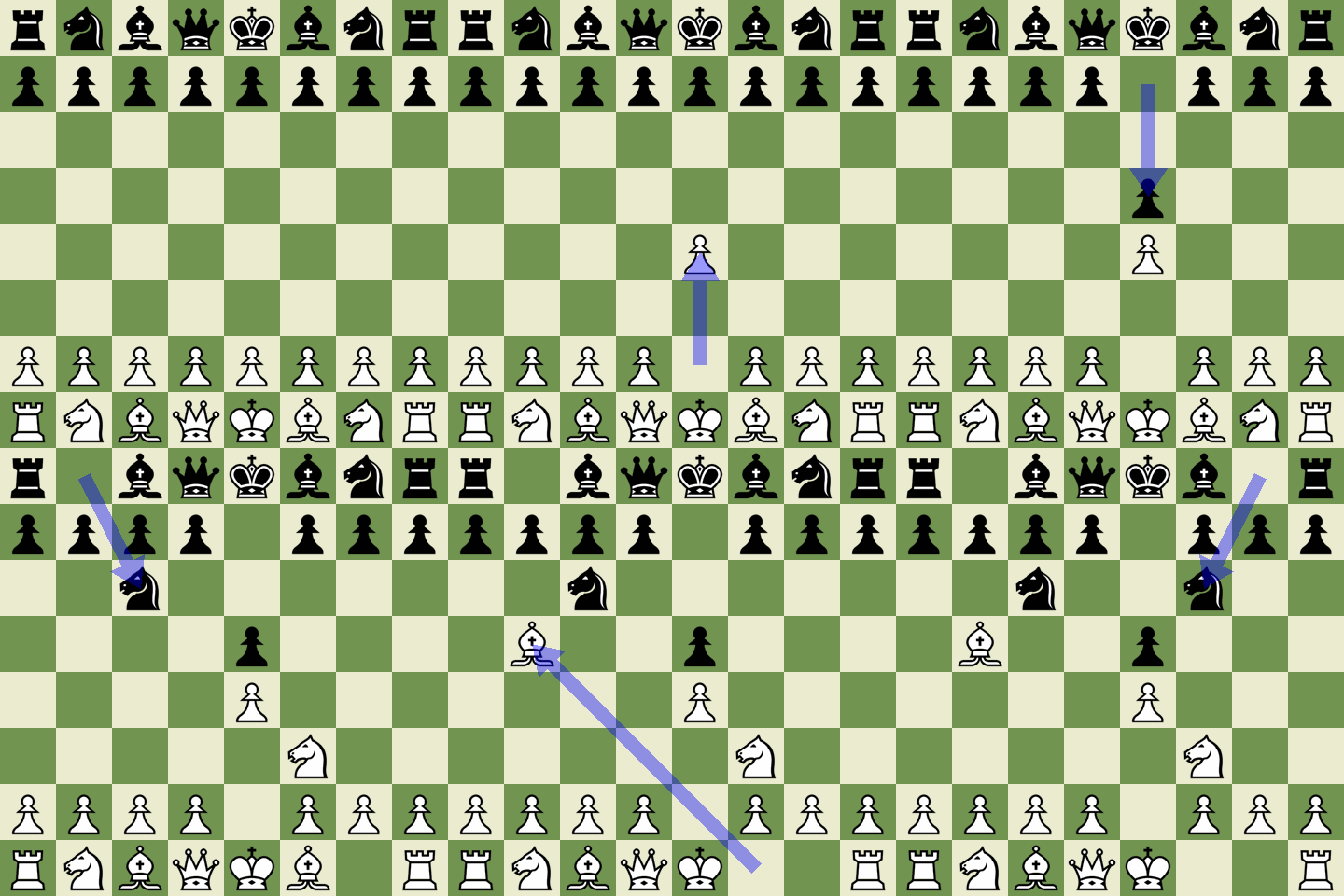
The Ruy Lopez: Berlin Defense arises after 1.e4 e5 2.Nf3 Nc6 3.Bb5 Nf6 and falls under ECO code C65. As the primary alternative to 3...a6, the Berlin Defense has earned a reputation for exceptional solidity and is employed at the highest levels of chess as a dependable drawing resource. The main line leads to a notoriously balanced endgame known as the Berlin Wall, where White struggles to generate winning chances, and another popular variation can even produce a draw by repetition as early as move 14. The developing move 3...Nf6 simultaneously controls the center, attacks the e4 pawn, and brings Black closer to castling. After 4. O-O, Black can capture on e4 with 4...Nxe4, though this is effectively a temporary win since White recovers the material through e-file pressure (for instance, 5. Re1 skewers through the knight to the e5 pawn). The main line then continues with 5. d4 Nd6 and either 6. Bxc6 or 6. dxe5. White can sidestep these typical Berlin endgames with 4. d3, which guards e4 and neutralizes the 4...Nxe4 threat while reinforcing the pressure on e5, since the ...Qd4 fork no longer works after Bxc6 dxc6 Nxe5. Black can respond with the straightforward 4...d6 or the tactical 4...Bc5!, which creates threats of ...Qd4 and ...Qxf2#. With 23 million Lichess games across all rating levels, it is a well-established opening choice.
- Black allows an early queen trade into the Berlin endgame, accepting doubled pawns and a king stuck in the center in return for the bishop pair.
- White banks on a healthy kingside pawn majority, but with accurate play Black is considered able to hold the endgame.
- Many White players now choose 4.d3, the Anti-Berlin, to keep the queens on and avoid the endgame entirely.
History and Notable Players
It arises from the Ruy Lopez. Among the most prolific practitioners on the White side are Viswanathan Anand (127 games), Maxime Vachier Lagrave (105 games), Fabiano Caruana (92 games). On the Black side, notable exponents include Aleksej Aleksandrov (190 games), Vladimir Kramnik (150 games), Levon Aronian (133 games).
Berlin players analyzed the defense deeply in the 1800s, and Zukertort used it against Steinitz in the first official world championship in 1886. Seen as passive, it faded for most of the 20th century until Kramnik revived it against Kasparov in their 2000 title match, drawing all four Berlin games and sparking a resurgence at every level.
Named after: Named for the 19th-century Berlin players who worked out its variations.
Notable players: Emanuel Lasker, Vladimir Kramnik, Magnus Carlsen, Viswanathan Anand
The resulting endgame is also called the Berlin Wall, and its drawing repetition is so familiar that Rapport-Nakamura at the 2022 World Blitz Championship reached a threefold draw in 36 seconds.
Statistics
Based on 23 million Lichess games across all rating levels:
- White wins: 52%
- Black wins: 43.4%
- Draws: 4.6%
White holds a moderate edge statistically, though Black has good practical chances.
Main Lines and Variations
After 1.e4 e5 2.Nf3 Nc6 3.Bb5 Nf6, the main continuations include:
Each of these lines leads to distinct types of positions and requires its own understanding of the resulting pawn structures and piece placements.
Practice on Chessiverse
The best way to learn the Ruy Lopez: Berlin Defense is through practice. On Chessiverse, you can play chess against computer opponents that specialize in this opening. Our AI bots range from beginner to grandmaster level, each with unique playing styles — from aggressive attackers to solid defenders. Choose a bot that matches your rating and work your way up as you master the opening's key ideas.
Performance Across Rating Levels
Popularity and results vary sharply by rating level. The 1200 bracket has 4,837,102 games (0.72% of all games at that level); White wins 52.4%, Black 43.4%, 4.2% are drawn. By 1800, popularity is 0.34% and White's score is 51.8% to Black's 43.2%. Among 2500-rated players the line appears in 0.55% of games and draws spike to 13.7%, indicating tight preparation. White's edge erodes by 8.1pp from 1200 to 2500 Elo, suggesting Black's counterplay is easier to find with experience.
Time Control Patterns
Look at the same opening across time controls and rapid stands out. In bullet, it appears in 0.27% of games (7,276,945); White wins 51.5%. Blitz shows 0.45% adoption across 16,090,006 games, White scoring 51.9%. In rapid, the share rises to 0.63% — 6,920,607 games, White 52.4%.
Move Diversity and Theory Depth
Move choice is far from uniform in the Ruy Lopez: Berlin Defense. At 1200 Elo (4,837,102 games), the top reply is Bxc6, played 33.5% of the time. Three other moves each take at least 5% of games, and the top three moves account for 75.8% of games. Entropy: 2.23. By 2500 (75,155 games), O-O takes over as the top reply at 50.5%; only one other move still reaches 5% and the top three moves account for 92.3% of games. Entropy drops to 1.61. The narrowing is significant — strong players consolidate around a small set of best moves, while amateurs scatter across many plausible-looking options.
Historical Trends
Year-over-year data tells you whether this opening is a contemporary fixture or a fading one. Adoption peaked in 2018 at 0.56% (1,050,975 games). By 2025 it sits at 0.42%, 26% below the peak but still 11% above its 2013 level, so the line is up over the full period despite easing from the high.