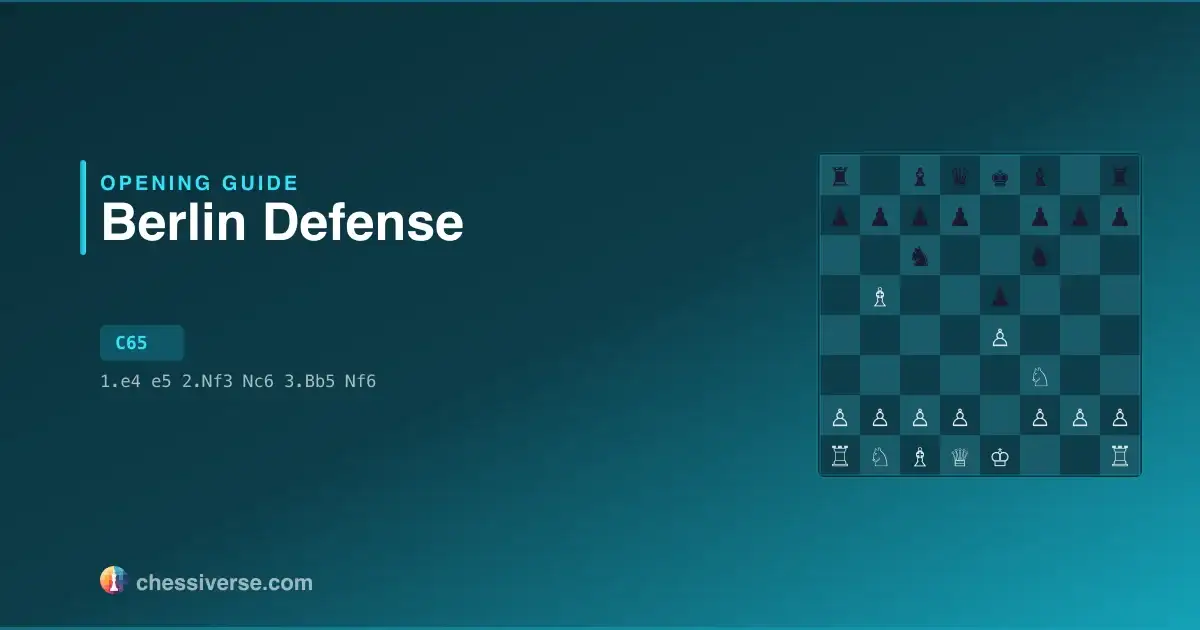




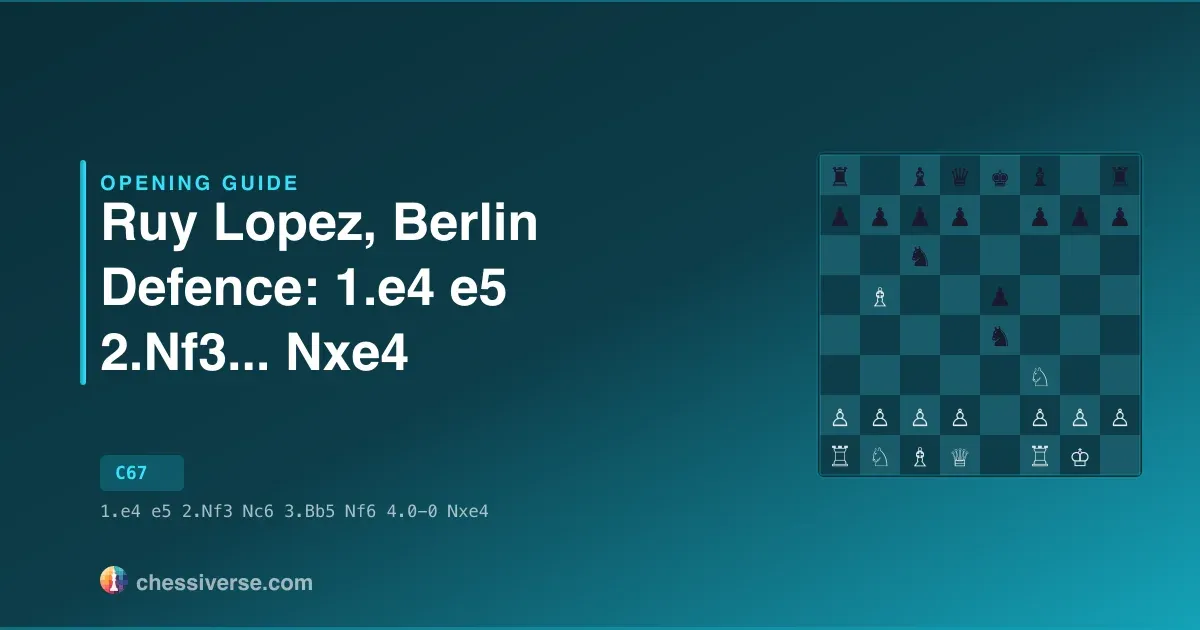
The Ruy Lopez: Berlin Defense (4...Nxe4) begins with 1.e4 e5 2.Nf3 Nc6 3.Bb5 Nf6 4.0-0 Nxe4 (ECO C67). Black grabs the e4-pawn and dares White to prove the compensation. This is the gateway to the famous Berlin Wall endgame — a position so dry that Kasparov famously couldn't crack it against Kramnik in 2000.
Strategic Overview
4...Nxe4 isn't really a pawn-grab so much as a structural transformation. White recovers the pawn easily because Black's king is stuck in the centre and the e-file is wide open. The two main tries split into 5.Re1 (the simple recovery that's drawish but solid) and 5.d4 (the main line that leads to the Berlin Wall endgame after the queens come off). Both share a common theme: White uses the open e-file and the bishop on b5 to create just enough pressure to force Black into concrete defence. 5...Nd6, hitting the bishop, is Black's only real way to keep things together; trying to hang onto material with anything else gets punished by discovered checks or pins. The Berlin Wall endgame that arises after 5.d4 Nd6 6.Bxc6 dxc6 7.dxe5 Nf5 8.Qxd8+ Kxd8 is a sturdy queenless middlegame where Black has the bishop pair and doubled c-pawns versus White's healthier structure and lead in development. It's the kind of position where strong defensive technique holds the draw and creative ideas are hard to come by — exactly why elite players like it with both colours.
Key Ideas
The recurring motifs below distinguish a confident handler of this opening from a beginner:
- The e-file is the real compensation — White doesn't worry about getting the pawn back because Black's king on e8 means any e-file traffic comes with pins and tempo. That's why 5.Re1 wins the pawn and 5.d4 wins the structure.
- 5...Nd6 is forced for a reason — The knight has to retreat and hit the bishop, otherwise tactics on the e-file collapse Black's position. 5...exd4? loses on the spot to 6.Re1 pinning the knight, so the route is concrete.
- The Berlin Wall is a structural draw machine — Once queens come off Black has the bishop pair and a slightly worse structure. The position is genuinely difficult for White to break, which is why the Berlin is the ultimate equaliser at elite level.
- Watch for discovered-check tactics — The line 5.Re1 Nd6 6.Nxe5 Nxb5? 7.Nxc6+ is the classic trap — the knight check wins the queen. Anyone playing this with Black needs to spot that pattern before sitting down.
History and Notable Players
It arises from the Ruy Lopez: Berlin Defense. Among the most prolific White practitioners are Maxime Vachier Lagrave (67 games), Alexei Shirov (63 games), Viswanathan Anand (58 games). Black-side regulars include Aleksej Aleksandrov (117 games), Vladimir Kramnik (79 games), Levon Aronian (77 games).
Performance Across Rating Levels
The picture changes a lot as you climb the rating ladder. Among 1200-rated players, it appears in 0.04% of games — 301,294 of them on record — with White winning 59.9% and Black 37%. Move up to 1800 Elo and the share shifts to 0.04%, with White winning 47.6% versus Black's 46.1%. At the top end (2500+ Elo), popularity is 0.25% with 17.3% draws — a clear sign of how much theory rules the line at master level. White's edge erodes by 16.4pp from 1200 to 2500 Elo, suggesting Black's counterplay is easier to find with experience.
Time Control Patterns
Look at the same opening across time controls and rapid stands out. In bullet, it appears in 0.02% of games (498,323); White wins 50.4%. Blitz shows 0.04% adoption across 1,515,118 games, White scoring 51.5%. In rapid, the share rises to 0.06% — 636,100 games, White 55.5%. White's score swings 5.1pp across formats, so time control isn't just a stylistic choice here — it shifts the actual results.
Move Diversity and Theory Depth
Move choice is far from uniform in the Ruy Lopez: Berlin Defense (4...Nxe4). At 1200 Elo (301,294 games), the top reply is Re1, played 62.8% of the time. Two other moves each take at least 5% of games, and the top three moves account for 91.5% of games. Entropy: 1.71. By 2500 (33,786 games), d4 takes over as the top reply at 51.2%; only one other move still reaches 5% and the top three moves account for 99% of games. Entropy drops to 1.15. The narrowing is significant — strong players consolidate around a small set of best moves, while amateurs scatter across many plausible-looking options.
Historical Trends
Tracking the Ruy Lopez: Berlin Defense (4...Nxe4) year over year shows a clear story. Adoption peaked in 2015 at 0.06% (12,503 games). By 2025 it sits at 0.04%, 34% below the peak but still 15% above its 2013 level, so the line is up over the full period despite easing from the high.
Common Mistakes
- Drifting away from main theory — At 400 Elo, the three most-played moves cover 78.2% of games, against 97.5% at 2000. The most popular deviation is d3 (played 12.4% of the time at 400, much less so up top). It looks fine but quietly hands the better-prepared side an edge.
- Neglecting development — It can feel productive to make extra pawn moves early, but falling behind in piece development is what loses most amateur games — especially in open positions where active pieces find squares fast.
- Playing without a plan — Each Ruy Lopez: Berlin Defense (4...Nxe4) middlegame demands a specific approach. Decide whether the position calls for attack, manoeuvre, or simplification before reaching for a move.
Practice on Chessiverse
Ready to try the Ruy Lopez: Berlin Defense (4...Nxe4) against a bot? Pick an opponent at your level and play a game.