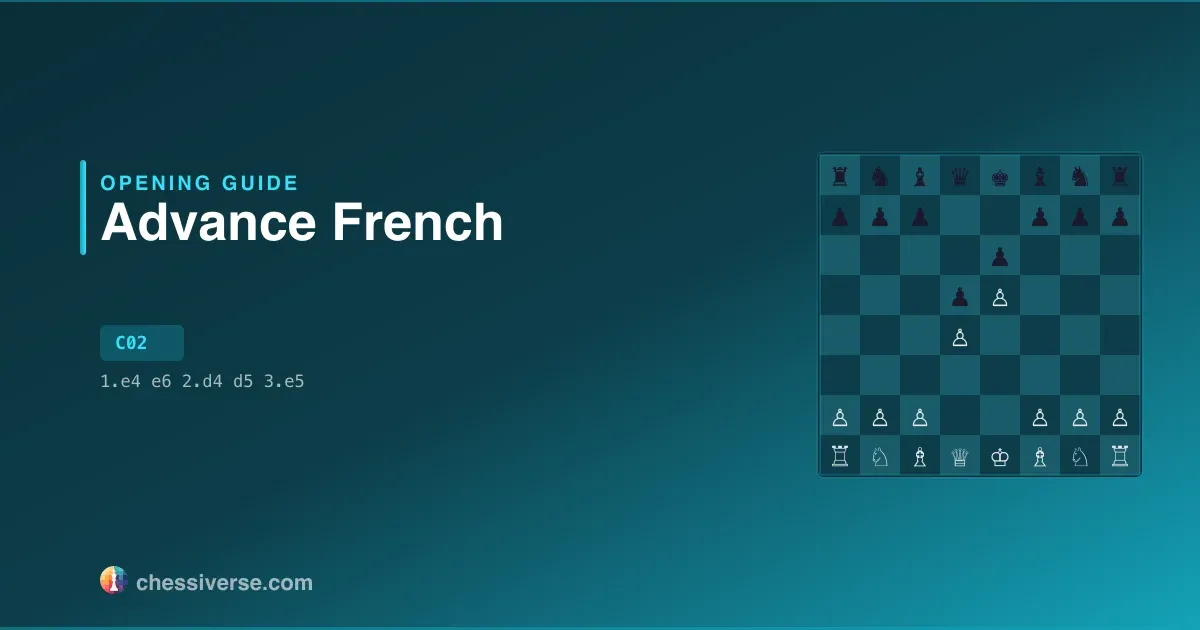
The French Defense: Advance Variation arises after 1.e4 e6 2.d4 d5 3.e5 and falls under ECO code C02. By pushing the e-pawn forward, White gains space and denies Black's knight access to its most natural square, f6. The resulting position is somewhat cramped for Black, so the standard strategy is to strike at the foundation of White's pawn chain by playing 3...c5, targeting the d4 pawn. This c5 break is essential, as moves like 3...Nc6, which block the c-pawn, hand White an easy advantage. Several sideline attempts have also been explored to address the persistent problem of Black's "French bishop" on c8, which remains difficult to develop actively while the e6 pawn stays in place. With 43.3 million Lichess games across all rating levels, it is a well-established opening choice.
- White uses the e5 wedge for space and attacks on the kingside, often pushing f4-f5 toward Black's king.
- Black hits the base of the pawn chain with ...c5 and piles pressure on d4, with the queen often landing on b6.
- The ...f6 break is Black's other lever, challenging the cramping e5 pawn head-on.
History and Notable Players
It arises from the French Defense. Among the most prolific practitioners on the White side are Evgeny Sveshnikov (105 games), Harmen Jonkman (98 games), Viktor D Kupreichik (87 games). On the Black side, notable exponents include Alexei Barsov (48 games), Ivan Farago (41 games), Wolfgang Uhlmann (41 games).
3.e5 was common in the French's earliest days but fell out of fashion for most of the 20th century, even though Nimzowitsch rated it White's best try and added many ideas to its theory. Evgeny Sveshnikov revived it in the 1980s and remained its leading expert, and it has lately closed in on 3.Nd2's popularity, with Alexander Grischuk championing it at the highest level.
Named after: The French Defence owes its name to a correspondence match of 1834 in which a Paris team, urged on by Jacques Chamouillet, used it against London.
Notable players: Aron Nimzowitsch, Evgeny Sveshnikov, Alexander Grischuk
The first world champion, Wilhelm Steinitz, dismissed the French as the dullest of all openings, yet it grew into the third most popular answer to 1.e4.
Statistics
Based on 43.3 million Lichess games across all rating levels:
- White wins: 46.4%
- Black wins: 49.5%
- Draws: 4.1%
Interestingly, Black scores well in this opening, suggesting it offers strong counterplay.
Common Mistakes to Avoid
- Being too passive: While this opening is solid, playing without a plan can lead to a cramped position. Look for the right moment to break with a central pawn advance and free your pieces.
Practice on Chessiverse
The best way to learn the French Defense: Advance Variation is through practice. On Chessiverse, you can play chess against computer opponents that specialize in this opening. Our AI bots range from beginner to grandmaster level, each with unique playing styles — from aggressive attackers to solid defenders. Choose a bot that matches your rating and work your way up as you master the opening's key ideas.
Performance Across Rating Levels
How well the French Defense: Advance Variation works depends on what level you're playing at. The 1200 bracket has 5,875,346 games (0.87% of all games at that level); White wins 47.8%, Black 48.6%, 3.7% are drawn. By 1800, popularity is 1.00% and White's score is 45.6% to Black's 50%. Among 2500-rated players the line appears in 0.80% of games and draws spike to 8.1%, indicating tight preparation.
Time Control Patterns
The French Defense: Advance Variation skews toward rapid chess. In bullet, it appears in 0.57% of games (15,104,772); White wins 48.1%. Blitz shows 0.91% adoption across 32,544,873 games, White scoring 46.5%. In rapid, the share rises to 0.97% — 10,736,000 games, White 46.1%.
Move Diversity and Theory Depth
What players actually play after the opening moves depends heavily on rating. At 1200 Elo (5,875,346 games), the top reply is c5, played 62.5% of the time. Two other moves each take at least 5% of games, and the top three moves account for 86.5% of games. Entropy: 1.92. By 2500 (109,715 games), c5 dominates at 94.7% of replies; no other move reaches 5% and the top three moves account for 97.9% of games. Entropy drops to 0.44. That entropy collapse is the signature of a line where preparation pays off: at the top, players know the best move and play it.
Historical Trends
Tracking the French Defense: Advance Variation year over year shows a clear story. Adoption peaked in 2013 at 1.22% (35,249 games). By 2025 it sits at 0.96%, down 21% from that high, leaving the line in decline.