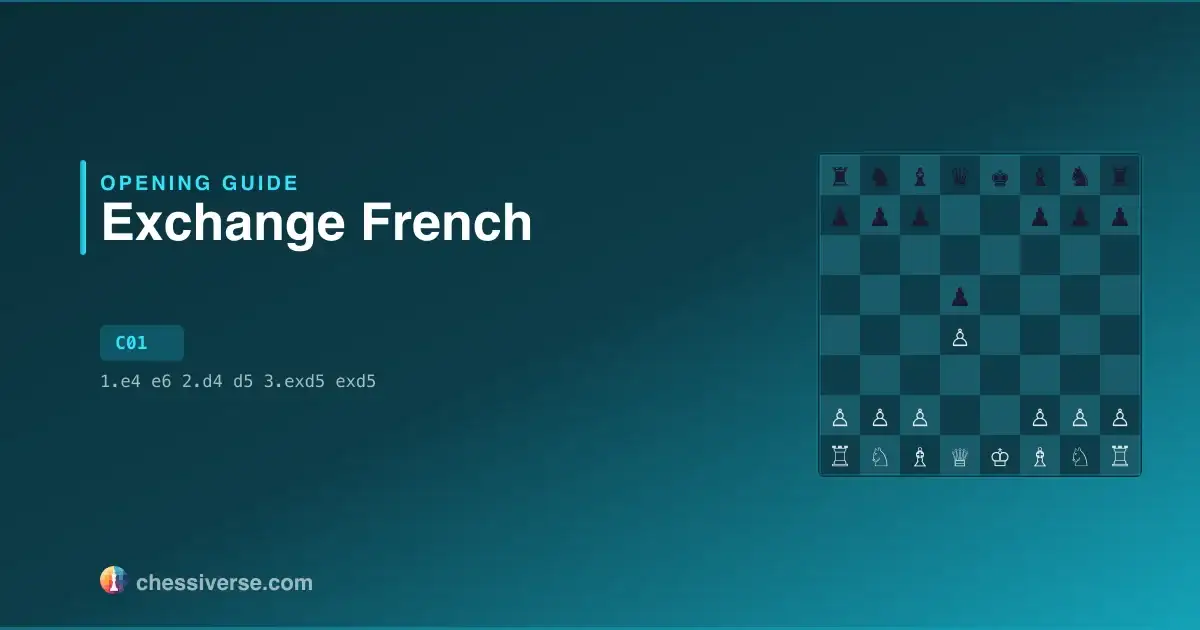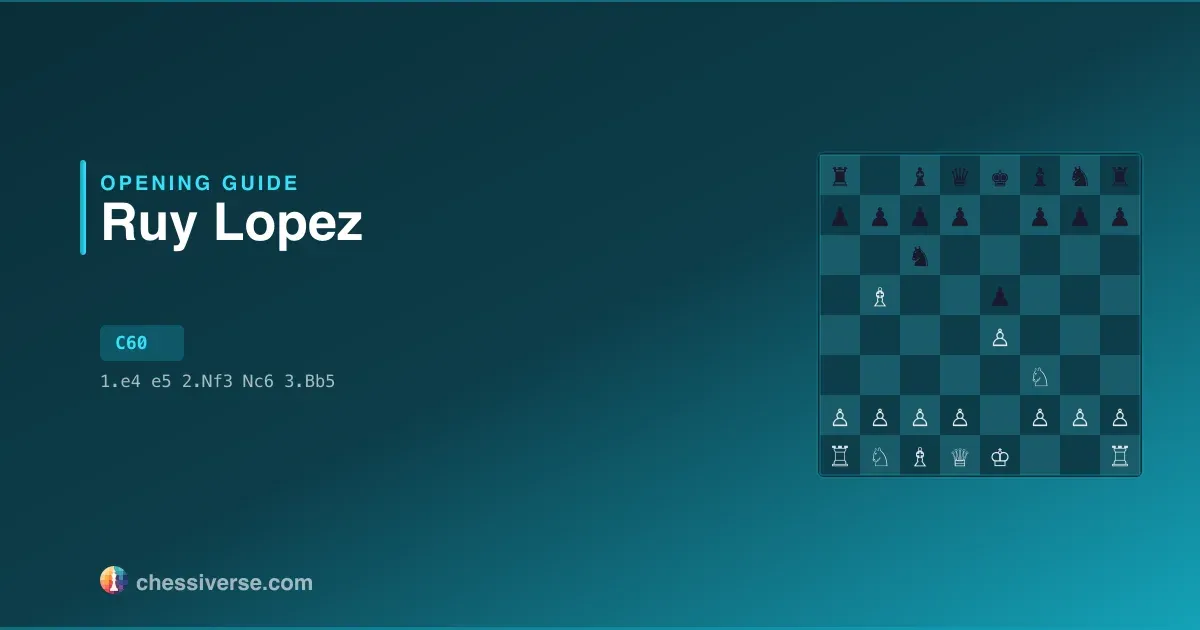
The Ruy Lopez arises after 1.e4 e5 2.Nf3 Nc6 3.Bb5 and falls under ECO code C60. Also known as the Spanish Game, this opening puts indirect pressure on Black's e5 pawn by threatening to eliminate the c6 knight that defends it, although a tactical resource allows Black to recover the pawn if White captures too hastily. White prioritizes rapid development (castling is already available) and long-term central control, with plans to eventually build a pawn majority via c3 and d4. Black typically wants to play ...Nf6, developing a piece while targeting the undefended e4 pawn, so the most common approaches involve developing the knight immediately (3...Nf6) or first challenging the bishop with 3...a6, usually followed by 4...Nf6. That said, Black has a wide array of third- and fourth-move alternatives to choose from. The Morphy Defense, 3...a6, forces White to decide the bishop's fate: retreat or exchange. The oldest option is 4. Bxc6, the Exchange Variation, though this does not actually win the e5 pawn (after 4...dxc6 5. Nxe5? Qd4! Black recovers it). While the Exchange Variation remains playable, 4. Ba4 is more popular, keeping the bishop pair intact and maintaining pressure against Black's knight. With 119.1 million Lichess games across all rating levels, it is one of the most popular openings.
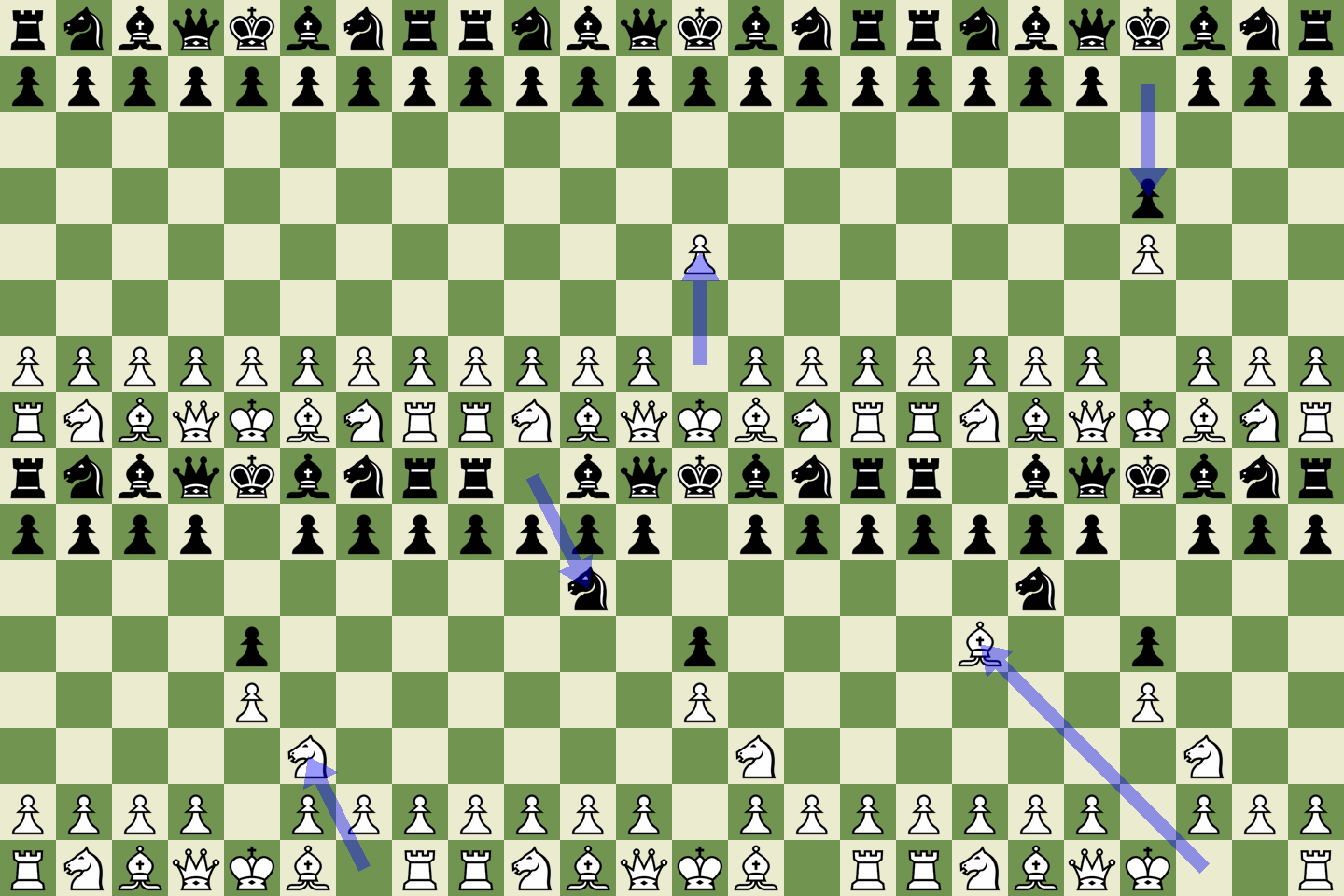
- White's bishop pressures the knight that defends e5, while White aims to build a strong centre with c3 and d4 and keep the e4-pawn well supported.
- Black typically grabs queenside space with ...b5 and looks for the freeing ...d5 break to hit back in the centre.
- At move five Black picks the character of the game: the solid Closed Defence with ...Be7, or capturing on e4 in the Open Defence.
History and Notable Players
The earliest known analysis of this opening dates back to Göttingen manuscript,. The opening is named after Ruy López de Segura, Libro del Axedrez, 1561. It arises from the Open Games (1...e5). Among the most prolific practitioners on the White side are Viswanathan Anand (437 games), Alexei Shirov (303 games), Vlastimil Jansa (302 games). On the Black side, notable exponents include Levon Aronian (356 games), Ivan Sokolov (340 games), Svetozar Gligoric (330 games).
The move 3.Bb5 already appears in the Gottingen manuscript of about 1490, and Lopez analysed it in his 1561 book. Interest stayed modest until Carl Jaenisch's 1847 analysis revived it, and Paul Morphy's use of 3...a6 in 1858 gave the Morphy Defence its name. It grew into the most important Open Game at master level.
Named after: The name honours the 16th-century Spanish priest Ruy Lopez de Segura, who recommended 3.Bb5 in his 1561 chess book, though the move is older still.
Notable players: Paul Morphy, Mikhail Chigorin, Boris Spassky, Vladimir Kramnik
Black's long struggle to equalise earned the opening the nickname 'the Spanish Torture', and roughly two thirds of all Ruy Lopez games still begin with Morphy's 3...a6.
Statistics
Based on 119.1 million Lichess games across all rating levels:
- White wins: 51.2%
- Black wins: 44.1%
- Draws: 4.6%
White holds a moderate edge statistically, though Black has good practical chances.
Main Lines and Variations
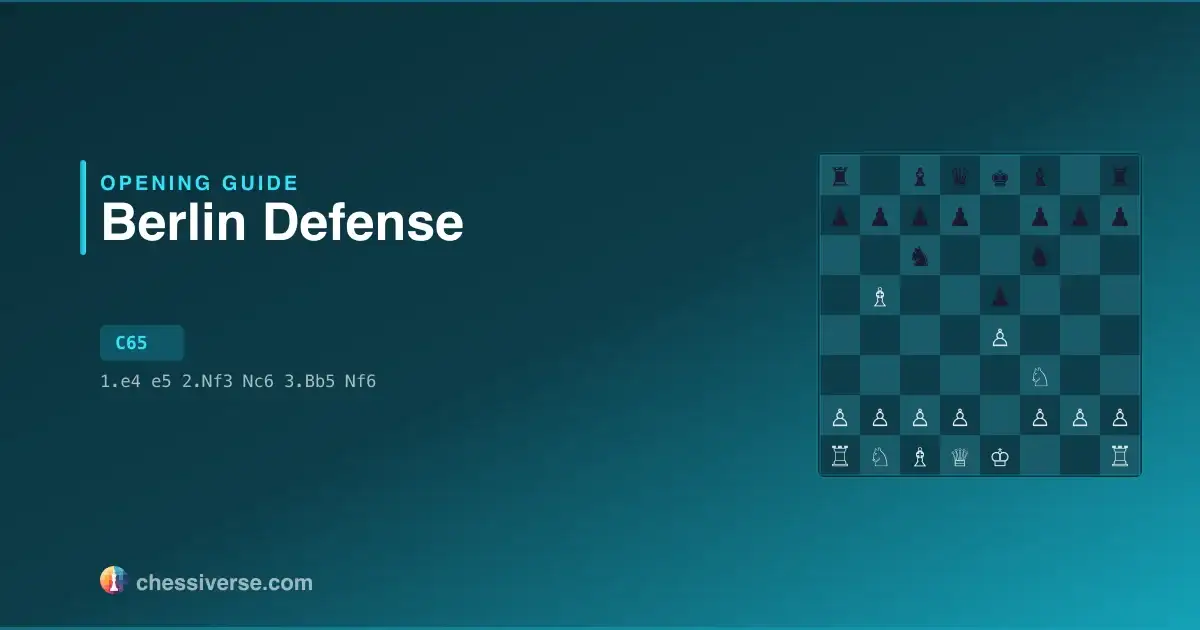
After 1.e4 e5 2.Nf3 Nc6 3.Bb5, the main continuations include:
- Morphy Defense
- Steinitz Defense
- Berlin Defense
- Schliemann
- Ruy Lopez: Bird Variation
- Ruy Lopez: Classical Variation
Each of these lines leads to distinct types of positions and requires its own understanding of the resulting pawn structures and piece placements.
Practice on Chessiverse
The best way to learn the Ruy Lopez is through practice. On Chessiverse, you can play chess against computer opponents that specialize in this opening. Our AI bots range from beginner to grandmaster level, each with unique playing styles — from aggressive attackers to solid defenders. Choose a bot that matches your rating and work your way up as you master the opening's key ideas.
Performance Across Rating Levels
The picture changes a lot as you climb the rating ladder. At 1200 Elo, the opening shows up in 3.13% of games (21,098,232 samples). White scores 51.4%, Black 44.4%, draws 4.2%. Move up to 1800 Elo and the share shifts to 2.18%, with White winning 51.5% versus Black's 43.6%. At the top end (2500+ Elo), popularity is 2.73% with 10.8% draws — a clear sign of how much theory rules the line at master level. White's edge erodes by 5.1pp from 1200 to 2500 Elo, suggesting Black's counterplay is easier to find with experience.
Time Control Patterns
Look at the same opening across time controls and rapid stands out. In bullet, it appears in 1.13% of games (29,959,393); White wins 50.9%. Blitz shows 2.37% adoption across 85,090,833 games, White scoring 51.1%. In rapid, the share rises to 3.07% — 33,973,973 games, White 51.7%.
Move Diversity and Theory Depth
Move choice is far from uniform in the Ruy Lopez. At 1200 Elo (21,098,232 games), the top reply is Nf6, played 23.3% of the time. Five other moves each take at least 5% of games, and the top three moves account for 65% of games. Entropy: 2.91. By 2500 (371,695 games), a6 takes over as the top reply at 64.8%; only one other move still reaches 5% and the top three moves account for 89.7% of games. Entropy drops to 1.65. The narrowing is significant — strong players consolidate around a small set of best moves, while amateurs scatter across many plausible-looking options.
Historical Trends
Year-over-year data tells you whether this opening is a contemporary fixture or a fading one. Adoption peaked in 2017 at 3.10% (3,539,434 games). By 2025 it sits at 2.20%, 29% below the peak and 21% under its 2013 level, leaving the line in decline.