



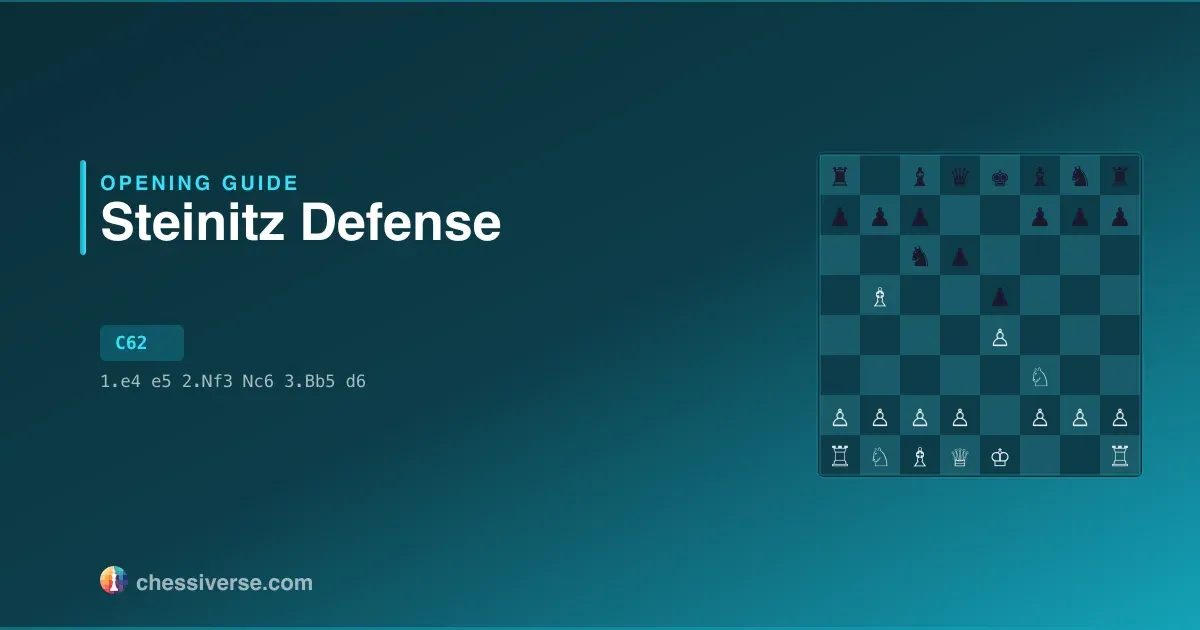
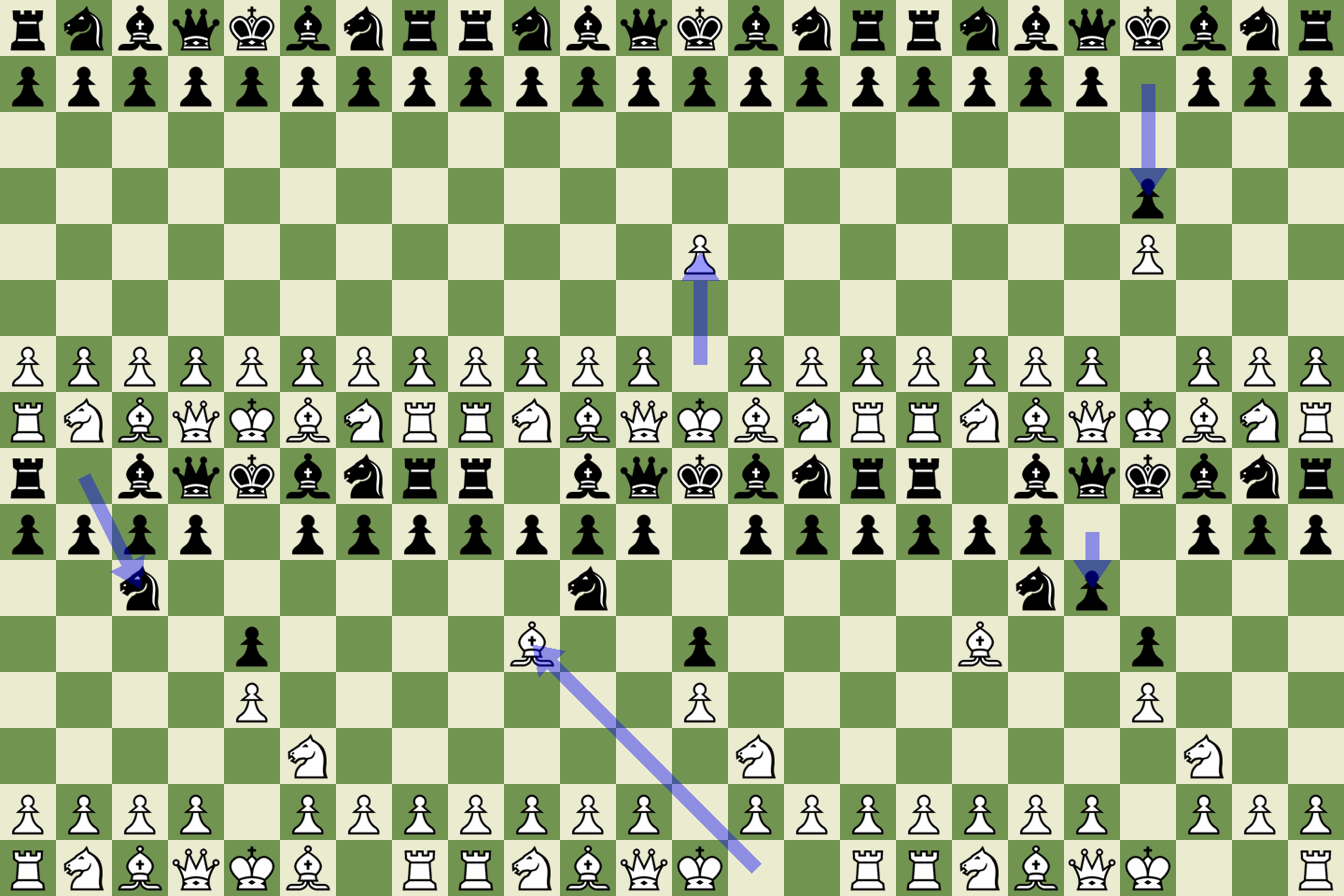
The Ruy Lopez: Steinitz Defense arises after 1.e4 e5 2.Nf3 Nc6 3.Bb5 d6 and falls under ECO code C62. Known as the Old Steinitz Defense, 3...d6 is a passive continuation that sees very little tournament play but remains common among amateurs. Ironically, the move appears to defend the e5 pawn, yet e5 was never truly under threat since the sequence Bxc6 dxc6 Nxe5 runs into Qd4!, forking the knight and the e4 pawn. What 3...d6 actually does is create a pin on Black's own knight, reducing central control. While it frees the light-squared bishop, it simultaneously blocks the dark-squared one, so there is little net gain in development. The most testing reply is 4. d4, adding a second attacker to e5 and threatening to win it outright. Black then faces a choice between exchanging pawns with 4...exd4 5. Nxd4 or breaking the pin with 4...Bd7 to maintain the defense of e5, though the latter can lead to an awkward balancing act between pawn protection and development. White can also play 4. O-O, 4. Nc3, or 4. c3, all of which tend to lead to d4 sooner or later. With 25.6 million Lichess games across all rating levels, it is a specialized opening choice.
- Black props up e5 with ...d6, reaching a position that is solid but cramped and passive.
- The drawback is that ...d6 hems in Black's dark-squared bishop.
- White's critical try is 4.d4, piling on e5, when Black must either trade in the center or defend with ...Bd7.
History and Notable Players
It arises from the Ruy Lopez. Among the most prolific practitioners on the White side are Emanuel Lasker (23 games), Alexander Alekhine (20 games), Jose Raul Capablanca (17 games). On the Black side, notable exponents include Maxim Novikov (38 games), William Steinitz (27 games), Aldo Haik (21 games).
Steinitz championed 3...d6 in his 1889 book The Modern Chess Instructor, preferring it to 3...a6, and he defended with it repeatedly in his 1894 world championship match against Emanuel Lasker. Today the old Steinitz is a very minor sideline among masters, though it remains popular in amateur play.
Named after: Named for Wilhelm Steinitz, the first world champion, who argued in The Modern Chess Instructor (1889) that 3...d6 let Black equalize against the Spanish.
Notable players: Wilhelm Steinitz
The line hides the famous Tarrasch Trap: Tarrasch published it in 1891, Georg Marco walked into it at Dresden 1892 anyway, and Tarrasch reportedly spent only five minutes of thought on the whole game.
Statistics
Based on 25.6 million Lichess games across all rating levels:
- White wins: 51.8%
- Black wins: 43.2%
- Draws: 4.9%
White holds a moderate edge statistically, though Black has good practical chances.
Practice on Chessiverse
The best way to learn the Ruy Lopez: Steinitz Defense is through practice. On Chessiverse, you can play chess against computer opponents that specialize in this opening. Our AI bots range from beginner to grandmaster level, each with unique playing styles — from aggressive attackers to solid defenders. Choose a bot that matches your rating and work your way up as you master the opening's key ideas.
Performance Across Rating Levels
The picture changes a lot as you climb the rating ladder. Among 1200-rated players, it appears in 0.64% of games — 4,318,114 of them on record — with White winning 50.4% and Black 44.9%. Move up to 1800 Elo and the share shifts to 0.49%, with White winning 54.1% versus Black's 40.6%. At 2500, 0.02% of games go into this opening; draws sit at 11.1% — the line is well-mapped at this level.
Time Control Patterns
Look at the same opening across time controls and rapid stands out. In bullet, it appears in 0.23% of games (6,170,077); White wins 51.2%. Blitz shows 0.52% adoption across 18,587,981 games, White scoring 51.8%. In rapid, the share rises to 0.63% — 6,987,109 games, White 51.9%.
Move Diversity and Theory Depth
Looking at move selection shows how forcing — or not — the position really is. At 1200 Elo (4,318,114 games), the top reply is Bxc6+, played 32.4% of the time. Five other moves each take at least 5% of games, and the top three moves account for 71.7% of games. Entropy: 2.58. By 2500 (2,742 games), d4 takes over as the top reply at 52.7%; only two other moves still reach 5% and the top three moves account for 92.4% of games. Entropy drops to 1.86. The narrowing is significant — strong players consolidate around a small set of best moves, while amateurs scatter across many plausible-looking options.
Historical Trends
Year-over-year data tells you whether this opening is a contemporary fixture or a fading one. Adoption peaked in 2013 at 0.67% (19,243 games). By 2025 it sits at 0.49%, down 26% from that high, leaving the line in decline.