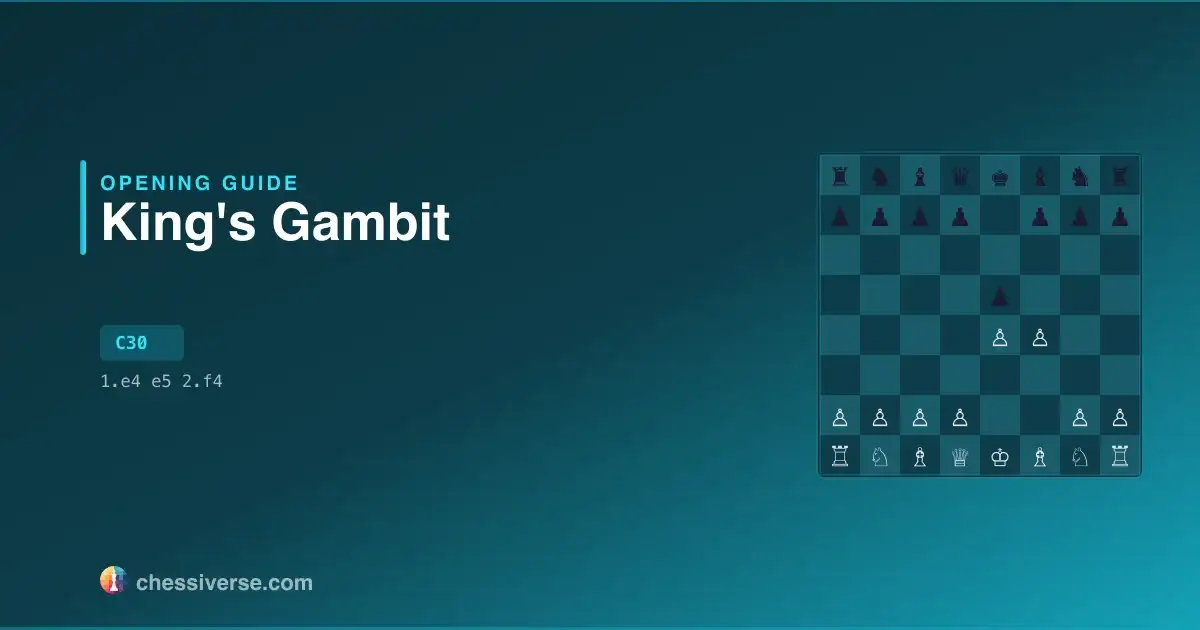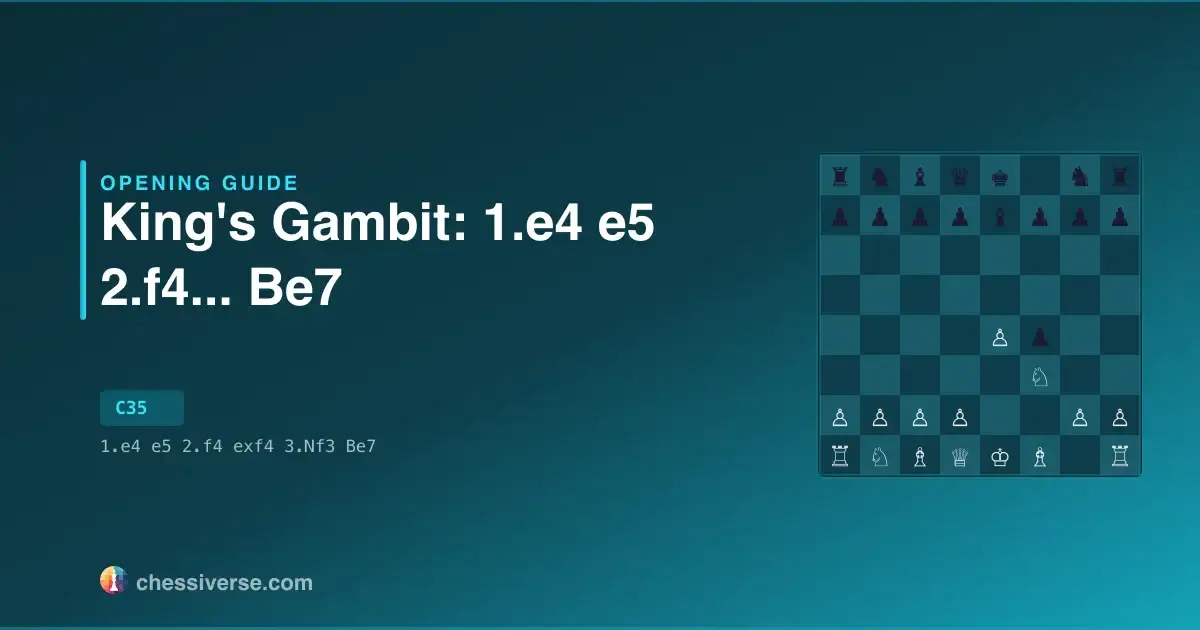


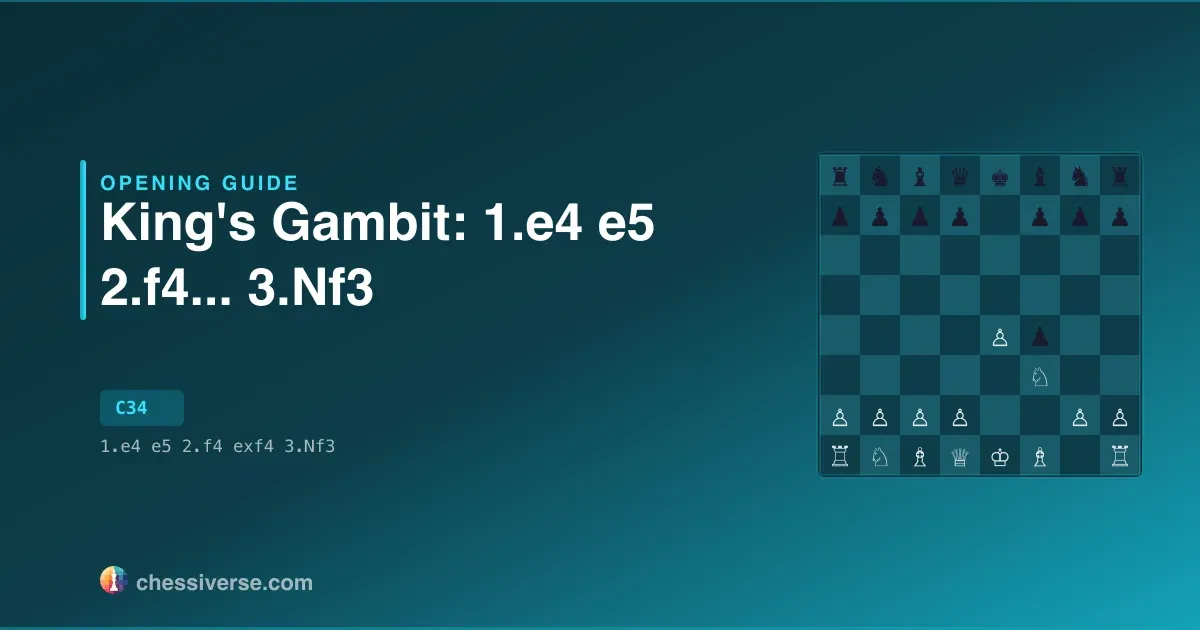
1.e4 e5 2.f4 exf4 3.Nf3 opens the King's Gambit Accepted: King's Knight's Gambit, ECO C34. White develops the knight, kills the Qh4+ threat, and lines up a future d4 to seize the centre and reclaim the pawn from a position of strength.
Strategic Overview
3.Nf3 is the King's Knight Gambit and the principled main line of the King's Gambit Accepted. The knight develops to its best square, covers h4 to neutralise the Qh4+ tactic, and supports the future d4 advance that will both grab the centre and uncover an attack on f4. Black's real choice is how to handle the extra pawn. Defending it with another pawn is the only structurally sound option, and the g-pawn is the available volunteer. Piece-based defences are bad: ...Bd6 blocks Black's own development and walks into e5; ...Qf6 gets kicked around and loses the queen tempo to e5. So the three main moves are 3...g5, 3...d6, and 3...d5: the Classical, Fischer, and Modern defences. 3...g5 holds the pawn aggressively and prepares to throw the g-pawn forward to chase the knight away. Yes, it weakens Black's kingside, but the pawn on f4 already gives Black space there and any kingside push by White runs straight into Black's own. 3...d6 is the Fischer, a more restrained setup that keeps the centre solid and prepares ...Bg7 with a kingside fianchetto. 3...d5 is the Modern, a central counter-strike that often transposes back into Falkbeer-style positions. Sidelines like 3...f5 (Gianutio), 3...h5 (Wagenbach), and 3...Nc6 (Macleod) all have their followers but none of them are mainstream theory.
Key Ideas
When players succeed in this line, they usually do so by leaning on the following themes:
- Knight covers h4 and prepares d4 — 3.Nf3 does double duty: it stops the ...Qh4+ tactic and supports d4, which White wants to play to take the centre and recover the pawn with Bxf4.
- 3...g5 holds the pawn the principled way — The Classical defence keeps the f4 pawn defended and prepares to kick the knight with ...g4. Yes it loosens the kingside, but Black already controls the wing through the f4 pawn.
- 3...d6 is the Fischer defence — A solid, restrained choice that keeps the centre stable and prepares to develop the bishop. Less ambitious about holding the pawn but easier to play safely.
- 3...d5 is the Modern counter-strike — Hitting back in the centre is a strategic answer to the gambit. Lines often transpose into structures resembling the Falkbeer or modern King's Gambit Accepted main lines.
- Piece-based pawn defences fail — Defending f4 with a bishop or queen invites kicks and structural concessions. Only a pawn can do the job, and only the g-pawn is in range.
History and Notable Players
It arises from the King's Gambit Accepted. On the White side, Adolf Anderssen (55 games), Joseph G Gallagher (37 games), Emanuel Lasker (36 games) top the database. Notable Black exponents: NN (49 games), Adolf Anderssen (43 games), Mikhail Chigorin (18 games).
Performance Across Rating Levels
How well the King's Gambit Accepted: King's Knight's Gambit works depends on what level you're playing at. The 1200 bracket has 3,383,835 games (0.50% of all games at that level); White wins 55.4%, Black 41.8%, 2.8% are drawn. At 1800 the opening surfaces in 0.83% of games; White wins 51%, Black 45.4%, draws 3.6%. At 2500, 0.08% of games go into this opening; draws sit at 7% — the line is well-mapped at this level. White's edge erodes by 8.7pp from 1200 to 2500 Elo, suggesting Black's counterplay is easier to find with experience.
Time Control Patterns
Look at the same opening across time controls and rapid stands out. In bullet, it appears in 0.28% of games (7,367,102); White wins 53.3%. Blitz shows 0.64% adoption across 23,084,830 games, White scoring 52.9%. In rapid, the share rises to 0.65% — 7,236,722 games, White 54.1%.
Move Diversity and Theory Depth
Looking at move selection shows how forcing — or not — the position really is. At 1200 Elo (3,383,835 games), the top reply is Nc6, played 24.8% of the time. Five other moves each take at least 5% of games, and the top three moves account for 56.4% of games. Entropy: 3.14. By 2500 (11,261 games), Nf6 takes over as the top reply at 23.9%; only four other moves still reach 5% and the top three moves account for 62.5% of games. Entropy drops to 2.71.
Historical Trends
Tracking the King's Gambit Accepted: King's Knight's Gambit year over year shows a clear story. Adoption peaked in 2013 at 1.28% (36,967 games). By 2025 it sits at 0.58%, down 55% from that high, leaving the line in decline.
Main Lines and Variations
After 1.e4 e5 2.f4 exf4 3.Nf3, the established follow-ups are:
- King's Gambit Accepted: Cunningham Defense
- King's Gambit Accepted: Modern Defense
- King's Gambit Accepted: King's Knight's Gambit (3...g5)
Each branch leads to a different middlegame character — the resulting pawn structure decides what kind of game you get.
Common Mistakes
- Neglecting development — Extra pawn moves in the opening are tempting, especially when you "know the moves". Developing a piece each turn is the simple correction.
- Overextending the attack — Gambits look like permission to throw everything forward. They aren't — every attacking move should improve a piece. Random checks and threats burn the initiative once they fail to coordinate.
Practice on Chessiverse
Ready to try the King's Gambit Accepted: King's Knight's Gambit against a bot? Pick an opponent at your level and play a game.