King's Gambit: 1.e4 e5 2.f4...... d5

-42%
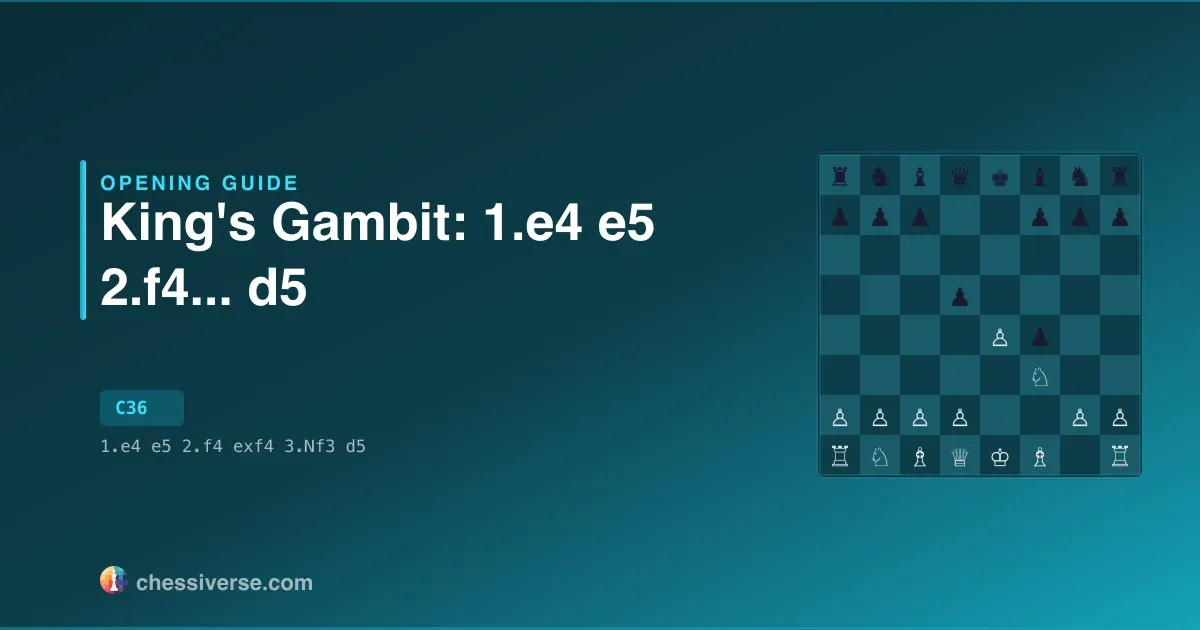
C361.e4 e5 2.f4 exf4 3.Nf3 d5
Feb 24, 2028
TL;DR

The Modern Defence: Black returns the pawn for easy development. After 4.exd5 the f-pawn will fall back, but Black gets active piece play and a comfortable structure rather than a desperate attempt to cling to material.

Reviewed by

IM John Bartholomew
IM John BartholomewCo-Founder & Chess Educator

International Master and chess educator. Co-founded Chessable and joined Chessiverse as co-founder. Best known for his "Climbing the Rating Ladder" YouTube series and structured opening courses.

King's Gambit: 1.e4 e5 2.f4...... d5: A Complete Guide
King's Gambit: 1.e4 e5 2.f4...... d5 - Opening Moves
Summary

The King's Gambit: 1.e4 e5 2.f4... d5 begins with 1.e4 e5 2.f4 exf4 3.Nf3 d5 (ECO C36). Black hits the centre instead of clinging to the extra pawn, prioritising development and active piece play over material.

Strategic Overview

The Modern Defence is a strategic answer to the King's Gambit. Instead of trying to hold the f4 pawn at all costs, Black throws ...d5 into the centre, attacks e4, and accepts that the material edge may evaporate in exchange for a comfortable, well-developed position. Many continuations transpose into Falkbeer-flavoured structures or into the main King's Gambit Accepted lines by a different move order, but the strategic point is the same: Black trades pawn count for easy development and piece activity. White typically takes on d5, and the resulting positions feature open files, active minor pieces for both sides, and a clear structural fight rather than a tactical one. The f4 pawn often returns to White at the right moment, leaving roughly material parity but with a structure that depends on who handled the central trades better. In some lines Black has to play actively just to keep the f4 pawn alive; in others Black gives it back voluntarily and uses the time gained to outdevelop White. Practically, the Modern Defence is what experienced players choose when they do not want to spend twenty moves defending a King's Gambit ending. It is principled, sound, and avoids the wildest tactical lines without making any structural concessions.

Key Ideas

When players succeed in this line, they usually do so by leaning on the following themes:

  • Trade material edge for development — ...d5 prioritises a healthy structure and quick development over holding the f4 pawn. The pawn often returns to White anyway, but Black has the better-coordinated army.
  • Hits e4 immediately — By striking at e4, Black forces White to make a central decision rather than carry out the planned d4 and Bxf4 plan unchallenged.
  • Transposes around modern theory — Lines often blend into Falkbeer-style positions or modern King's Gambit Accepted main lines. Knowing the related structures is more important than memorising deep theory.
  • Active defence keeps the pawn alive in some lines — Some sub-variations let Black hold the f4 pawn, but only with precise, active play. The strategic premise stays the same: piece activity over pawn count.

History and Notable Players

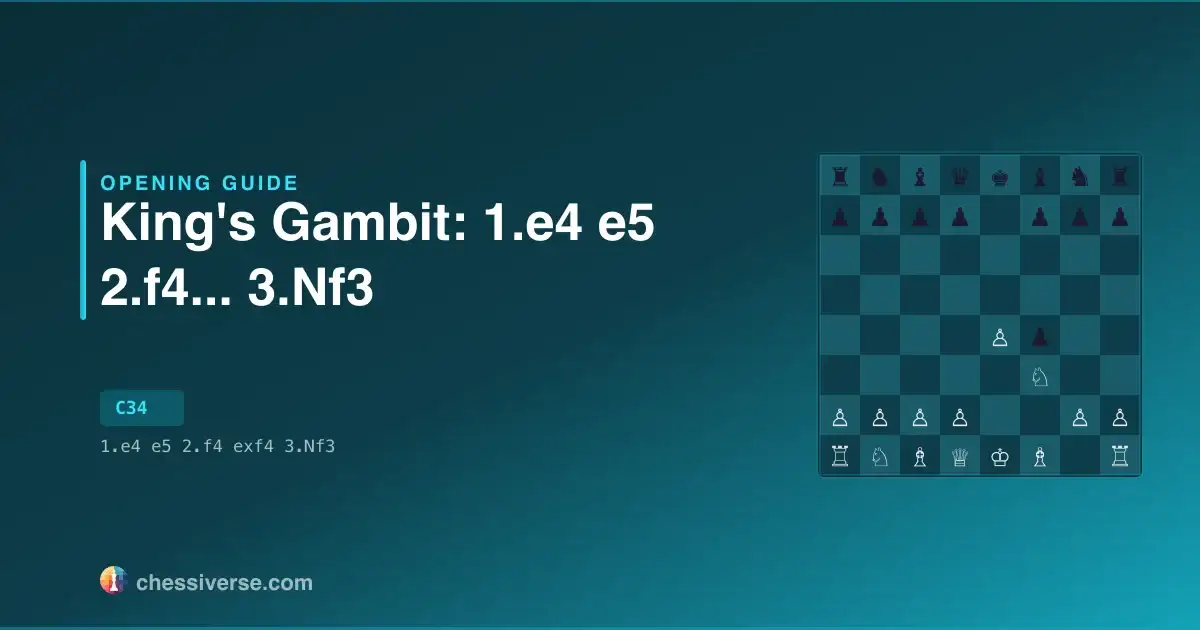
It arises from the King's Gambit: 1.e4 e5 2.f4... 3.Nf3. On the White side, Joseph G Gallagher (8 games), Mark L Hebden (7 games), Richard S Jones (6 games) top the database. Notable Black exponents: Timothy J Upton (6 games), Boris Alexander Latzke (5 games), Stefan Walter (5 games).

Performance Across Rating Levels

The picture changes a lot as you climb the rating ladder. At 1200 Elo, the opening shows up in 0.04% of games (302,858 samples). White scores 53.5%, Black 43.4%, draws 3.1%. At 1800 the opening surfaces in 0.11% of games; White wins 49.9%, Black 46.2%, draws 4%. At the top end (2500+ Elo), popularity is 0.02% with 8.8% draws — a clear sign of how much theory rules the line at master level. White's edge erodes by 6.1pp from 1200 to 2500 Elo, suggesting Black's counterplay is easier to find with experience.

Time Control Patterns

Look at the same opening across time controls and blitz stands out. In bullet, it appears in 0.04% of games (973,999); White wins 50.2%. Blitz shows 0.07% adoption across 2,653,884 games, White scoring 51%. In rapid, the share rises to 0.07% — 746,076 games, White 52.8%. White's score swings 2.6pp across formats, so time control isn't just a stylistic choice here — it shifts the actual results.

Move Diversity and Theory Depth

Move choice is far from uniform in the King's Gambit: 1.e4 e5 2.f4... d5. At 1200 Elo, the top reply is exd5, played 46.2% of the time. There are 5 other moves seeing meaningful share, and 82.4% of games stick to established theory. Entropy: 2.22. By 2500, exd5 dominates at 91.7% of replies; only 2 viable alternatives remain and 99.4% of moves are theory. Entropy drops to 0.50. The narrowing is significant — strong players consolidate around a small set of best moves, while amateurs scatter across many plausible-looking options.

Long-term, the trajectory of this opening is informative. Adoption peaked in 2014 at 0.12% (10,527 games). By 2025 it sits at 0.07% — a 42% shift overall, leaving the line in decline.

Common Mistakes

  • Drifting away from main theory — At 400 Elo, theory adherence sits at 64% — versus 97.7% at 2000. The most popular deviation is Nc3 (played 18.2% of the time at 400, much less so up top). It looks fine but quietly hands the better-prepared side an edge.
  • Neglecting development — Extra pawn moves in the opening are tempting, especially when you "know the moves". Developing a piece each turn is the simple correction.
  • Overextending the attack — Gambits look like permission to throw everything forward. They aren't — every attacking move should improve a piece. Random checks and threats burn the initiative once they fail to coordinate.

Practice on Chessiverse

Ready to try the King's Gambit: 1.e4 e5 2.f4... d5 against a bot? Pick an opponent at your level and play a game.

Quick Facts

Main Line1.e4 e5 2.f4 exf4 3.Nf3 d5
DifficultyIntermediate
Style

Gambiteers sacrifice material early for rapid development and initiative. These openings often lead to sharp, tactical positions where the attacking side must strike quickly before the opponent consolidates.

3,399,960games on Lichess
51.4%
3.7%
45%
White wins Draws Black wins

Top Players

Data from Lichess opening explorer (blitz & rapid)

Most Popular At1800
SharpnessVery Sharp

Popularity by Rating

Percentage of all games at each rating bracket that feature this opening.

Data from Lichess opening explorer (blitz & rapid games)

Theory Adherence by Rating

How often players choose the single most popular move at this position. Higher = more predictable play.

White to move after the opening line

Popularity Over Time

Share of all Lichess blitz + rapid games featuring this opening, by year.

Top Moves by Rating

White to move after the opening line

RatingMost Popular2nd3rd
400exd526.1%e519.7%Nc318.2%
1000exd535.6%e524.7%Nc313.3%
1200exd546.2%e527.5%Nc38.7%
1400exd555.1%e529.3%Nc34.8%
1600exd561.5%e529.3%Nc32.5%
1800exd566.6%e527.7%Nc31.8%
2000exd570.4%e525.6%Nc31.6%
2200exd580.7%e516.9%Nc31.1%
2500exd591.7%e56.8%Nc30.9%

Popularity by Time Control

Bullet
0.04%974K
Blitz
0.07%2.7M
Rapid
0.07%746K
2% more decisive in bullet
Raw data tables (Lichess blitz + rapid)
King's Gambit: 1.e4 e5 2.f4...... d5: popularity and win rates by player rating
Rating (Elo)Share %GamesWhite win %Black win %Draw %Sharpness
4000.0134,54050.345.93.80.962
10000.03123,46752.044.63.30.967
12000.04302,85853.543.43.10.969
14000.07608,69053.943.03.10.969
16000.09936,47352.544.13.40.966
18000.11928,57549.946.24.00.960
20000.09395,18247.448.04.60.954
22000.0468,02446.347.85.80.942
25000.022,15147.443.88.80.912
King's Gambit: 1.e4 e5 2.f4...... d5: move-choice theory adherence by rating
Rating (Elo)Top moveTop move %Viable movesTheory %Entropy
400exd526.1564.02.835
1000exd535.6573.52.566
1200exd546.2582.42.216
1400exd555.1289.21.829
1600exd561.5293.31.515
1800exd566.6296.11.288
2000exd570.4297.71.135
2200exd580.7298.70.865
2500exd591.7299.40.503
King's Gambit: 1.e4 e5 2.f4...... d5: popularity over time
YearShare %GamesWhite win %Black win %Draw %
20130.113,22258.239.22.6
20140.1210,52755.341.53.2
20150.1125,21554.042.93.1
20160.1166,98553.642.93.5
20170.10116,26052.144.23.6
20180.09166,67651.544.83.7
20190.08236,49551.644.83.6
20200.07426,59651.444.73.9
20210.07528,14851.345.03.7
20220.07530,17151.345.13.6
20230.07543,48451.145.23.7
20240.07510,83150.945.43.6
20250.07485,22951.245.23.6
King's Gambit: 1.e4 e5 2.f4...... d5: popularity by time control
FormatShare %GamesWhite win %Black win %Draw %Sharpness
bullet0.04973,99950.247.42.40.976
blitz0.072,653,88451.045.43.60.964
rapid0.07746,07652.843.43.90.961
King's Gambit: 1.e4 e5 2.f4...... d5: top candidate moves by rating bracket
Rating (Elo)1st move1st %2nd move2nd %3rd move3rd %
400exd526.1e519.7Nc318.2
1000exd535.6e524.7Nc313.3
1200exd546.2e527.5Nc38.7
1400exd555.1e529.3Nc34.8
1600exd561.5e529.3Nc32.5
1800exd566.6e527.7Nc31.8
2000exd570.4e525.6Nc31.6
2200exd580.7e516.9Nc31.1
2500exd591.7e56.8Nc30.9
King's Gambit: 1.e4 e5 2.f4...... d5: top practitioners by side
SidePlayerGames
WhiteJoseph G Gallagher8
WhiteMark L Hebden7
WhiteRichard S Jones6
BlackTimothy J Upton6
BlackBoris Alexander Latzke5
BlackStefan Walter5

Frequently Asked Questions

What is the King's Gambit: 1.e4 e5 2.f4... d5?

The King's Gambit: 1.e4 e5 2.f4... d5 begins with 1.e4 e5 2.f4 exf4 3.Nf3 d5 and is classified under ECO code C36. Black attacks the e4 pawn for initiative and easier development overall than White.

Is the King's Gambit: 1.e4 e5 2.f4... d5 good for beginners?

The King's Gambit: 1.e4 e5 2.f4... d5 can be played at any level. Beginners should focus on understanding the key strategic ideas rather than memorizing long theoretical lines. Our AI bots at various rating levels provide a great way to practice the opening concepts.

What are the win rates for the King's Gambit: 1.e4 e5 2.f4... d5?

In a database of 3,399,960 master games, White wins 51.4% of the time, Black wins 45%, and 3.7% are drawn. Notable players on the White side include Joseph G Gallagher and Mark L Hebden. On the Black side, Timothy J Upton and Boris Alexander Latzke are among the most frequent practitioners.

How can I practice the King's Gambit: 1.e4 e5 2.f4... d5?

On Chessiverse, you can practice the King's Gambit: 1.e4 e5 2.f4... d5 by playing against our 600+ AI bots. Each bot has a unique playing style and opening repertoire, so you can find the perfect sparring partner for any level.

Reviewed by

IM John Bartholomew
IM John BartholomewCo-Founder & Chess Educator

International Master and chess educator. Co-founded Chessable and joined Chessiverse as co-founder. Best known for his "Climbing the Rating Ladder" YouTube series and structured opening courses.

Practice This Opening on Chessiverse

Play against 1000+ AI bots with unique personalities and opening repertoires. From beginner-friendly to grandmaster-level opponents, find the perfect sparring partner for any opening.

Play Now

Not sure which opening fits you? Take the free chess personality test — your style determines which openings will work with you.

Back to Articles