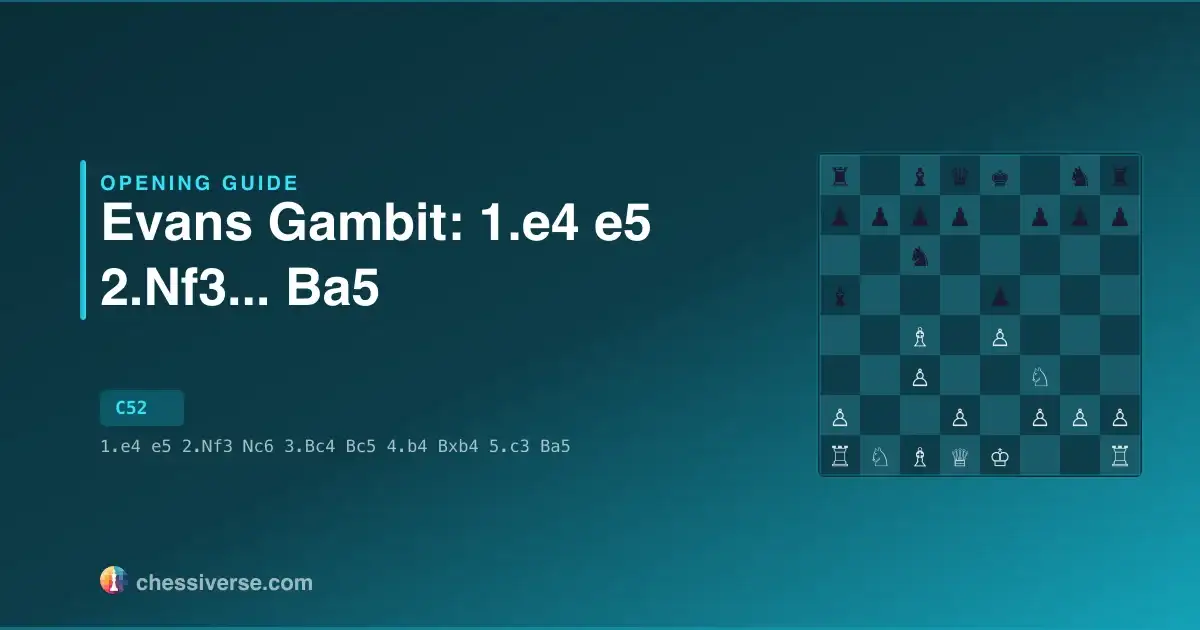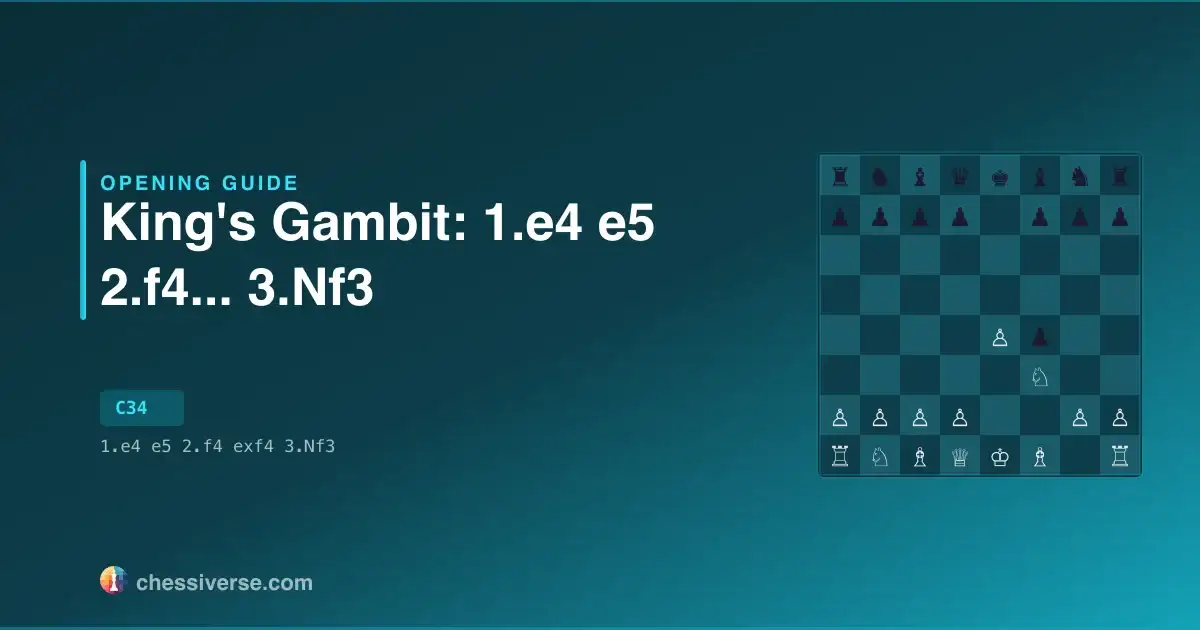




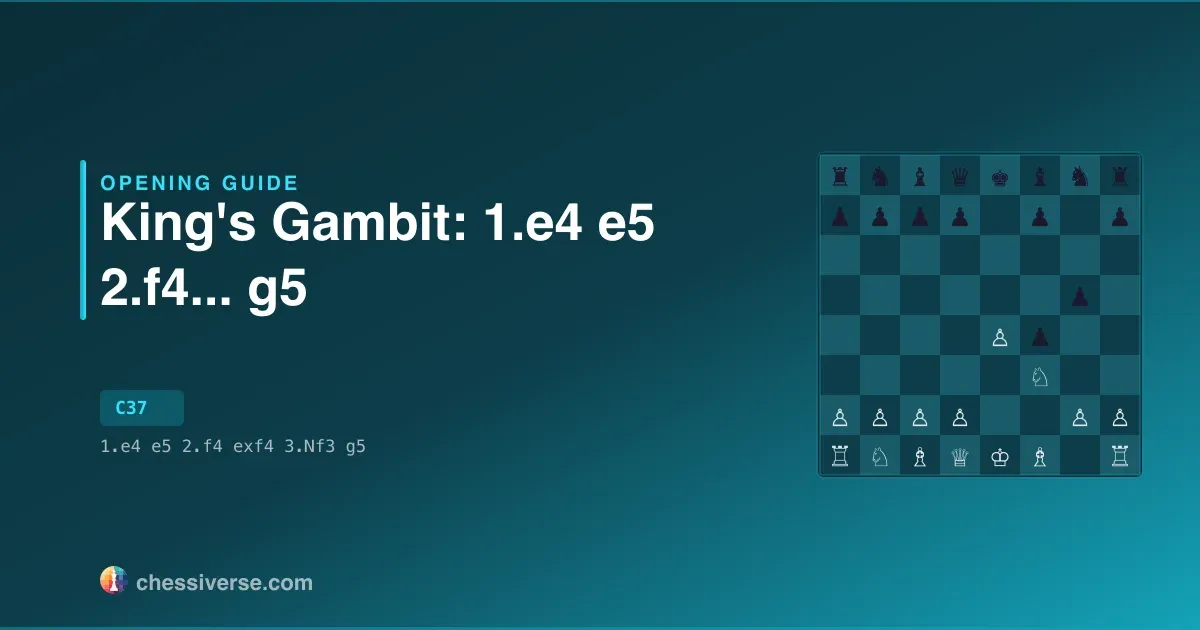
1.e4 e5 2.f4 exf4 3.Nf3 g5 opens the King's Gambit Accepted: King's Knight's Gambit (3...g5), ECO C37. Black props the f4 pawn up with a kingside pawn, dares White to find a way through, and threatens to chase the f3 knight away while the centre is still in motion.
Strategic Overview
3...g5 is the Classical Defense and the most direct way to hold the King's Gambit pawn. The g-pawn defends f4, and the immediate plan is to advance ...g4 to kick the knight off f3 and follow up with ...Qh4+ once the defender of h4 is gone. White cannot tolerate that and must respond actively. There are four serious attempts. 4.h4 is the principal direct defence: White attacks the g5 pawn and prevents the queen from settling on h4 with check, since the queen would lose a tempo to the rook. The most common practical defence is 4.Bc4, vacating f1 for the king and preparing wild gambit lines like the Muzio, Lolli, and Salvio, where White sacrifices a piece for a raging attack on f7 and the exposed Black king. 4.d4 is the indirect defence, opening lines for the dark-squared bishop and allowing some thrilling tactical sequences after ...g4 where White either sacrifices a knight for a roaring attack or finds a queen sortie that turns the position around. 4.Nc3 is the most underrated try, ignoring the kingside chase to prepare a Scholar's-Mate-style attack while keeping the c3 knight ready to leap into d5. All four lines lead to old-school, sharp attacking chess where memorisation, calculation, and a strong stomach all matter more than positional touch.
Key Ideas
The recurring motifs below distinguish a confident handler of this opening from a beginner:
- ...g4 is the looming threat — Black's plan is to push ...g4, chase the knight off f3, and then check on h4 to force White's king into the centre. White must address this before quiet development.
- 4.h4 attacks the g-pawn directly — The direct defence undermines the support for f4 and prevents Black from using h4 for the queen check. It is the principal move at top level.
- 4.Bc4 sets up piece sacrifices — Clearing f1 for the king and aiming at f7 leads to gambits like the Muzio and Lolli, where White sacrifices the knight or bishop to crash through to the king.
- 4.d4 opens the dark-squared bishop — The indirect defence prepares Bxf4 to recover the pawn while keeping the centre under tension. Tactical resources abound for both sides.
- 4.Nc3 is a sneaky attacking try — Ignoring the kingside chase and reserving the c3 knight for Nd5 later is a creative attacking plan with concrete tactical justification.
History and Notable Players
It arises from the King's Gambit Accepted: King's Knight's Gambit. Among the most prolific White practitioners are Frank Zeller (3 games), Martin Petr (2 games), Harry Nelson Pillsbury (2 games). Black-side regulars include Benjamin Abel Garcia Romero (2 games), Viktor Korchnoi (1 games), David Pardo Simon (1 games).
Performance Across Rating Levels
The picture changes a lot as you climb the rating ladder. The 1200 bracket has 292,633 games (0.04% of all games at that level); White wins 53.6%, Black 43.8%, 2.5% are drawn. By 1800, popularity is 0.20% and White's score is 49% to Black's 47.9%. Among 2500-rated players the line appears in 0.02% of games and draws spike to 5.2%, indicating tight preparation. White's edge erodes by 5.8pp from 1200 to 2500 Elo, suggesting Black's counterplay is easier to find with experience.
Time Control Patterns
The King's Gambit Accepted: King's Knight's Gambit (3...g5) skews toward blitz chess. In bullet, it appears in 0.05% of games (1,384,233); White wins 51.5%. Blitz shows 0.11% adoption across 4,131,841 games, White scoring 50.3%. In rapid, the share rises to 0.10% — 1,056,833 games, White 49.9%.
Move Diversity and Theory Depth
Looking at move selection shows how forcing — or not — the position really is. At 1200 Elo (292,633 games), the top reply is Bc4, played 42.5% of the time. Three other moves each take at least 5% of games, and the top three moves account for 82.9% of games. Entropy: 2.25. By 2500 (2,490 games), Bc4 is still the top reply, at 34.1%; three other moves reach 5% and the top three moves account for 83.6% of games. Entropy drops to 2.02.
Historical Trends
Tracking the King's Gambit Accepted: King's Knight's Gambit (3...g5) year over year shows a clear story. Adoption peaked in 2014 at 0.24% (21,338 games). By 2025 it sits at 0.10%, 57% below the peak and 56% under its 2013 level, leaving the line in decline.
Main Lines and Variations
From the position after 1.e4 e5 2.f4 exf4 3.Nf3 g5, the recognised continuations are:
- King's Gambit Accepted: King's Knight's Gambit (3...g5 4.h4)
- King's Gambit Accepted: Traditional Variation
Each branch leads to a different middlegame character — the resulting pawn structure decides what kind of game you get.
Common Mistakes
- Drifting away from main theory — At 400 Elo, the three most-played moves cover 73.8% of games, against 93.3% at 2000. The most popular deviation is d4 (played 27.9% of the time at 400, much less so up top). It looks fine but quietly hands the better-prepared side an edge.
- Neglecting development — It can feel productive to make extra pawn moves early, but falling behind in piece development is what loses most amateur games — especially in open positions where active pieces find squares fast.
- Overextending the attack — Gambits look like permission to throw everything forward. They aren't — every attacking move should improve a piece. Random checks and threats burn the initiative once they fail to coordinate.
Practice on Chessiverse
Ready to try the King's Gambit Accepted: King's Knight's Gambit (3...g5) against a bot? Pick an opponent at your level and play a game.