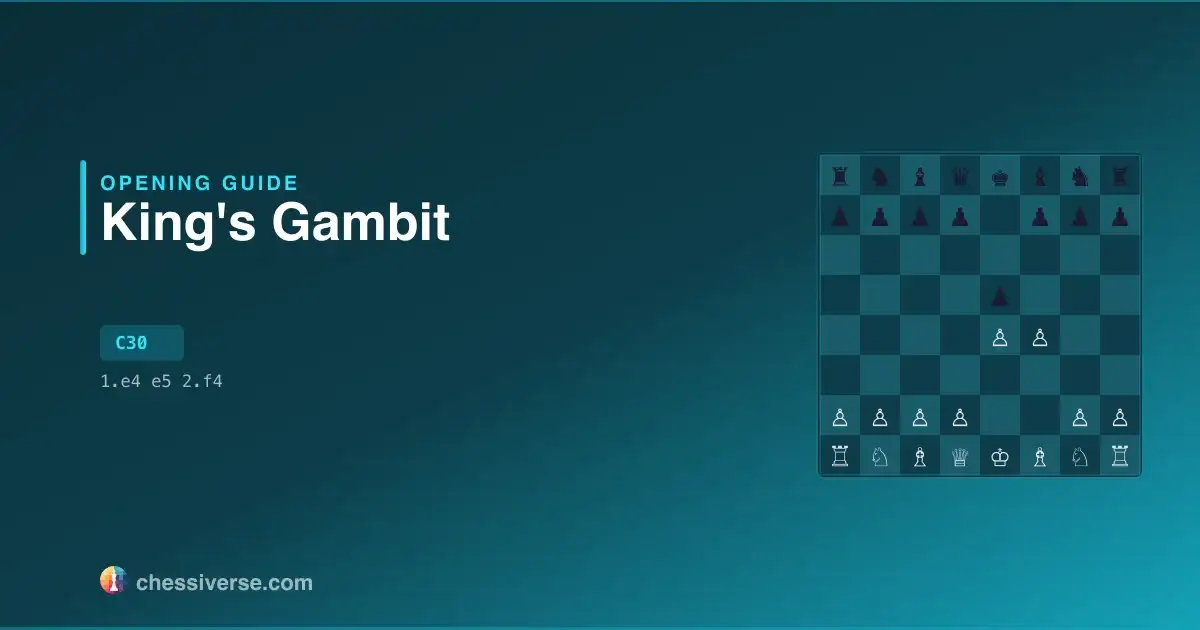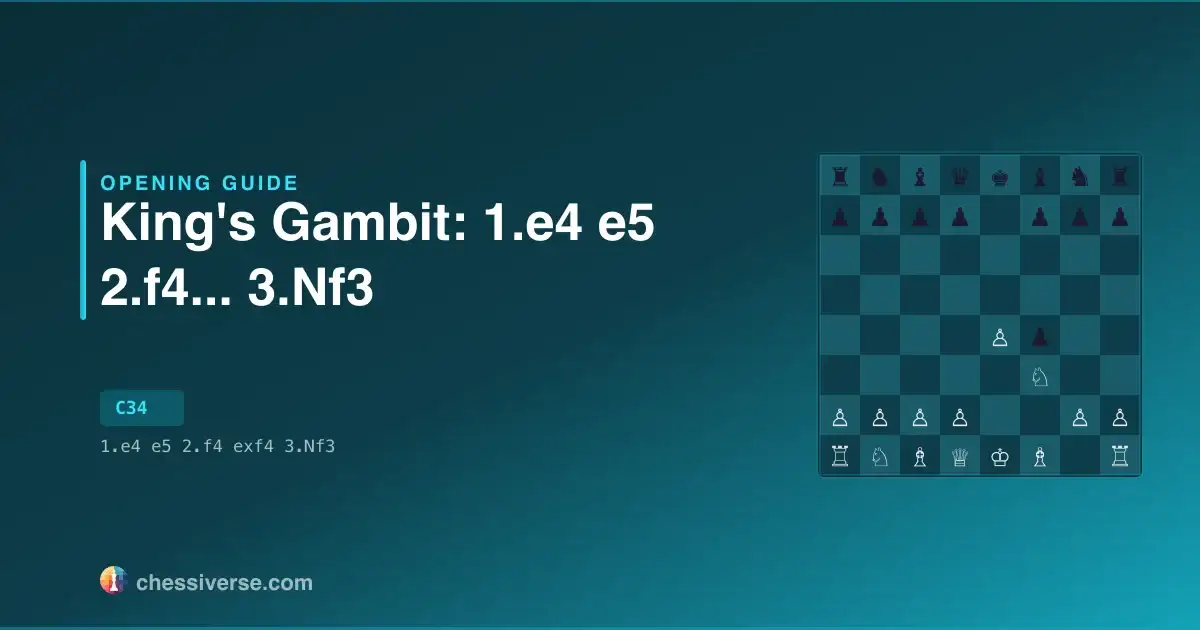




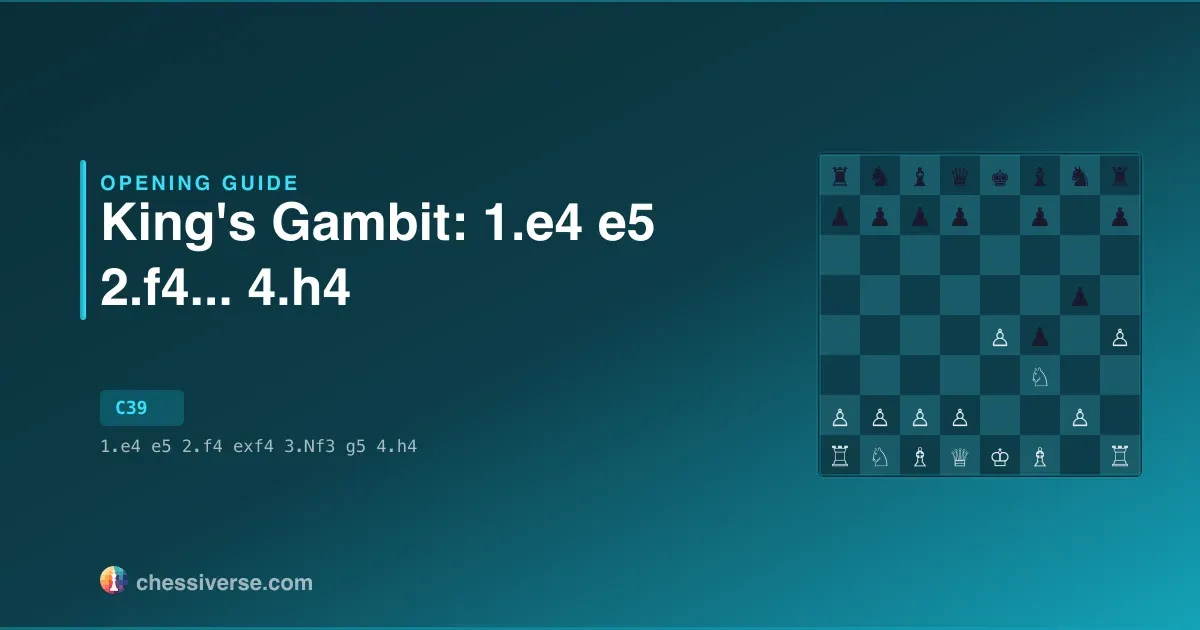
Starting from 1.e4 e5 2.f4 exf4 3.Nf3 g5 4.h4, players enter the King's Gambit Accepted: King's Knight's Gambit (3...g5 4.h4) — ECO C39. White attacks the g-pawn before it can do any work, forcing Black into the only defence that keeps the structure intact: pushing the pawn forward and accepting the resulting chaos.
Strategic Overview
4.h4 attacks the g5 pawn and forces Black into a hard decision. Almost every natural-looking defensive move is a structural disaster. Trying 4...f6 hangs the g-pawn outright and leads to a quick mating attack on the king. Defending with 4...h6 also loses material because of the rook-file tactics that follow. Capturing 4...gxh4 saddles Black with isolated, doubled pawns on the rook and bishop files, a structure even a player with two extra pawns can hardly survive. Bishop blocks like 4...Bh6 or 4...Be7 let White win the f-pawn back cleanly and emerge ahead in development. The only structurally sound answer is 4...g4, which advances the pawn out of harm's way and kicks the knight on f3. From there the position becomes wide open. The other principled option is 4...d5, a central counter-strike that often leads to extremely unclear positions after both sides commit pawns and pieces to the centre. This is the kind of position where a single tempo can decide the game. Both players need to know the concrete lines because there is no general principle that saves a wrong move; the structure is too fragile and the king positions too exposed for slow play.
Key Ideas
A few ideas come up again and again in this opening:
- Only ...g4 keeps the structure intact — Pushing the pawn out of attack is the lone move that does not create irreparable structural damage. Every other natural defence loses material or wrecks Black's pawns.
- ...d5 is the principled alternative — Hitting the centre is a strong counter-strike that often leads to balanced but completely unclear positions. It is a serious alternative for Black who knows the theory.
- Natural moves are blunders here — Trying to defend g5 with ...f6, ...h6, or by capturing on h4 all lead to disasters. Bishop blocks like ...Bh6 or ...Be7 simply hand the f-pawn back with extra time for White.
- Concrete play, not principles — The position is too sharp for general guidelines. Both sides need to know specific move orders because king safety and pawn structure are decided by tactics, not by themes.
History and Notable Players
It arises from the King's Gambit Accepted: King's Knight's Gambit (3...g5). Among the most prolific White practitioners are Adolf Anderssen (31 games), Emanuel Lasker (24 games), William Steinitz (15 games). Black-side regulars include Adolf Anderssen (16 games), William Ewart Napier (12 games), NN (12 games).
Performance Across Rating Levels
How well the King's Gambit Accepted: King's Knight's Gambit (3...g5 4.h4) works depends on what level you're playing at. Among 1200-rated players, it appears in 0.01% of games — 52,434 of them on record — with White winning 54.7% and Black 42.7%. By 1800, popularity is 0.04% and White's score is 53.2% to Black's 43.5%. At 2500, 0.01% of games go into this opening; draws sit at 5.9% — the line is well-mapped at this level. White's edge erodes by 7.1pp from 1200 to 2500 Elo, suggesting Black's counterplay is easier to find with experience.
Time Control Patterns
Time control matters here: blitz players reach for this opening more than others. In bullet, it appears in 0.01% of games (258,724); White wins 53.6%. Blitz shows 0.02% adoption across 833,104 games, White scoring 53.4%. In rapid, the share rises to 0.02% — 222,099 games, White 53.1%.
Move Diversity and Theory Depth
Move choice is far from uniform in the King's Gambit Accepted: King's Knight's Gambit (3...g5 4.h4). At 1200 Elo (52,434 games), the top reply is g4, played 53.3% of the time. Four other moves each take at least 5% of games, and the top three moves account for 82.9% of games. Entropy: 2.07. By 2500 (761 games), g4 dominates at 94% of replies; no other move reaches 5% and the top three moves account for 99.2% of games. Entropy drops to 0.41. That entropy collapse is the signature of a line where preparation pays off: at the top, players know the best move and play it.
Historical Trends
Year-over-year data tells you whether this opening is a contemporary fixture or a fading one. Adoption peaked in 2014 at 0.05% (4,426 games). By 2025 it sits at 0.02%, 57% below the peak and 56% under its 2013 level, leaving the line in decline.
Common Mistakes
- Drifting away from main theory — At 400 Elo, the three most-played moves cover 80.6% of games, against 96.6% at 2000. The most popular deviation is gxh4 (played 19.1% of the time at 400, much less so up top). It looks fine but quietly hands the better-prepared side an edge.
- Neglecting development — It can feel productive to make extra pawn moves early, but falling behind in piece development is what loses most amateur games — especially in open positions where active pieces find squares fast.
- Overextending the attack — Gambits look like permission to throw everything forward. They aren't — every attacking move should improve a piece. Random checks and threats burn the initiative once they fail to coordinate.
Practice on Chessiverse
Ready to try the King's Gambit Accepted: King's Knight's Gambit (3...g5 4.h4) against a bot? Pick an opponent at your level and play a game.