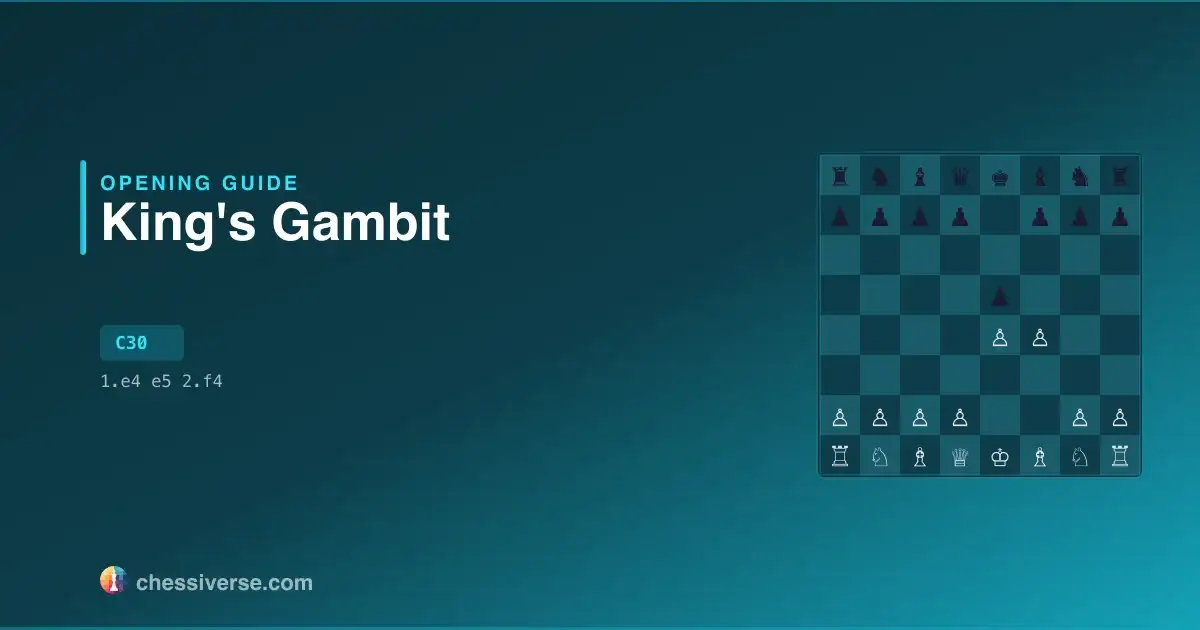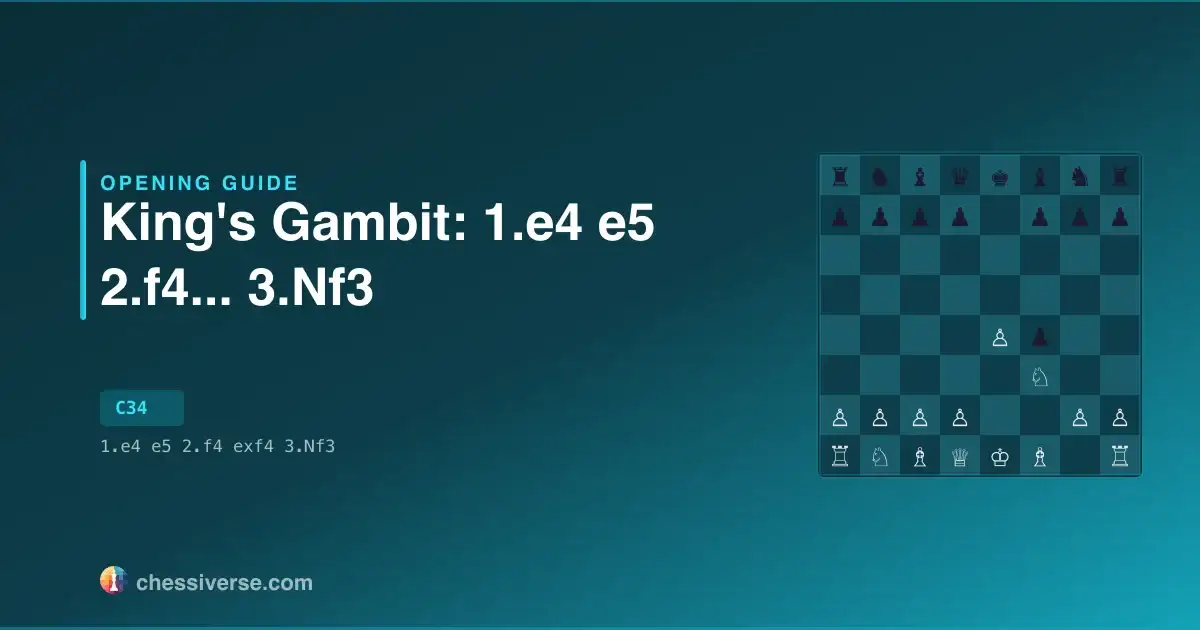


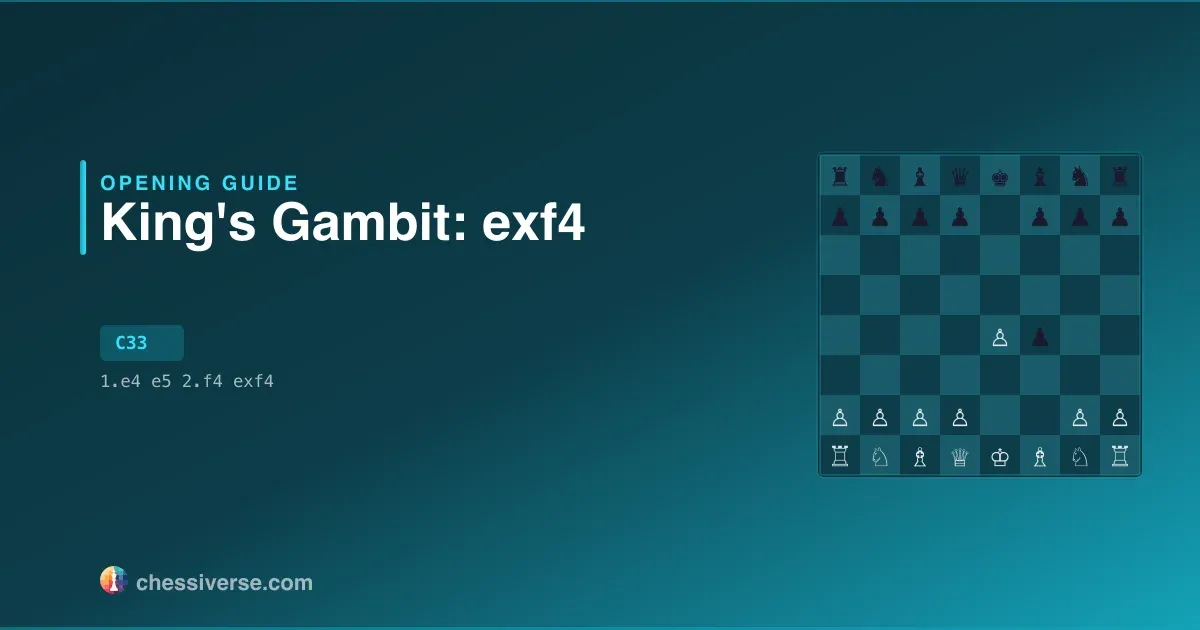
1.e4 e5 2.f4 exf4 opens the King's Gambit Accepted, ECO C33. Black takes the bait, pockets the pawn, and now White must figure out how to stop the looming Qh4+ before the position falls apart.
Strategic Overview
Accepting the King's Gambit is the principled answer, but it puts White on the clock. The pawn on f4 does more than count material: it controls the long diagonal toward the king, denies the g-pawn the chance to block ...Qh4+ effectively, and would saddle White with an awkward king walk to e2 if Black got a free move. So White's choice on move three is really about how to neutralise the Qh4+ threat while staying ambitious. The two principled moves are 3.Nf3, controlling h4 by piece power while developing, and 3.Bc4, eyeing f7 and clearing f1 for the king. 3.Nf3 is by far the most common and starts the King's Knight Gambit, where White plans d4 to take the centre and Bxf4 to recover the pawn. The various Black responses divide the territory: ...g5 holds the pawn aggressively, ...d6 prepares a solid defensive setup, and ...d5 hits back in the centre. The sideline moves (3.Qg4, 3.h4, 3.Qf3, 3.Nh3) all have their charms but tend to give Black easy development. Strategically, this is a fight about whether White can convert the lead in development and central potential before Black gets coordinated and starts cashing in the extra pawn.
Key Ideas
A few ideas come up again and again in this opening:
- Qh4+ is the permanent threat — With f4 in Black's hands, the natural pawn block on g3 is unavailable. White must address ...Qh4+ structurally or risk a forced Ke2 that wrecks coordination.
- 3.Nf3 is the workhorse — Developing the knight controls h4 with a piece and prepares d4 to take over the centre. This is the main road of King's Gambit theory and the move you should know.
- 3.Bc4 clears f1 for the king — The bishop sortie aims at f7 and vacates f1 so the king can step there after a check. It is a serious alternative to 3.Nf3 with sharper attacking ideas.
- Sidelines look cute but concede development — Moves like 3.Qg4, 3.h4, 3.Qf3, and 3.Nh3 each have a tactical point, but they all spend tempo on something other than development and let Black equalise comfortably.
History and Notable Players
It arises from the King's Gambit. Among the most prolific White practitioners are Adolf Anderssen (79 games), Heikki MJ Westerinen (65 games), Emanuel Lasker (45 games). Black-side regulars include Adolf Anderssen (80 games), NN (70 games), Gustav Richard Neumann (24 games).
Performance Across Rating Levels
How well the King's Gambit Accepted works depends on what level you're playing at. At 1200 Elo, the opening shows up in 0.59% of games (3,967,721 samples). White scores 54.5%, Black 42.6%, draws 2.9%. At 1800 the opening surfaces in 0.92% of games; White wins 51.2%, Black 45.3%, draws 3.5%. At the top end (2500+ Elo), popularity is 0.12% with 6.8% draws — a clear sign of how much theory rules the line at master level. White's edge erodes by 4.9pp from 1200 to 2500 Elo, suggesting Black's counterplay is easier to find with experience.
Time Control Patterns
Time control matters here: rapid players reach for this opening more than others. In bullet, it appears in 0.32% of games (8,419,342); White wins 53.2%. Blitz shows 0.73% adoption across 26,112,193 games, White scoring 52.7%. In rapid, the share rises to 0.75% — 8,313,473 games, White 53.6%.
Move Diversity and Theory Depth
Move choice is far from uniform in the King's Gambit Accepted. At 1200 Elo (3,967,721 games), the top reply is Nf3, played 85.6% of the time. One other move takes at least 5% of games, and the top three moves account for 96.5% of games. Entropy: 0.90. By 2500 (16,522 games), Nf3 dominates at 68.2% of replies; two other moves reach 5% and the top three moves account for 97.5% of games. Entropy rises to 1.30.
Historical Trends
Long-term, the trajectory of this opening is informative. Adoption peaked in 2013 at 1.41% (40,645 games). By 2025 it sits at 0.65%, down 54% from that high, leaving the line in decline.
Main Lines and Variations
After 1.e4 e5 2.f4 exf4, the established follow-ups are:
Each branch leads to a different middlegame character — the resulting pawn structure decides what kind of game you get.
Common Mistakes
- Drifting away from main theory — At 400 Elo, the three most-played moves cover 86.1% of games, against 98.6% at 2000. The most popular deviation is d4 (played 14.7% of the time at 400, much less so up top). It looks fine but quietly hands the better-prepared side an edge.
- Neglecting development — It can feel productive to make extra pawn moves early, but falling behind in piece development is what loses most amateur games — especially in open positions where active pieces find squares fast.
- Overextending the attack — Gambits look like permission to throw everything forward. They aren't — every attacking move should improve a piece. Random checks and threats burn the initiative once they fail to coordinate.
Practice on Chessiverse
Ready to try the King's Gambit Accepted against a bot? Pick an opponent at your level and play a game.