

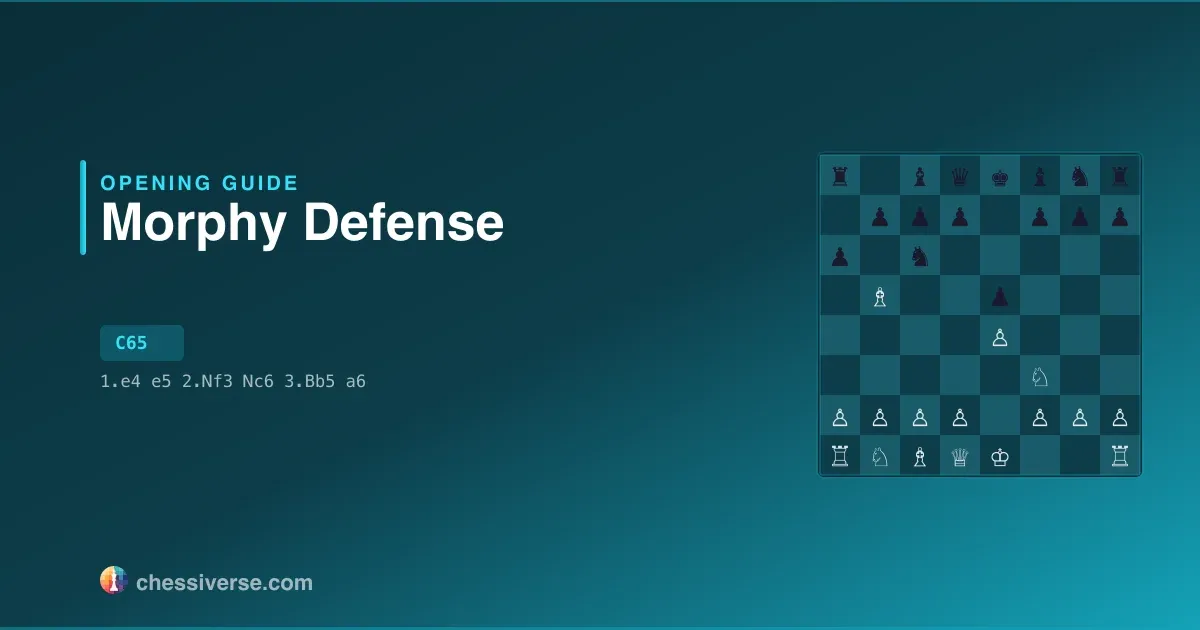
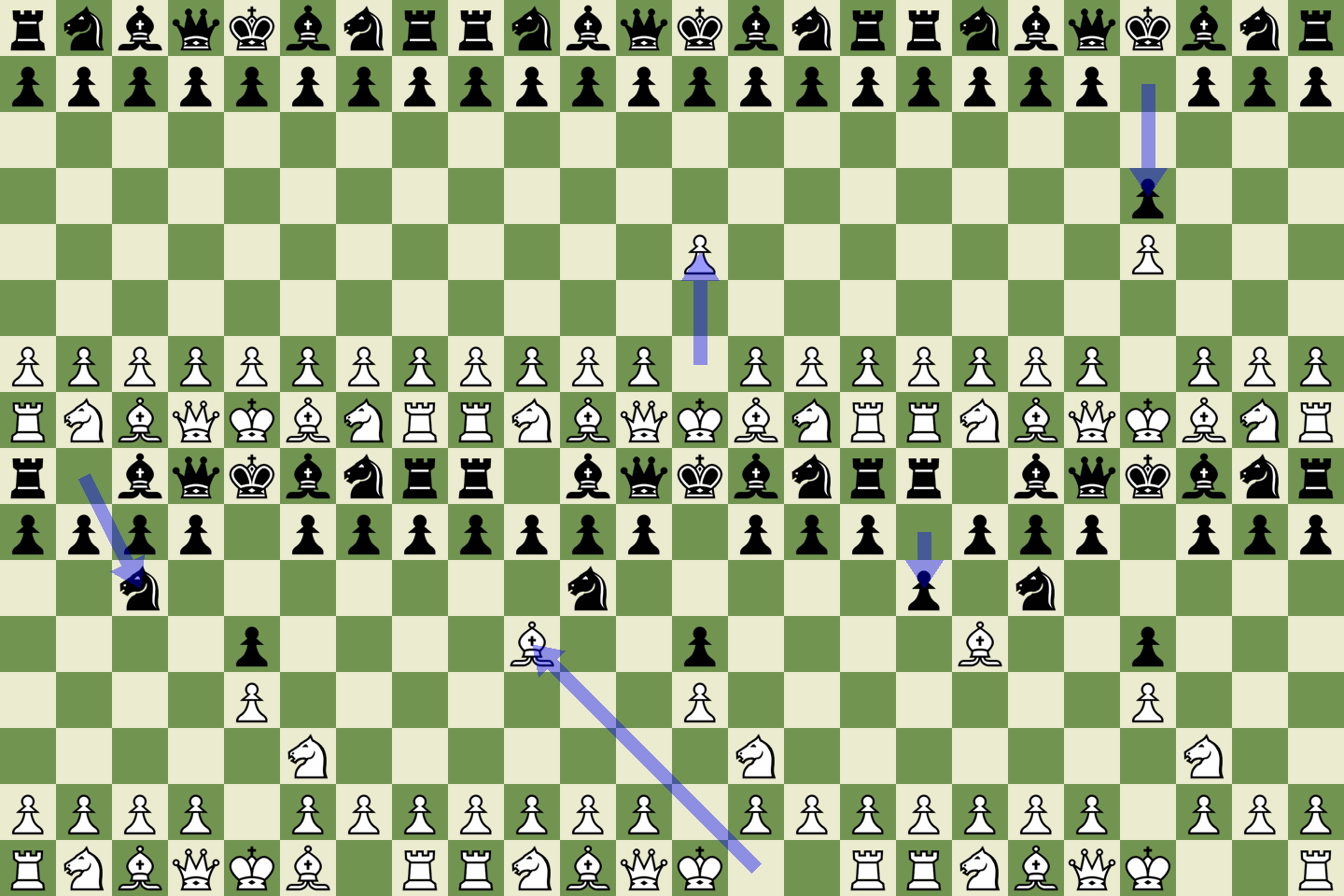
The Ruy Lopez: Morphy Defense arises after 1.e4 e5 2.Nf3 Nc6 3.Bb5 a6 and falls under ECO code C70. The move 3...a6 forces the bishop to make an immediate decision: capture the knight or retreat, since staying on b5 is no longer viable. One option is 4. Bxc6, the Exchange Variation, which removes Black's knight and weakens the defense of e5. However, White cannot win the e5 pawn immediately because after 4...dxc6 5. Nxe5?, the reply 5...Qd4! forks the knight and the e4 pawn. While playable, the Exchange is not the principal continuation. The main line is 4. Ba4, which, as Carl Jaenisch recognized in the 19th century, serves not to double Black's pawns by capturing the knight, but rather to restrict the development of Black's kingside for as long as possible. By retreating, White keeps both bishops and maintains persistent pressure on the c6 knight. After 4. Ba4, Black gains the option of neutralizing the threat at any convenient moment with ...b5. White, in turn, must be cautious about the Noah's Ark Trap, a well-known tactical pattern in which Black uses an ...a6, ...b5, and ...c4 pawn advance to snare the bishop on b3. With 31.2 million Lichess games across all rating levels, it is a well-established opening choice.
- 3...a6 puts the question to the Spanish bishop: White must either retreat with Ba4 or trade it on c6.
- In the Closed Defence (4.Ba4 Nf6 5.0-0 Be7), Black meets 6.Re1 with ...b5, driving the bishop to b3, and then plays ...d6 or castles.
- The rich main-line systems - Chigorin, Breyer, Zaitsev - revolve around queenside counterplay and pressure against White's center.
History and Notable Players
It arises from the Ruy Lopez. Among the most prolific practitioners on the White side are Viswanathan Anand (127 games), Maxime Vachier Lagrave (105 games), Fabiano Caruana (92 games). On the Black side, notable exponents include Aleksej Aleksandrov (190 games), Vladimir Kramnik (150 games), Levon Aronian (133 games).
The move was first mentioned in Ercole del Rio's 1750 treatise and played twice by Charles Stanley in an 1845 New Orleans match; it later gained wide popularity and was named after Morphy. Steinitz argued against 3...a6 in 1889, yet it went on to become the overwhelming main line of the Ruy Lopez.
Named after: Named after Paul Morphy, who played 3...a6 in games 2 and 4 of his 1858 match with Anderssen in Paris, though he was not its originator.
Notable players: Paul Morphy, Charles Stanley
Steinitz disapproved of 3...a6 in his 1889 Modern Chess Instructor, but history overruled the first world champion: about two thirds of all Ruy Lopez games today begin with the Morphy Defense.
Statistics
Based on 31.2 million Lichess games across all rating levels:
- White wins: 50.8%
- Black wins: 44.3%
- Draws: 5%
White holds a moderate edge statistically, though Black has good practical chances.
Main Lines and Variations
After 1.e4 e5 2.Nf3 Nc6 3.Bb5 a6, the main continuations include:
Each of these lines leads to distinct types of positions and requires its own understanding of the resulting pawn structures and piece placements.
Practice on Chessiverse
The best way to learn the Ruy Lopez: Morphy Defense is through practice. On Chessiverse, you can play chess against computer opponents that specialize in this opening. Our AI bots range from beginner to grandmaster level, each with unique playing styles — from aggressive attackers to solid defenders. Choose a bot that matches your rating and work your way up as you master the opening's key ideas.
Performance Across Rating Levels
How well the Ruy Lopez: Morphy Defense works depends on what level you're playing at. At 1200 Elo, the opening shows up in 0.65% of games (4,366,468 samples). White scores 52%, Black 43.7%, draws 4.2%. At 1800 the opening surfaces in 0.67% of games; White wins 50.2%, Black 44.7%, draws 5.1%. At 2500, 1.77% of games go into this opening; draws sit at 10.2% — the line is well-mapped at this level. White's edge erodes by 5.3pp from 1200 to 2500 Elo, suggesting Black's counterplay is easier to find with experience.
Time Control Patterns
Time control matters here: rapid players reach for this opening more than others. In bullet, it appears in 0.26% of games (6,951,337); White wins 51.5%. Blitz shows 0.64% adoption across 22,881,401 games, White scoring 50.7%. In rapid, the share rises to 0.76% — 8,358,083 games, White 51%.
Move Diversity and Theory Depth
Looking at move selection shows how forcing — or not — the position really is. At 1200 Elo (4,366,468 games), the top reply is Bxc6, played 56.7% of the time. One other move takes at least 5% of games, and the top three moves account for 99.4% of games. Entropy: 1.18. By 2500 (240,697 games), Ba4 takes over as the top reply at 85.9%; one other move reaches 5% and the top three moves account for 100% of games. Entropy drops to 0.59. The narrowing is significant — strong players consolidate around a small set of best moves, while amateurs scatter across many plausible-looking options.
Historical Trends
Tracking the Ruy Lopez: Morphy Defense year over year shows a clear story. Adoption peaked in 2016 at 0.95% (588,580 games). By 2025 it sits at 0.54%, 44% below the peak and 32% under its 2013 level, leaving the line in decline.