



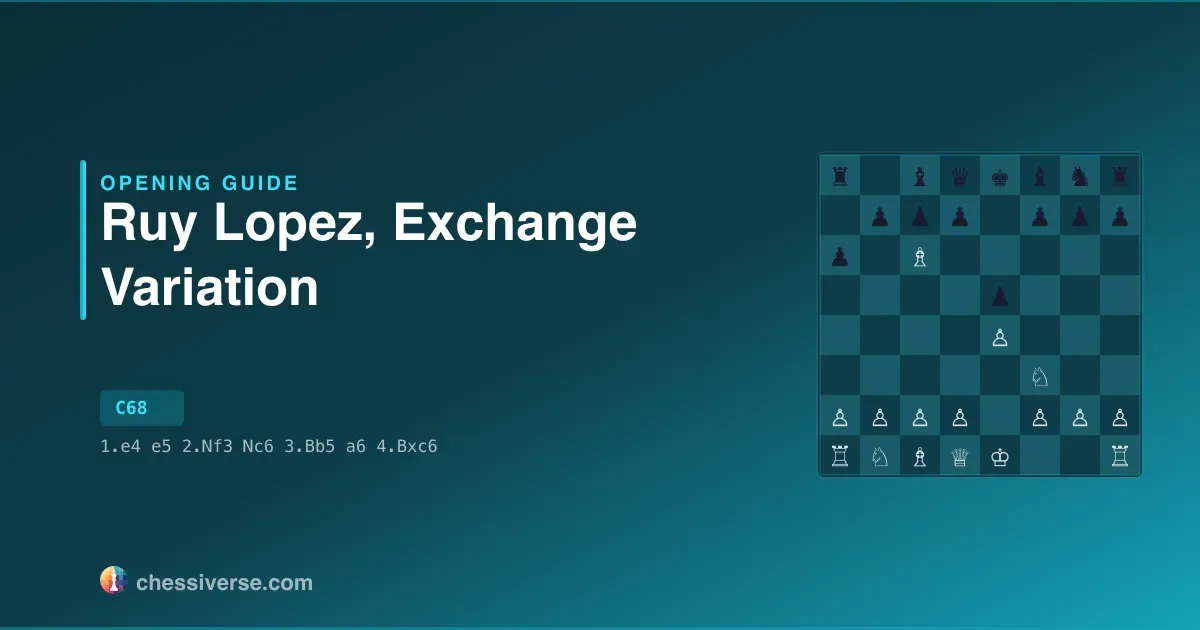
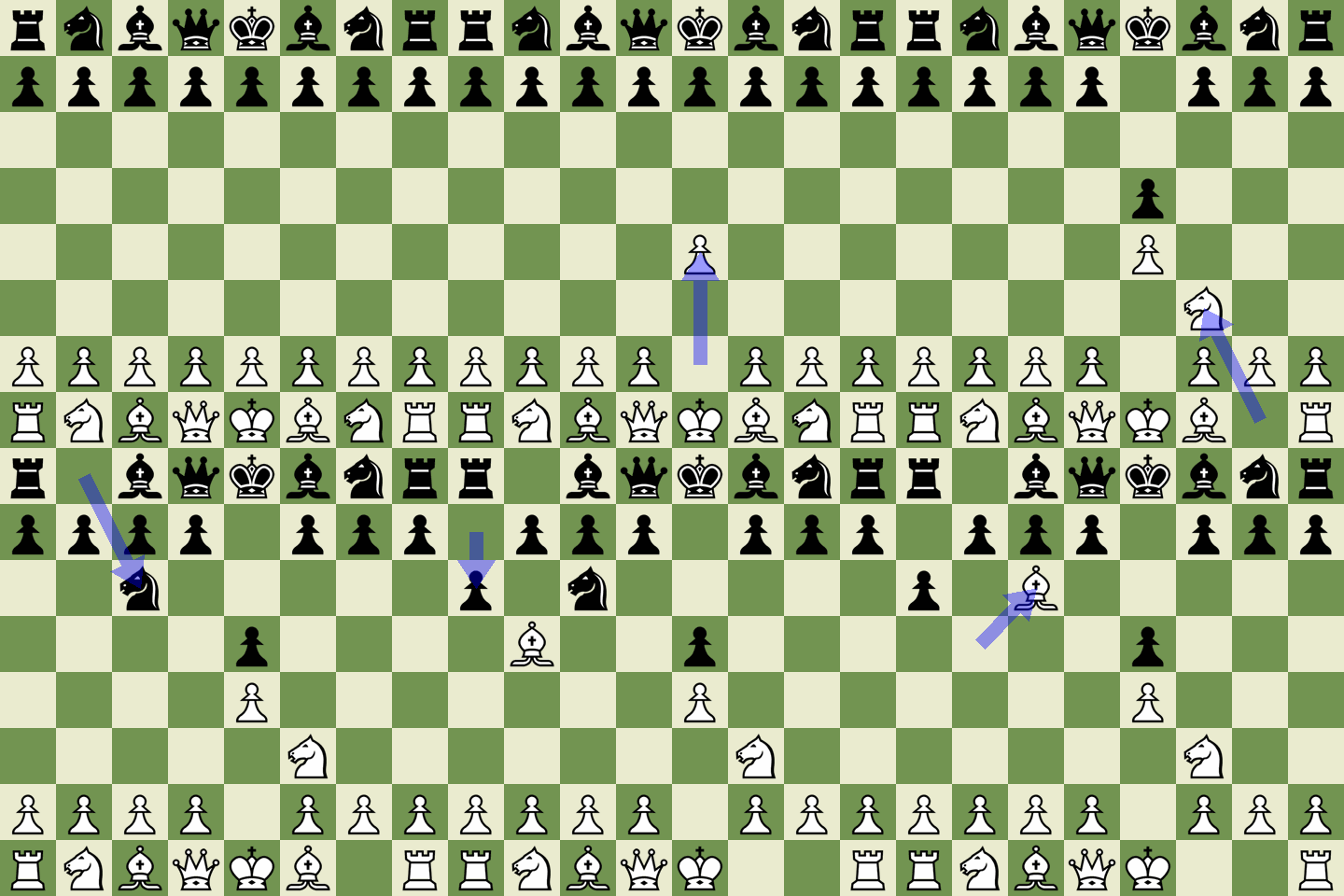
1.e4 e5 2.Nf3 Nc6 3.Bb5 a6 4.Bxc6 opens the Ruy Lopez, Exchange Variation, ECO C68. White trades the prized Spanish bishop for a knight and hands Black the bishop pair — voluntarily. The catch is the doubled c-pawns and a long endgame where White grinds and Black defends.
Strategic Overview
The Exchange Spanish is a positional commitment, not a draw offer. By taking on c6 immediately, White trades the bishop pair (Black's main long-term asset) for a permanent structural concession in Black's pawn formation: doubled c-pawns and a less mobile pawn majority on the kingside. White's queenside majority is the cleaner one, and in any endgame those healthy pawns can roll while Black's doubled c-pawns struggle. The main reply 4...dxc6 is the principled recapture — it opens lines for Black's queen and queen's bishop and keeps the e5-pawn defended by tactics (Nxe5? Qd4! forks). White typically responds with 5.O-O or 5.Nc3 to protect e4 before claiming the pawn, or 5.d4 to open the position right away. The 4...bxc6 recapture is the Lutikov, and it's slightly worse because White gets the pawn cleanly. Bobby Fischer revived the Exchange in the 1960s with concrete ideas about the resulting endgames, and that's still the spirit: White plays for a small, lasting structural edge that becomes meaningful as pieces come off the board.
Key Ideas
The recurring motifs below distinguish a confident handler of this opening from a beginner:
- White trades the bishop pair for structure — Most openings keep the Spanish bishop alive at all costs. Here White inverts the priority: the doubled c-pawns and worse pawn majority for Black are the long-term asset, and the bishop pair concession is the acceptable price.
- 4...dxc6 keeps the position playable — Recapturing toward the centre opens diagonals for both bishops and the queen. Crucially, e5 is tactically defended — Nxe5 runs into Qd4 forking the knight and e4 — so Black isn't forced into passive defence.
- Black's e5-pawn defends itself for one move — White can't just grab e5 because of Qd4 hitting both the knight and the e4-pawn. That's why White has to spend a tempo on 5.O-O or 5.Nc3 before any kingside activity makes sense.
- The endgame is the destination — Both sides know where this is headed: a queenless middlegame or endgame where Black's doubled pawns become a real problem. White trades early and often, Black tries to keep enough pieces on to use the bishop pair.
History and Notable Players
It arises from the Ruy Lopez: Morphy Defense. Among the most prolific White practitioners are Eduardas Rozentalis (97 games), Dragan Solak (69 games), Viesturs Meijers (62 games). Black-side regulars include Oleg M Romanishin (47 games), Mark L Hebden (38 games), Peter Lukacs (34 games).
Performance Across Rating Levels
How well the Ruy Lopez, Exchange Variation works depends on what level you're playing at. The 1200 bracket has 2,474,965 games (0.37% of all games at that level); White wins 50.6%, Black 44.6%, 4.8% are drawn. At 1800 the opening surfaces in 0.19% of games; White wins 48.6%, Black 45.4%, draws 6%. Among 2500-rated players the line appears in 0.25% of games and draws spike to 12.6%, indicating tight preparation. Positions also become less sharp as level rises (sharpness 0.95 → 0.87).
Time Control Patterns
Look at the same opening across time controls and rapid stands out. In bullet, it appears in 0.10% of games (2,746,715); White wins 51.6%. Blitz shows 0.24% adoption across 8,584,807 games, White scoring 49.9%. In rapid, the share rises to 0.34% — 3,717,743 games, White 49.4%. White's score swings 2.2pp across formats, so time control isn't just a stylistic choice here — it shifts the actual results.
Move Diversity and Theory Depth
What players actually play after the opening moves depends heavily on rating. At 1200 Elo (2,474,965 games), the top reply is dxc6, played 71.4% of the time. One other move takes at least 5% of games, and the top three moves account for 99.8% of games. Entropy: 0.89. By 2500 (33,806 games), dxc6 dominates at 98.8% of replies; no other move reaches 5% and the top three moves account for 99.9% of games. Entropy drops to 0.11. That entropy collapse is the signature of a line where preparation pays off: at the top, players know the best move and play it.
Historical Trends
Tracking the Ruy Lopez, Exchange Variation year over year shows a clear story. Adoption peaked in 2016 at 0.39% (241,704 games). By 2025 it sits at 0.21%, 47% below the peak and 41% under its 2013 level, leaving the line in decline.
Main Lines and Variations
From the position after 1.e4 e5 2.Nf3 Nc6 3.Bb5 a6 4.Bxc6, the recognised continuations are:
Each branch leads to a different middlegame character — the resulting pawn structure decides what kind of game you get.
Common Mistakes
- Neglecting development — It can feel productive to make extra pawn moves early, but falling behind in piece development is what loses most amateur games — especially in open positions where active pieces find squares fast.
- Playing without a plan — Each Ruy Lopez, Exchange Variation middlegame demands a specific approach. Decide whether the position calls for attack, manoeuvre, or simplification before reaching for a move.
Practice on Chessiverse
Ready to try the Ruy Lopez, Exchange Variation against a bot? Pick an opponent at your level and play a game.