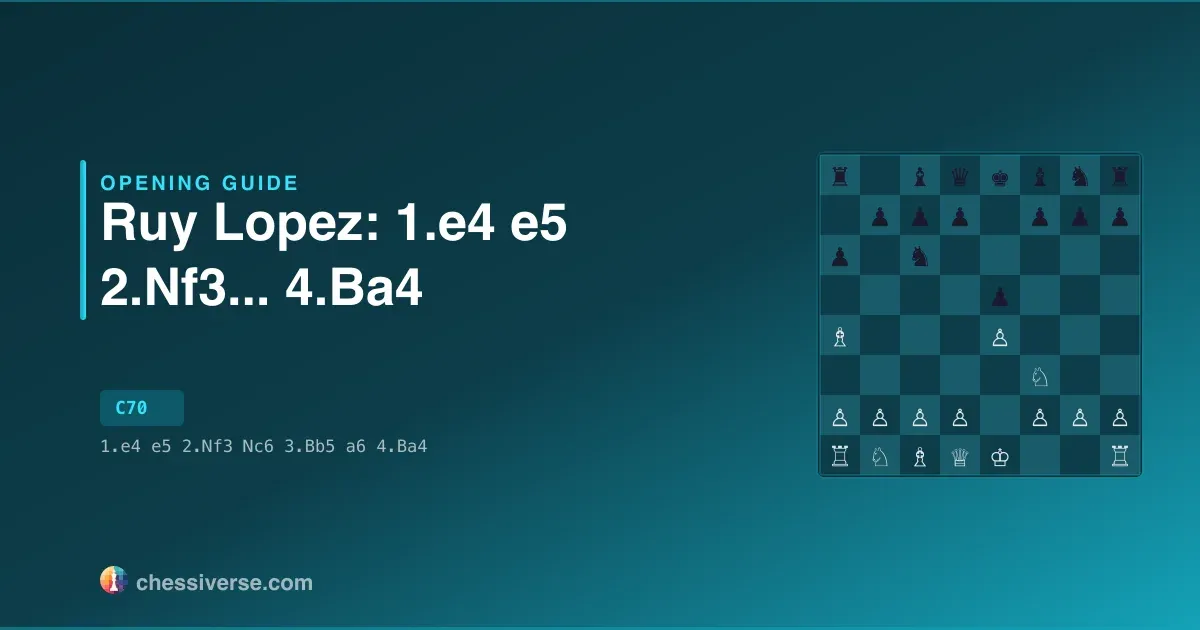
Starting from 1.e4 e5 2.Nf3 Nc6 3.Bb5 a6 4.Ba4, players enter the Ruy Lopez: Morphy Defense — ECO C70. White keeps the bishop and the long-term plan. 4.Ba4 is the gateway to the Closed Spanish — the main highway of 1.e4 e5 that every serious player either lives in or has to know how to handle.
Strategic Overview
4.Ba4 is the move that says "we're playing a real Spanish." By preserving the bishop, White keeps the latent pressure on c6 and e5 alive — and crucially keeps the option of slowly building a big centre with c3 and d4 down the line. The trade-off is that Black gets the ...b5 break in their back pocket whenever they need it. The moment White commits a piece to defending e4, Black can play ...b5 to chase the bishop and shut down the Bxc6/Nxe5 trick for good. Until then, Black has zero reason to spend a tempo on ...b5 and instead develops the kingside. The whole Spanish revolves around this dance: White builds slowly, Black times their counter-thrusts (...b5, ...d5, ...f5, ...Nb8-d7-f6 manoeuvres) to neutralise White's space. The mainline runs through 4...Nf6, the most principled developing move and the entry into the deepest theory in chess. The Modern Steinitz (4...d6), Classical Deferred (4...Bc5), and Caro (4...b5) are the major sidelines, each with their own structural identity. This position is the launching pad — everything in the Closed Spanish flows from here.
Key Ideas
The recurring motifs below distinguish a confident handler of this opening from a beginner:
- ...b5 is Black's permanent get-out-of-jail card — The threat of Bxc6 followed by Nxe5 isn't real yet, but it's always there. Black can play ...b5 the moment White defends the e4-pawn, kicking the bishop and killing the tactic for good.
- 4...Nf6 is the gateway to the main lines — Developing the knight, hitting e4, and getting ready to castle — this is the move that opens the door to the Berlin Defense Deferred and ultimately the heaviest theory in classical chess.
- 4...d6 is the solid Modern Steinitz — Defending e5 with a pawn defuses the threats once and for all, at the cost of a more passive bishop. The Deferred Steinitz improves on the Old Steinitz precisely because ...a6 and Ba4 are inserted, letting Black always meet d4 with ...b5 if needed.
- Black develops, then breaks — The Spanish rewards patience. Black finishes kingside development and castles before committing the queenside. Premature ...b5 just loses time; well-timed ...b5 wins the strategic battle.
History and Notable Players
It arises from the Ruy Lopez: Morphy Defense. On the White side, Viswanathan Anand (269 games), Vlastimil Jansa (238 games), Michael Adams (207 games) top the database. Notable Black exponents: Svetozar Gligoric (295 games), Alexander G Beliavsky (269 games), Oleg M Romanishin (266 games).
Performance Across Rating Levels
Popularity and results vary sharply by rating level. Among 1200-rated players, it appears in 0.26% of games — 1,755,112 of them on record — with White winning 54.5% and Black 42.1%. At 1800 the opening surfaces in 0.48% of games; White wins 50.9%, Black 44.3%, draws 4.8%. At the top end (2500+ Elo), popularity is 1.52% with 9.8% draws — a clear sign of how much theory rules the line at master level. White's edge erodes by 7.9pp from 1200 to 2500 Elo, suggesting Black's counterplay is easier to find with experience.
Time Control Patterns
Time control matters here: rapid players reach for this opening more than others. In bullet, it appears in 0.15% of games (4,066,966); White wins 51.7%. Blitz shows 0.39% adoption across 13,919,952 games, White scoring 51.4%. In rapid, the share rises to 0.40% — 4,414,187 games, White 52.6%.
Move Diversity and Theory Depth
Move choice is far from uniform in the Ruy Lopez: Morphy Defense (4.Ba4). At 1200 Elo (1,755,112 games), the top reply is b5, played 54.1% of the time. Three other moves each take at least 5% of games, and the top three moves account for 90.6% of games. Entropy: 1.79. By 2500 (206,748 games), Nf6 takes over as the top reply at 78.1%; only one other move still reaches 5% and the top three moves account for 90.8% of games. Entropy drops to 1.26. The narrowing is significant — strong players consolidate around a small set of best moves, while amateurs scatter across many plausible-looking options.
Historical Trends
Year-over-year data tells you whether this opening is a contemporary fixture or a fading one. Adoption peaked in 2016 at 0.55% (337,284 games). By 2025 it sits at 0.32%, 42% below the peak and 23% under its 2013 level, leaving the line in decline.
Main Lines and Variations
From the position after 1.e4 e5 2.Nf3 Nc6 3.Bb5 a6 4.Ba4, the recognised continuations are:
Each branch leads to a different middlegame character — the resulting pawn structure decides what kind of game you get.
Common Mistakes
- Neglecting development — Extra pawn moves in the opening are tempting, especially when you "know the moves". Developing a piece each turn is the simple correction.
- Playing without a plan — Each Ruy Lopez: Morphy Defense middlegame demands a specific approach. Decide whether the position calls for attack, manoeuvre, or simplification before reaching for a move.
Practice on Chessiverse
Ready to try the Ruy Lopez: Morphy Defense against a bot? Pick an opponent at your level and play a game.