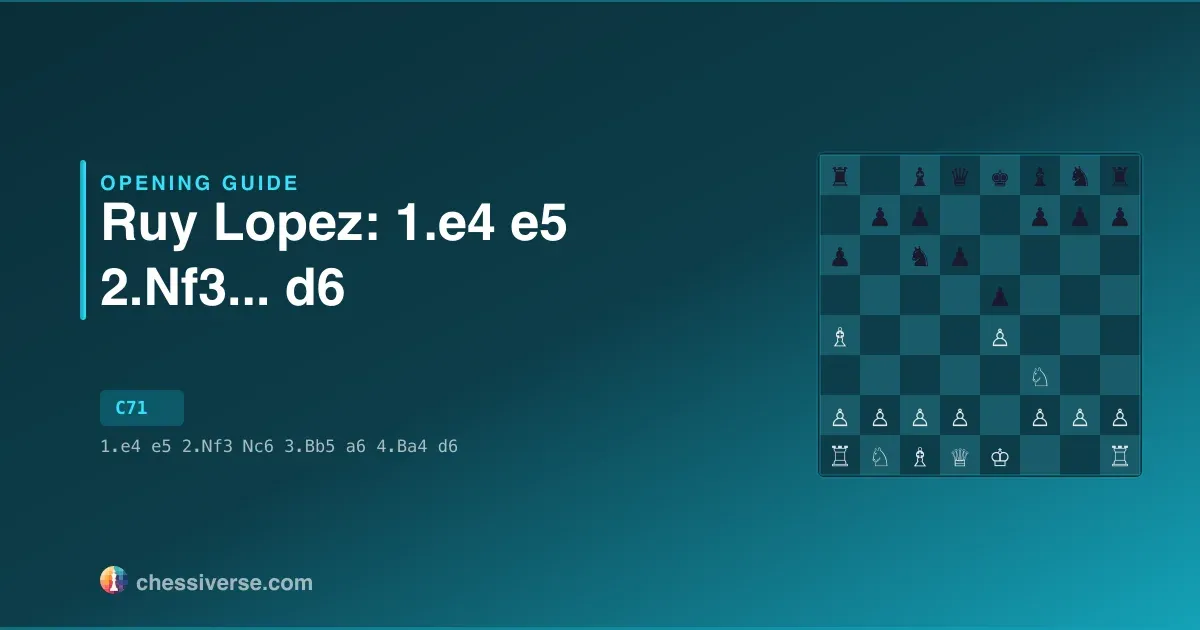
1.e4 e5 2.Nf3 Nc6 3.Bb5 a6 4.Ba4 d6 opens the Ruy Lopez: Morphy Defense, Modern Steinitz Defense, ECO C71. Black defends e5 with a pawn and kills the cycle of threats once and for all. The price is a closed-in king's bishop and a knight that's now pinned — but with ...a6 already played, that pin can be broken any time.
Strategic Overview
The Modern Steinitz is the no-drama Spanish. Where the rest of the Closed Spanish revolves around constant low-level threats on e5, ...d6 just nails the pawn down and ends the conversation. Black accepts two structural concessions in return: the f8-bishop is stuck behind the d6-e5 pawn chain for a while, and the c6-knight is now pinned by the a4-bishop. Critically, because Black has already played ...a6 and forced Ba4, the pin can be released at any moment with ...b5 — that's the entire reason this is called the "Modern" Steinitz rather than the old 3...d6 version, where Black couldn't escape the bishop's hold. The defining sequence is what happens after the natural-looking 5.d4?!. White seems to be winning the e5-pawn (Black only has one defender), but 5...exd4? then 6.Nxd4 sets up Nxc6/Bxc6+ winning material on c6. Black needs to react carefully, often with concrete piece play rather than principled development. The whole variation rewards players who like solid, slightly cramped positions with clear plans: finish development, time ...b5, and look for ...c5 or ...d5 breaks down the road.
Key Ideas
A few ideas come up again and again in this opening:
- The pawn on e5 is finally safe — Defending e5 with the d-pawn permanently solves Black's central problem. White can't just keep threatening Bxc6 and Nxe5 — that whole pressure complex evaporates the moment ...d6 hits the board.
- ...b5 unfreezes the position whenever Black wants — The inclusion of ...a6 and Ba4 is the entire point. Any time the bishop's pin becomes inconvenient, Black plays ...b5 and the pin is gone. This is the structural upgrade over the Old Steinitz.
- 5.d4?! is more dangerous than it looks — White's central break threatens to win the e5-pawn with Nxc6/Bxc6+ tactics. Black has to navigate it concretely rather than just developing — 5...exd4 6.Nxd4 sets up real material threats on c6.
- The king's bishop is the long-term concern — With pawns on d6 and e5, the f8-bishop has no obvious diagonal. Black usually develops it modestly with ...Be7 and waits for ...c5 or ...d5 to open lines — patience is the defining skill in this line.
History and Notable Players
It arises from the Ruy Lopez: Morphy Defense (4.Ba4). Among the most prolific White practitioners are Paul Keres (26 games), Wolfgang Unzicker (26 games), Bruno Parma (24 games). Black-side regulars include Valeri Yandemirov (106 games), Victor Ciocaltea (78 games), Heikki MJ Westerinen (69 games).
Performance Across Rating Levels
Popularity and results vary sharply by rating level. Among 1200-rated players, it appears in 0.01% of games — 91,809 of them on record — with White winning 52.5% and Black 43.8%. By 1800, popularity is 0.04% and White's score is 50.2% to Black's 44.8%. Among 2500-rated players the line appears in 0.14% of games and draws spike to 9.3%, indicating tight preparation. White's edge erodes by 8.1pp from 1200 to 2500 Elo, suggesting Black's counterplay is easier to find with experience.
Time Control Patterns
Time control matters here: blitz players reach for this opening more than others. In bullet, it appears in 0.01% of games (278,763); White wins 49.9%. Blitz shows 0.03% adoption across 1,033,660 games, White scoring 49.8%. In rapid, the share rises to 0.03% — 318,133 games, White 50.7%.
Move Diversity and Theory Depth
Move choice is far from uniform in the Ruy Lopez: Morphy Defense, Modern Steinitz Defense. At 1200 Elo (91,809 games), the top reply is O-O, played 31.9% of the time. Five other moves each take at least 5% of games, and the top three moves account for 68.6% of games. Entropy: 2.72. By 2500 (18,581 games), O-O is still the top reply, at 45.2%; only four other moves still reach 5% and the top three moves account for 82.6% of games. Entropy drops to 2.13. The narrowing is significant — strong players consolidate around a small set of best moves, while amateurs scatter across many plausible-looking options.
Historical Trends
Long-term, the trajectory of this opening is informative. Adoption peaked in 2017 at 0.034% (39,024 games). By 2025 it sits at 0.029%, 17% below the peak but still 21% above its 2013 level, so the line is up over the full period despite easing from the high.
Main Lines and Variations
The main branches off 1.e4 e5 2.Nf3 Nc6 3.Bb5 a6 4.Ba4 d6 include:
- Ruy Lopez: Morphy Defense, Modern Steinitz Defense (5.0-0)
- Ruy Lopez: Morphy Defense, Modern Steinitz Defense (5.c3)
- Ruy Lopez: Morphy Defense, Modern Steinitz Defense (5.Bxc6+ 5...bxc6)
Each branch leads to a different middlegame character — the resulting pawn structure decides what kind of game you get.
Common Mistakes
- Drifting away from main theory — At 400 Elo, the three most-played moves cover 65.4% of games, against 79% at 2000. The most popular deviation is Nc3 (played 14.9% of the time at 400, much less so up top). It looks fine but quietly hands the better-prepared side an edge.
- Neglecting development — It can feel productive to make extra pawn moves early, but falling behind in piece development is what loses most amateur games — especially in open positions where active pieces find squares fast.
- Playing without a plan — Each Ruy Lopez: Morphy Defense, Modern Steinitz Defense middlegame demands a specific approach. Decide whether the position calls for attack, manoeuvre, or simplification before reaching for a move.
Practice on Chessiverse
Ready to try the Ruy Lopez: Morphy Defense, Modern Steinitz Defense against a bot? Pick an opponent at your level and play a game.