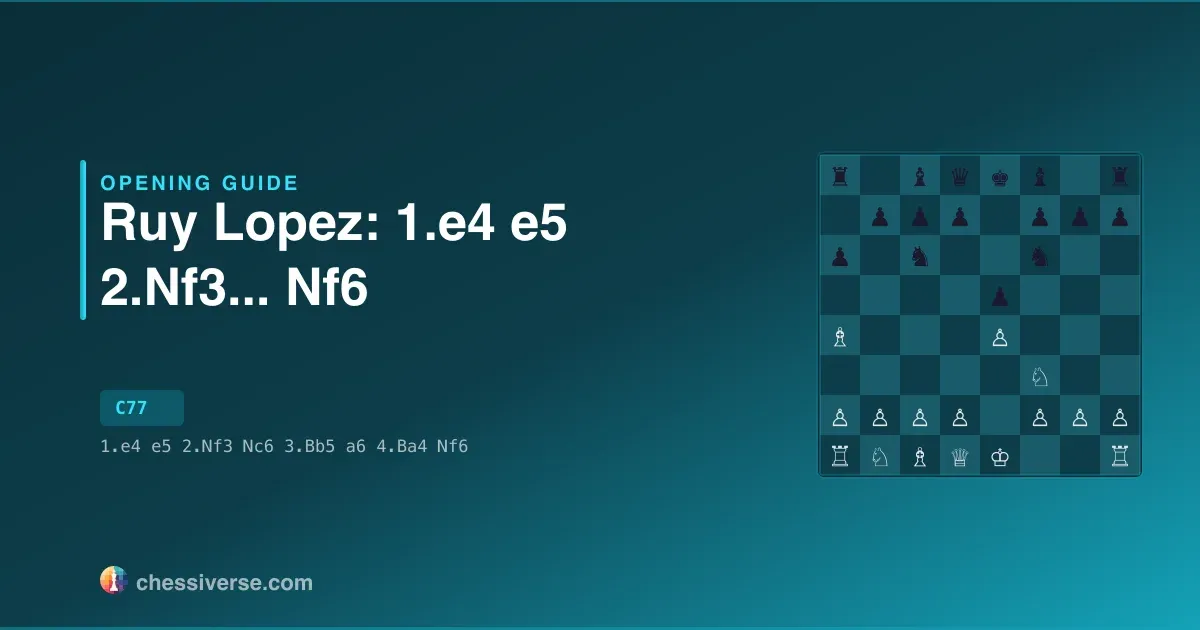
The Ruy Lopez: Morphy Defense (4...Nf6) begins with 1.e4 e5 2.Nf3 Nc6 3.Bb5 a6 4.Ba4 Nf6 (ECO C77). Black develops with tempo and asks the question every Spanish player has to answer: defend the e-pawn, or castle and trust the tactics? The mainline answer — castle anyway — is one of the great strategic decisions in opening theory.
Strategic Overview
4...Nf6 is the move that turns the Spanish into the Spanish. Black hits e4, gets ready to castle, and forces White to make a real decision. The mainline 5.O-O famously leaves the e-pawn hanging — White trusts that Black's structural concessions if they grab it (the Open Spanish after ...Nxe4) outweigh the material. The defensive alternatives all have specific strategic ideas. 5.d3 (Anderssen) is the modern positional choice: defend the pawn solidly, take ...Nxe4 off the table entirely, and play a slow manoeuvring Spanish without the deepest theory. 5.Nc3 (Tarrasch) develops a piece and protects the pawn, but usually transposes back into d3 set-ups. 5.d4 (Mackenzie) is the sharp pawn-thrust that avoids Closed Spanish positions completely by opening the centre early. The crooked tries — 5.Qe2 (Wormald), 5.Bxc6 (Bayreuth) — are sidelines that swap depth of theory for surprise value. The Jaffe gambit 5.c3? deserves its question mark: it allows 5...Nxe4 and White's pawn recovery isn't smooth. The choice at move five effectively determines the character of the entire game, which is why this position is one of the most-studied in chess.
Key Ideas
When players succeed in this line, they usually do so by leaning on the following themes:
- 5.O-O is the mainline and accepts the pawn loss temporarily — Castling first with the e-pawn hanging is the Spanish at its purest. If Black takes with 5...Nxe4 the game enters the Open Spanish, where White's lead in development and pressure on e5 give long-term compensation.
- 5.d3 sidesteps theory and plays positional chess — The Anderssen defends e4 with a pawn, kills the ...Nxe4 option, and renews the long-term Bxc6/Nxe4 motif. It's the modern engine-approved way to avoid 30 moves of memorisation while keeping a Spanish-flavoured edge.
- 5.d4 opens the position immediately — The Mackenzie skips Closed Spanish manoeuvring entirely. Black either takes on e4, entering the Open Spanish after castling, or takes on d4 and faces 7.e5 kicking the knight — both lead to sharp piece play.
- 5.Nc3 develops but often transposes — Tarrasch's move defends e4 with a piece and develops, but typically funnels back into d3-style set-ups after Black plays 5...b5 6.Bb3 Be7 7.d3. Useful as a move-order finesse, less so as an independent system.
- 5.c3? is a real mistake — The Jaffe gambit looks like the standard Spanish c3-preparation but here it just hangs the e-pawn. After 5...Nxe4 White's recovery is awkward and Black has no reason to give the pawn back.
History and Notable Players
It arises from the Ruy Lopez: Morphy Defense (4.Ba4). Among the most prolific White practitioners are Viswanathan Anand (246 games), Vlastimil Jansa (207 games), Michael Adams (182 games). Black-side regulars include Svetozar Gligoric (271 games), Oleg M Romanishin (265 games), Alexander G Beliavsky (263 games).
Performance Across Rating Levels
Popularity and results vary sharply by rating level. Among 1200-rated players, it appears in 0.08% of games — 525,629 of them on record — with White winning 52.5% and Black 43.9%. By 1800, popularity is 0.29% and White's score is 49.7% to Black's 45.3%. At the top end (2500+ Elo), popularity is 1.18% with 10% draws — a clear sign of how much theory rules the line at master level. White's edge erodes by 5.3pp from 1200 to 2500 Elo, suggesting Black's counterplay is easier to find with experience.
Time Control Patterns
Time control matters here: blitz players reach for this opening more than others. In bullet, it appears in 0.09% of games (2,265,556); White wins 51%. Blitz shows 0.22% adoption across 7,810,073 games, White scoring 50%. In rapid, the share rises to 0.19% — 2,049,594 games, White 49.9%.
Move Diversity and Theory Depth
Move choice is far from uniform in the Ruy Lopez: Morphy Defense (4...Nf6). At 1200 Elo (525,629 games), the top reply is O-O, played 43.9% of the time. Two other moves each take at least 5% of games, and the top three moves account for 90.2% of games. Entropy: 2.06. By 2500 (161,536 games), O-O dominates at 74.2% of replies; only one other move still reaches 5% and the top three moves account for 93.1% of games. Entropy drops to 1.28. That entropy collapse is the signature of a line where preparation pays off: at the top, players know the best move and play it.
Historical Trends
Long-term, the trajectory of this opening is informative. Adoption peaked in 2016 at 0.32% (199,032 games). By 2025 it sits at 0.17%, 49% below the peak and 30% under its 2013 level, leaving the line in decline.
Main Lines and Variations
From the position after 1.e4 e5 2.Nf3 Nc6 3.Bb5 a6 4.Ba4 Nf6, the recognised continuations are:
Each branch leads to a different middlegame character — the resulting pawn structure decides what kind of game you get.
Common Mistakes
- Drifting away from main theory — At 400 Elo, the three most-played moves cover 83.6% of games, against 93.4% at 2000. The most popular deviation is Nc3 (played 25.6% of the time at 400, much less so up top). It looks fine but quietly hands the better-prepared side an edge.
- Neglecting development — It can feel productive to make extra pawn moves early, but falling behind in piece development is what loses most amateur games — especially in open positions where active pieces find squares fast.
- Playing without a plan — Each Ruy Lopez: Morphy Defense (4...Nf6) middlegame demands a specific approach. Decide whether the position calls for attack, manoeuvre, or simplification before reaching for a move.
Practice on Chessiverse
Ready to try the Ruy Lopez: Morphy Defense (4...Nf6) against a bot? Pick an opponent at your level and play a game.