



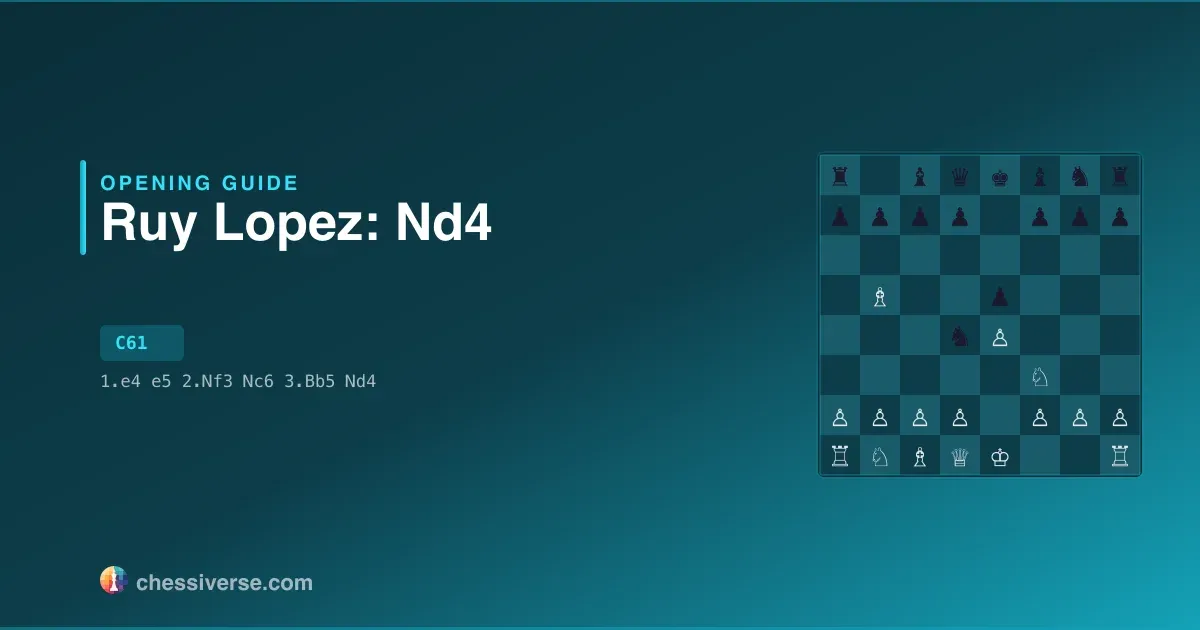
1.e4 e5 2.Nf3 Nc6 3.Bb5 Nd4 opens the Ruy Lopez: Bird Variation, ECO C61. Bird's Defense answers the Spanish by giving up the e5-pawn before White can even threaten it. Black trades knights, plants a pawn on d4, and dares White to figure out what to do about it.
Strategic Overview
3...Nd4 is the chess equivalent of a shoulder check. Black voluntarily abandons the defence of e5, swaps off White's knight, and accepts doubled pawns in return for an annoying pawn wedge on d4. After the near-automatic 4.Nxd4 exd4, the d4-pawn becomes a permanent feature of the position. It cramps White's natural queenside development (no easy c3 or Nc3 setups) and gives Black extra space on the queenside. The cost is real: Black ends up with doubled c-pawns and a slight lag in development, plus the bishop pair is in question. White usually castles short, plays d3 to keep the centre closed, and looks to undermine the d4-pawn with a later c3. The whole opening is a structural bet — Black says the d4-pawn is more annoying than the doubled pawns are weak, and White says the opposite. At club level Bird's scores reasonably because the structures are unbalanced from move three and White rarely gets to play the smooth manoeuvring Spanish they signed up for. The alternative 4.Bc4 sidesteps the trade but tends to feel more like an Italian than a Spanish.
Key Ideas
A few ideas come up again and again in this opening:
- The d4 pawn cramps White's queenside — After the knight trade, the d4-pawn blocks the natural c3/Nc3/d4 build-up. White's queenside pieces have to find awkward routes, which gives Black time to finish development and equalise.
- Black accepts doubled pawns for activity — The doubled c-pawns are the structural price Black pays. In return Black gets space, half-open files, and a position that doesn't follow standard Spanish patterns, which is usually worth more than the structural concession in practical games.
- 4.Bc4 dodges the trade entirely — The bishop redeploys to a useful diagonal and the position drifts toward Italian territory. Black usually initiates the knight trade with 4...Nxf3 5.Qxf3 and gets a comfortable game out of the opening.
- White wants to play d3 and castle fast — Trying to break the centre open immediately favours Black because of the d4-wedge. White's plan is the slow burn: castle, play d3, complete development, then prepare c3 to challenge the pawn under better circumstances.
History and Notable Players
It arises from the Ruy Lopez. On the White side, Efim Geller (6 games), Garry Kasparov (5 games), Szymon Winawer (5 games) top the database. Notable Black exponents: Jiri Jirka (96 games), Marat Burakovsky (26 games), Henry Edward Bird (24 games).
Performance Across Rating Levels
The picture changes a lot as you climb the rating ladder. The 1200 bracket has 1,406,169 games (0.21% of all games at that level); White wins 50.1%, Black 46.3%, 3.6% are drawn. Move up to 1800 Elo and the share shifts to 0.10%, with White winning 52% versus Black's 43.6%. Among 2500-rated players the line appears in 0.02% of games and draws spike to 9.4%, indicating tight preparation. Positions also become less sharp as level rises (sharpness 0.96 → 0.91).
Time Control Patterns
The Ruy Lopez: Bird Variation skews toward rapid chess. In bullet, it appears in 0.05% of games (1,242,994); White wins 49.1%. Blitz shows 0.12% adoption across 4,468,626 games, White scoring 50.4%. In rapid, the share rises to 0.21% — 2,275,118 games, White 51.3%. White's score swings 2.2pp across formats, so time control isn't just a stylistic choice here — it shifts the actual results.
Move Diversity and Theory Depth
Move choice is far from uniform in the Ruy Lopez: Bird Variation. At 1200 Elo (1,406,169 games), the top reply is Nxd4, played 78.3% of the time. One other move takes at least 5% of games, and the top three moves account for 89.6% of games. Entropy: 1.37. By 2500 (2,111 games), Nxd4 dominates at 86.3% of replies; one other move reaches 5% and the top three moves account for 99% of games. Entropy drops to 0.73. The narrowing is significant — strong players consolidate around a small set of best moves, while amateurs scatter across many plausible-looking options.
Historical Trends
Year-over-year data tells you whether this opening is a contemporary fixture or a fading one. Adoption peaked in 2016 at 0.20% (122,330 games). By 2025 it sits at 0.12%, 40% below the peak and 34% under its 2013 level, leaving the line in decline.
Common Mistakes
- Drifting away from main theory — At 400 Elo, the three most-played moves cover 80.9% of games, against 97.6% at 2000. The most popular deviation is Nxe5 (played 12% of the time at 400, much less so up top). It looks fine but quietly hands the better-prepared side an edge.
- Neglecting development — Extra pawn moves in the opening are tempting, especially when you "know the moves". Developing a piece each turn is the simple correction.
- Playing without a plan — Each Ruy Lopez: Bird Variation middlegame demands a specific approach. Decide whether the position calls for attack, manoeuvre, or simplification before reaching for a move.
Practice on Chessiverse
Ready to try the Ruy Lopez: Bird Variation against a bot? Pick an opponent at your level and play a game.