



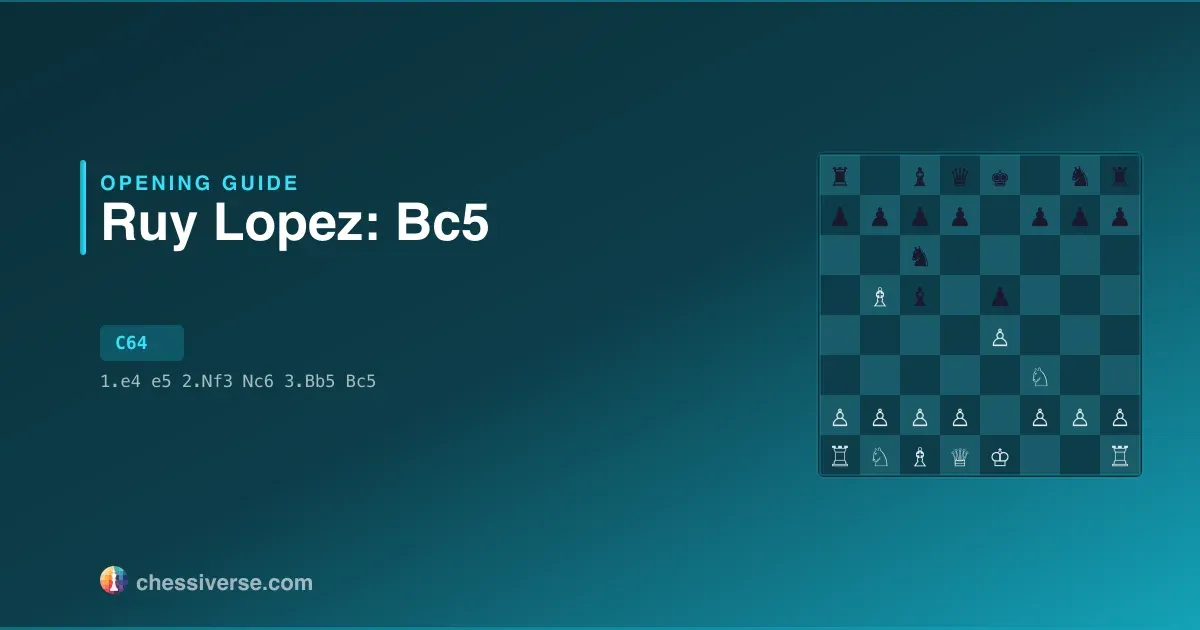
1.e4 e5 2.Nf3 Nc6 3.Bb5 Bc5 opens the Ruy Lopez: Classical Variation, ECO C64. The Classical Defense is the move every beginner wants to play in the Spanish — bishop out, active square, no fuss. It still works at amateur level, but masters know the c3-d4 hammer is coming and steer clear.
Strategic Overview
3...Bc5 is one of the oldest replies to the Spanish, and on the surface it looks great: Black develops to the most aggressive available square, defends nothing, threatens nothing, and gets ready to castle. The problem is the long-term picture. The bishop on c5 is a target. White's natural plan of c3 followed by d4 doesn't just gain centre — it kicks the bishop and asks Black to make a concrete decision about where it goes. Combined with the latent pressure on e5 via Bxc6 and Nxe5, the Classical leaves Black walking a structural tightrope. At club level Black can absolutely make it work because the positions are simple and the plans are intuitive. At master level it's a sideline because White's typical Spanish toolkit (c3, d4, the manoeuvring game) hits this set-up especially well. The sharp 4.c3 is the critical try and usually leads to a small but stable edge for White, while 4.O-O is the calmer move that keeps options open. 4.Nxe5!? is a cheeky fork-trick attempt that Black can navigate if they know the moves.
Key Ideas
A few ideas come up again and again in this opening:
- The bishop on c5 is a future target — c3 and d4 by White isn't just a central plan — it's a direct attack on the bishop. Black has to be ready to retreat or trade pieces, and the loss of tempo is what keeps this defence as a sideline.
- 4.c3 is the principled punisher — White goes straight for the central build-up. The threat of d4 with tempo forces Black to either accept a slightly cramped position or get adventurous with the gambit-style 4...f5, which is fun but dubious.
- 4.O-O leaves White with a pin to live with — Castling first is the patient option. White is safe and ready to defend e4 with the rook, but the bishop on c5 still eyes f2, so White's rook on f1 has chaperone duty for a while.
- The fork trick 4.Nxe5 is sketchy — White goes for the centre fork pattern that works in some Italian lines, but here the bishop on c5 changes the tactics. Black can navigate it safely if they know the sequence, otherwise it's a free pawn for White.
History and Notable Players
It arises from the Ruy Lopez. On the White side, Aleksandar Matanovic (10 games), Emanuel Lasker (10 games), Wolfgang Unzicker (9 games) top the database. Notable Black exponents: Evgenija Ovod (46 games), Jonny Hector (39 games), Marjan Crepan (35 games).
Performance Across Rating Levels
How well the Ruy Lopez: Classical Variation works depends on what level you're playing at. At 1200 Elo, the opening shows up in 0.32% of games (2,190,186 samples). White scores 49.4%, Black 46.8%, draws 3.8%. At 1800 the opening surfaces in 0.31% of games; White wins 50.5%, Black 45.2%, draws 4.3%. At the top end (2500+ Elo), popularity is 0.08% with 9.9% draws — a clear sign of how much theory rules the line at master level. White's edge erodes by 3.4pp from 1200 to 2500 Elo, suggesting Black's counterplay is easier to find with experience.
Time Control Patterns
The Ruy Lopez: Classical Variation skews toward rapid chess. In bullet, it appears in 0.18% of games (4,810,576); White wins 49.9%. Blitz shows 0.29% adoption across 10,349,481 games, White scoring 49.8%. In rapid, the share rises to 0.32% — 3,545,812 games, White 50.1%.
Move Diversity and Theory Depth
Move choice is far from uniform in the Ruy Lopez: Classical Variation. At 1200 Elo (2,190,186 games), the top reply is Bxc6, played 40.8% of the time. Four other moves each take at least 5% of games, and the top three moves account for 81.2% of games. Entropy: 2.26. By 2500 (10,952 games), O-O takes over as the top reply at 49.4%; only one other move still reaches 5% and the top three moves account for 93.2% of games. Entropy drops to 1.60. The narrowing is significant — strong players consolidate around a small set of best moves, while amateurs scatter across many plausible-looking options.
Historical Trends
Year-over-year data tells you whether this opening is a contemporary fixture or a fading one. Adoption peaked in 2023 at 0.31% (2,454,877 games). By 2025 it sits at 0.27%, 12% below the peak and roughly back to its 2013 level, leaving the line flat over the full period.
Common Mistakes
- Drifting away from main theory — At 400 Elo, the three most-played moves cover 79.2% of games, against 90.8% at 2000. The most popular deviation is Nc3 (played 8.6% of the time at 400, much less so up top). It looks fine but quietly hands the better-prepared side an edge.
- Neglecting development — Extra pawn moves in the opening are tempting, especially when you "know the moves". Developing a piece each turn is the simple correction.
- Playing without a plan — Each Ruy Lopez: Classical Variation middlegame demands a specific approach. Decide whether the position calls for attack, manoeuvre, or simplification before reaching for a move.
Practice on Chessiverse
Ready to try the Ruy Lopez: Classical Variation against a bot? Pick an opponent at your level and play a game.