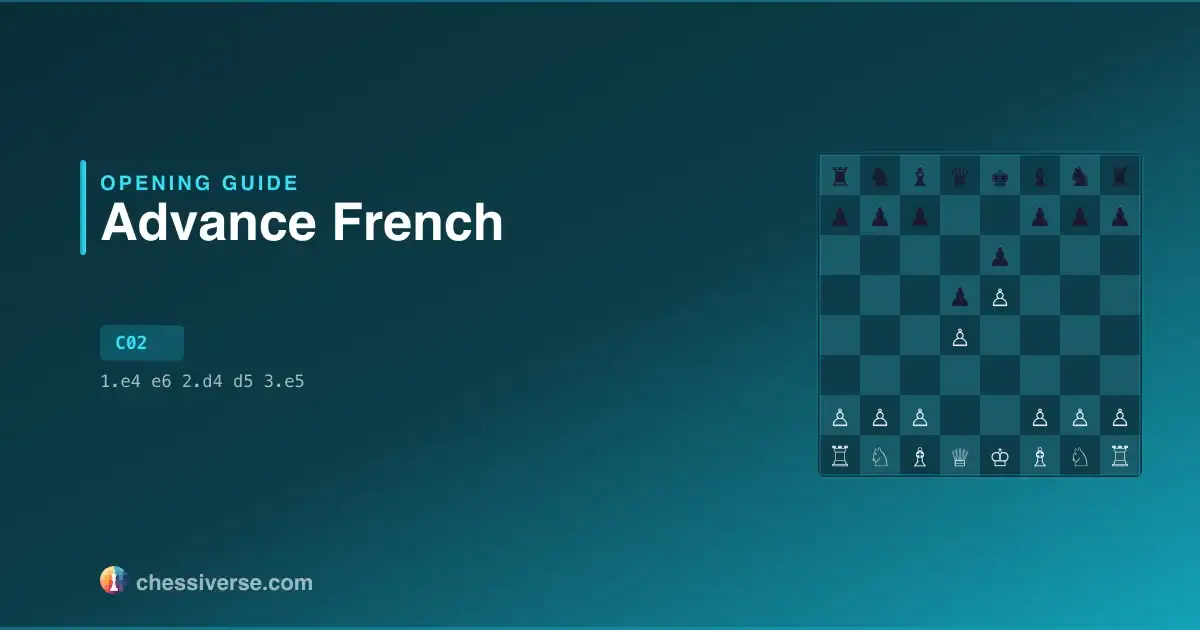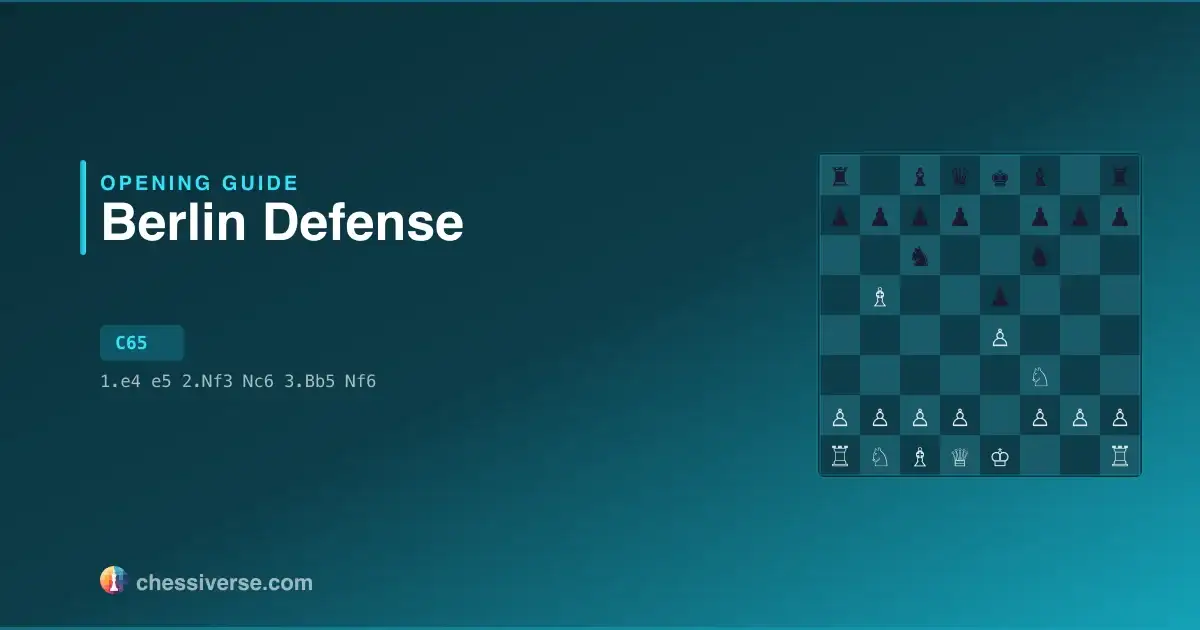




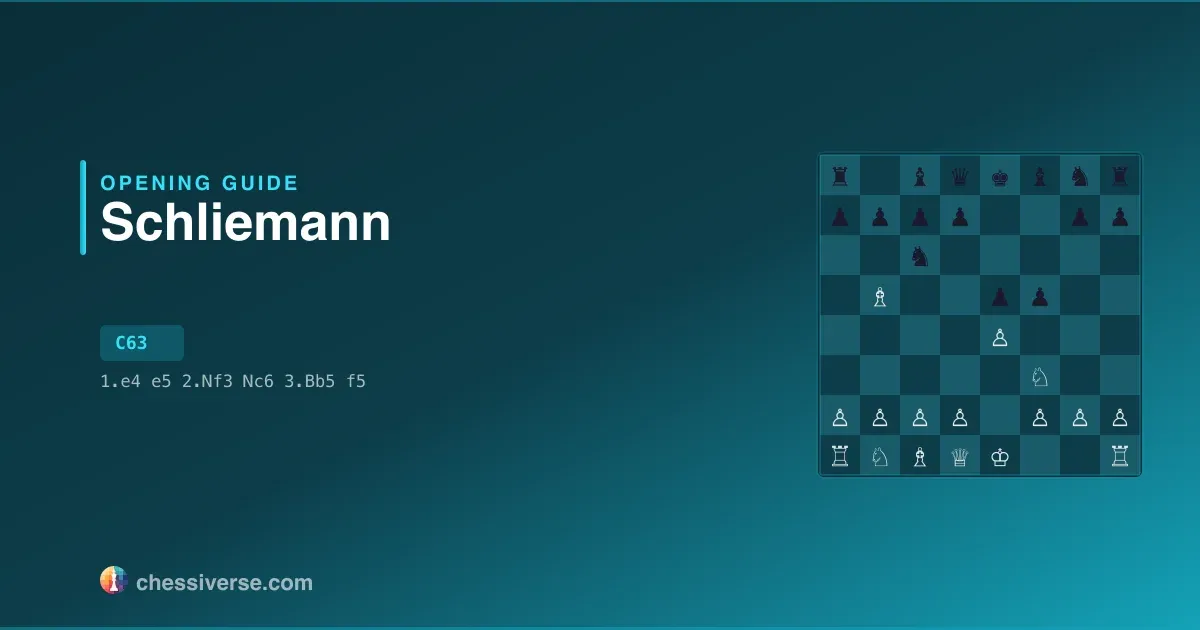
The Ruy Lopez: Schliemann Defense arises after 1.e4 e5 2.Nf3 Nc6 3.Bb5 f5 and falls under ECO code C63. The bishop move to b5 characterizes the Ruy Lopez (or Spanish Game), creating an indirect threat against the e5 pawn by targeting its defender on c6. Although the pawn cannot be won immediately thanks to a well-known tactical resource, White's aim is rapid development — castling is already possible — and central control, with plans to eventually build a pawn majority via c3 and d4. Black most commonly responds by developing the knight to f6, either at once (3...Nf6) or after first challenging the bishop with 3...a6, typically followed by 4...Nf6. That said, Black has numerous third- and fourth-move alternatives available. The Morphy Defense, 3...a6, compels White to choose between capturing the knight and retreating the bishop. The Exchange Variation (4. Bxc6) is the oldest option, though it does not actually win the e5 pawn since 4...dxc6 5. Nxe5? is refuted by 5...Qd4!, recovering the material. More popular is 4. Ba4, maintaining the bishop pair and sustained pressure on Black's knight. With 119.1 million Lichess games across all rating levels, it is one of the most popular openings.
- Black counterattacks e4 with the f-pawn at once, often giving up a pawn or two for rapid, aggressive piece play against the Ruy Lopez.
- The critical 4.Nc3 leads to razor-sharp, theory-heavy positions, while the calmer 4.d3 has overtaken it in popularity in recent years.
- Black accepts a loosened kingside and banks on active pieces; White is best served by patient play rather than immediate tactics.
History and Notable Players
It arises from the Open Games (1...e5). Among the most prolific practitioners on the White side are Viswanathan Anand (437 games), Alexei Shirov (303 games), Vlastimil Jansa (302 games). On the Black side, notable exponents include Levon Aronian (356 games), Ivan Sokolov (340 games), Svetozar Gligoric (330 games).
Carl Jaenisch, the Finnish-Russian theoretician, published analysis of 3...f5 in Le Palamede in December 1847. In the 1970s Jozef Boey used it in ICCF Correspondence World Championship finals, and in the modern era Teimour Radjabov has been the only top player to employ it regularly.
Named after: Adolph Schliemann (1817-1872), a German lawyer, though Carl Jaenisch actually pioneered the line, so it is also known as the Jaenisch Gambit.
Notable players: Jozef Boey, Teimour Radjabov
The English name is a historical mix-up: in the 1860s Schliemann was really promoting another gambit, 3...Bc5 4.c3 f5 in the Cordel Defence, and in Russian and German the opening is named after Carl Jaenisch instead.
Statistics
Based on 2.2 million Lichess games across all rating levels:
- White wins: 45.4%
- Black wins: 50%
- Draws: 4.5%
Interestingly, Black scores well in this opening, suggesting it offers strong counterplay.
Practice on Chessiverse
The best way to learn the Ruy Lopez: Schliemann Defense is through practice. On Chessiverse, you can play chess against computer opponents that specialize in this opening. Our AI bots range from beginner to grandmaster level, each with unique playing styles — from aggressive attackers to solid defenders. Choose a bot that matches your rating and work your way up as you master the opening's key ideas.
Performance Across Rating Levels
How well the Ruy Lopez: Schliemann Defense works depends on what level you're playing at. At 1200 Elo, the opening shows up in 0.03% of games (176,214 samples). White scores 48.9%, Black 48%, draws 3.1%. By 1800, popularity is 0.06% and White's score is 44.3% to Black's 51.3%. At 2500, 0.13% of games go into this opening; draws sit at 8.9% — the line is well-mapped at this level.
Time Control Patterns
The Ruy Lopez: Schliemann Defense skews toward rapid chess. In bullet, it appears in 1.13% of games (29,959,393); White wins 50.9%. Blitz shows 2.37% adoption across 85,090,833 games, White scoring 51.1%. In rapid, the share rises to 3.07% — 33,973,973 games, White 51.7%.
Move Diversity and Theory Depth
What players actually play after the opening moves depends heavily on rating. At 1200 Elo (21,098,232 games), the top reply is Nf6, played 23.3% of the time. Five other moves each take at least 5% of games, and the top three moves account for 65% of games. Entropy: 2.91. By 2500 (371,695 games), a6 takes over as the top reply at 64.8%; only one other move still reaches 5% and the top three moves account for 89.7% of games. Entropy drops to 1.65. The narrowing is significant — strong players consolidate around a small set of best moves, while amateurs scatter across many plausible-looking options.
Historical Trends
Tracking the Ruy Lopez: Schliemann Defense year over year shows a clear story. Adoption peaked in 2017 at 3.10% (3,539,434 games). By 2025 it sits at 2.20%, 29% below the peak and 21% under its 2013 level, leaving the line in decline.