



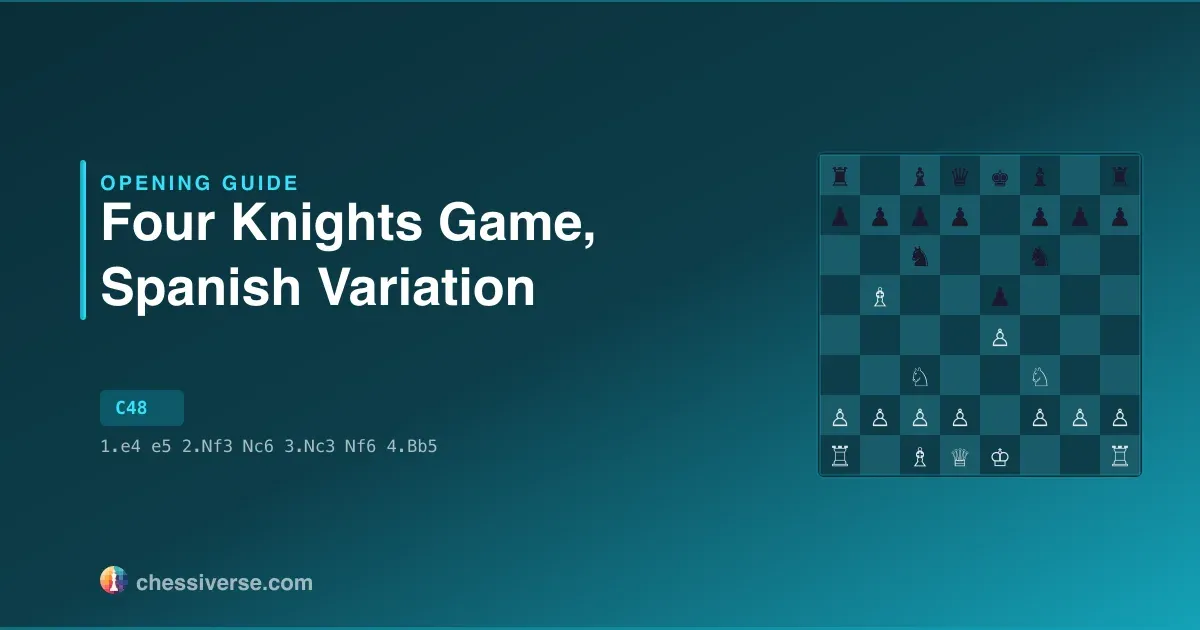
The Four Knights Game, Spanish Variation begins with 1.e4 e5 2.Nf3 Nc6 3.Nc3 Nf6 4.Bb5 (ECO C48). White pins the c6 knight, treats the position like a Ruy Lopez with a useful c3 knight already developed, and dares Black to break the symmetry.
Strategic Overview
The Spanish Four Knights is a clean blend of Ruy Lopez and Four Knights ideas. White develops the bishop with Bb5, pins the c6 knight, and immediately puts the question to Black: do you want to defend e5 with conventional moves and accept a drawish symmetric position, or do you want to break the pattern with active play? The position is famously even but not lifeless. The natural-looking pawn grab attempt 4...a6 5.Bxc6 dxc6 6.Nxe5 needs care from Black, because the standard Spanish trick 6...Qd5 forks e4 and a knight, but here White's c3 knight defends e4 and the fork collects nothing. The saving resource is 6...Nxe4!, sacrificing the knight for the pawn so that 7.Nxe4 Qd5 forks the two remaining knights and recovers the material. Modern Black usually plays one of two principled lines: 4...Bc5, the Classical reply, developing actively and pressing f2, or 4...Bb4, the Double Spanish, the current main line with symmetric pinning that produces dynamic but balanced positions. White's best practical chance for an edge usually involves quiet build-up: castling, finding the right moment to release the c6 pin, and slowly outplaying Black in a known structure rather than trying to refute symmetric defence with sharp tactics.
Key Ideas
A few ideas come up again and again in this opening:
- Spanish bishop with extra development — Bb5 brings the bishop to its best square with the c3 knight already out. White gets the Ruy Lopez bishop without the slow theoretical detours of the regular Spanish.
- ...a6 Bxc6 Nxe5 has a tactical save — The obvious pawn grab fails to 6...Nxe4, sacrificing a knight to fork on d5 next move. Black always has this resource because the c3 knight no longer defends both targets.
- 4...Bc5 is the classical, active reply — Developing the bishop aggressively and pressing f2 keeps Black's pieces active. Often White answers with O-O or the centre fork trick Nxe5 followed by d4.
- 4...Bb4 is the modern main line — The Double Spanish keeps the position symmetric with pins on both sides. It is the most respected reply at top level and tends toward balanced but living middlegames.
- Drawish reputation hides real play — Although the Spanish Four Knights has an even theoretical assessment, the middlegames are full of small imbalances. Patient build-up matters more than tactical fireworks.
History and Notable Players
It arises from the Four Knights Game. Among the most prolific White practitioners are Geza Maroczy (54 games), Dawid Markelowicz Janowski (44 games), Daniel H Campora (40 games). Black-side regulars include Frank James Marshall (44 games), Akiba Rubinstein (39 games), Dawid Markelowicz Janowski (29 games).
Performance Across Rating Levels
How well the Four Knights Game, Spanish Variation works depends on what level you're playing at. At 1200 Elo, the opening shows up in 0.54% of games (3,649,663 samples). White scores 50.3%, Black 45%, draws 4.7%. By 1800, popularity is 0.18% and White's score is 50.4% to Black's 44.2%. At the top end (2500+ Elo), popularity is 0.29% with 11% draws — a clear sign of how much theory rules the line at master level. Positions also become less sharp as level rises (sharpness 0.95 → 0.89).
Time Control Patterns
Time control matters here: rapid players reach for this opening more than others. In bullet, it appears in 0.20% of games (5,231,575); White wins 50.9%. Blitz shows 0.30% adoption across 10,889,300 games, White scoring 50.3%. In rapid, the share rises to 0.48% — 5,257,365 games, White 49.5%.
Move Diversity and Theory Depth
What players actually play after the opening moves depends heavily on rating. At 1200 Elo (3,649,663 games), the top reply is Bc5, played 23.8% of the time. Four other moves each take at least 5% of games, and the top three moves account for 66.3% of games. Entropy: 2.73. By 2500 (40,216 games), Nd4 takes over as the top reply at 35%; only three other moves still reach 5% and the top three moves account for 82.1% of games. Entropy drops to 2.17. The narrowing is significant — strong players consolidate around a small set of best moves, while amateurs scatter across many plausible-looking options.
Historical Trends
Long-term, the trajectory of this opening is informative. Adoption peaked in 2020 at 0.38% (2,206,769 games). By 2025 it sits at 0.32%, 16% below the peak but still 26% above its 2013 level, so the line is up over the full period despite easing from the high.
Main Lines and Variations
The main branches off 1.e4 e5 2.Nf3 Nc6 3.Nc3 Nf6 4.Bb5 include:
Each branch leads to a different middlegame character — the resulting pawn structure decides what kind of game you get.
Common Mistakes
- Neglecting development — It can feel productive to make extra pawn moves early, but falling behind in piece development is what loses most amateur games — especially in open positions where active pieces find squares fast.
- Playing without a plan — Each Four Knights Game, Spanish Variation middlegame demands a specific approach. Decide whether the position calls for attack, manoeuvre, or simplification before reaching for a move.
Practice on Chessiverse
Ready to try the Four Knights Game, Spanish Variation against a bot? Pick an opponent at your level and play a game.