



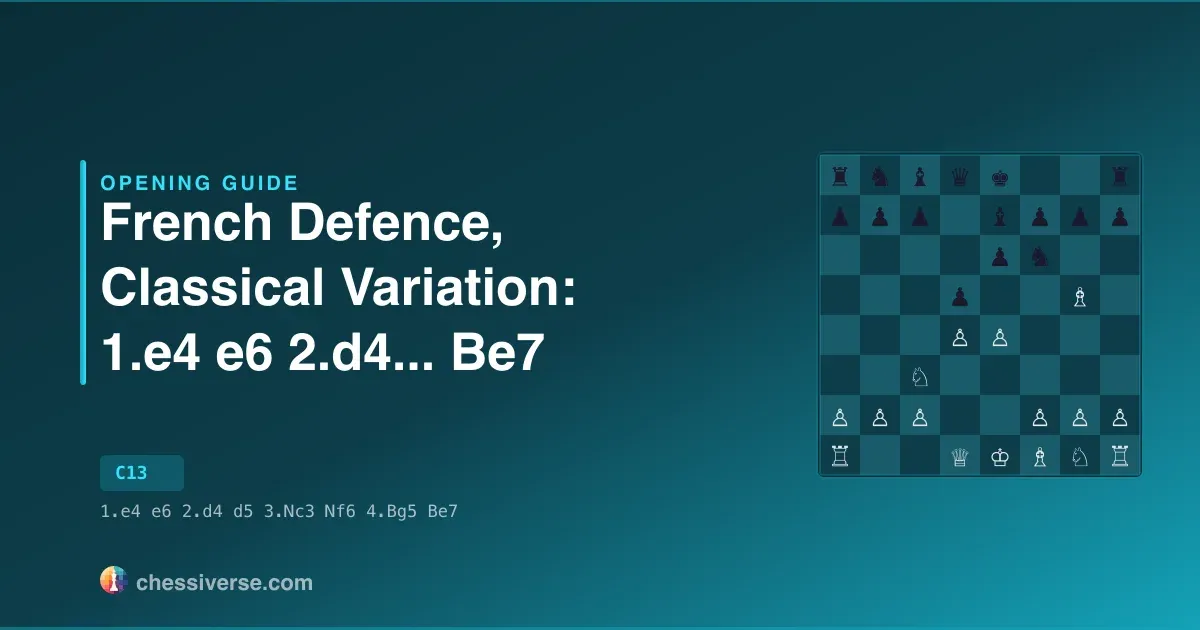
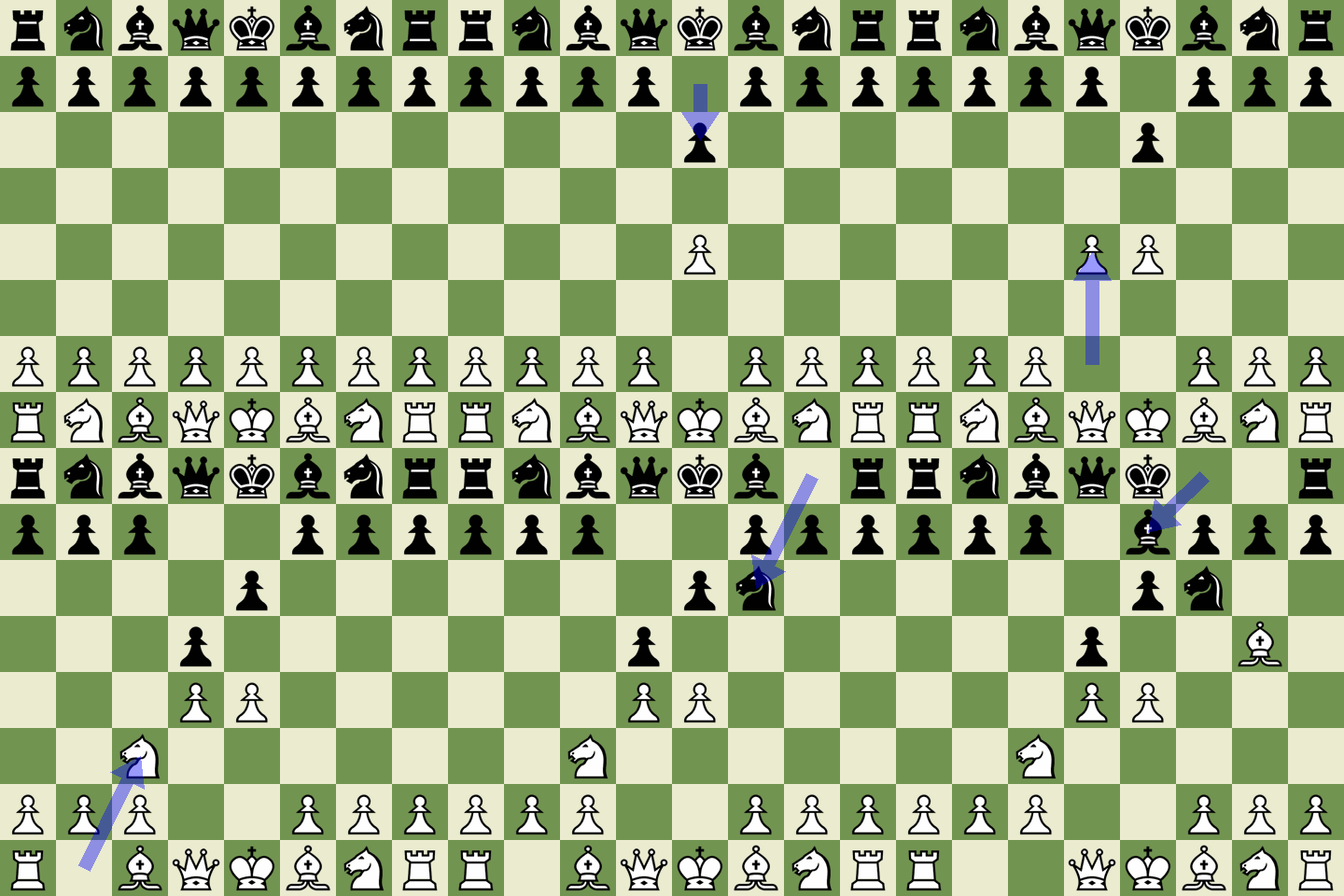
The French Defense: Classical Variation, Normal Variation begins with 1.e4 e6 2.d4 d5 3.Nc3 Nf6 4.Bg5 Be7 (ECO C13). Black quietly breaks the pin, suddenly attacks e4 in earnest, and forces White to decide between advancing, exchanging, or stepping aside.
Strategic Overview
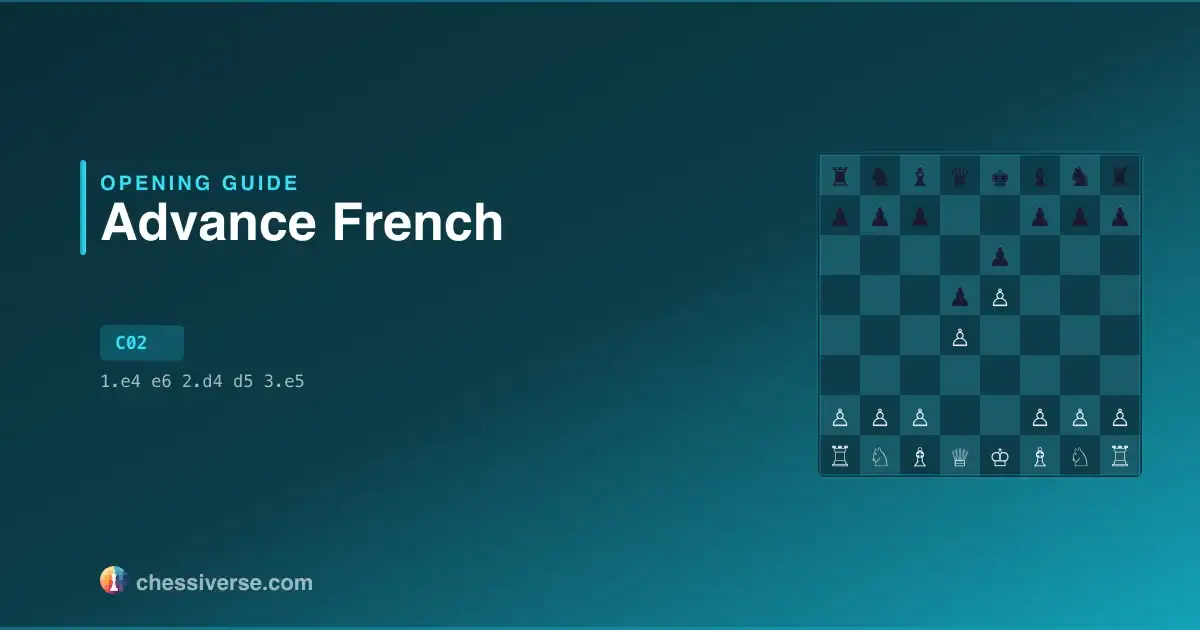
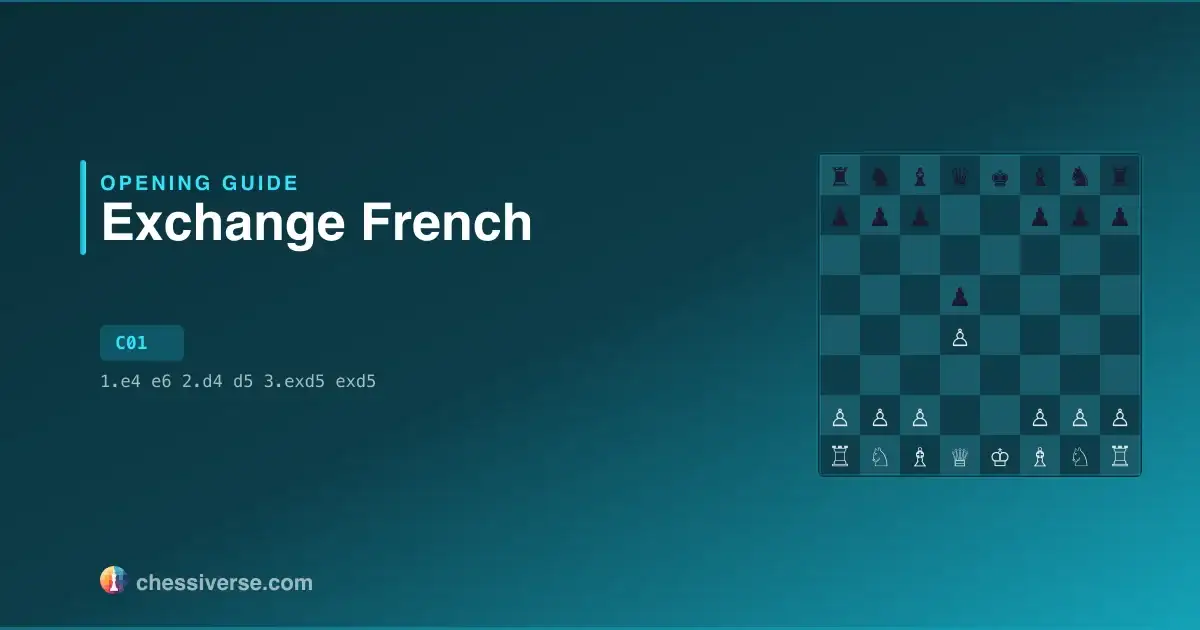
4...Be7 is the calm, structural answer to the Classical French. By blocking the pin, Black removes the tactical excuse for 4.Bg5 and threatens to win the e4 pawn outright, since the g5 bishop is now hanging. White has three serious replies, each leading to a different game. 5.e5 is the principled move, gaining space and kicking the knight to d7. After ...Nfd7 we get a classical pawn chain with White committed to a kingside space squeeze and Black aiming for ...c5 against the chain. 5.Bxf6 unloads the dark-squared bishop and concedes the pair, but tries to make Black recapture awkwardly with ...Bxf6 and live with a slightly stiffer position. 5.exd5 dissolves into Exchange French waters where the symmetry should suit Black perfectly fine. Strategically, Be7 is the principled French move: solid, structurally sound, and willing to accept a cramped position in exchange for a clear long-term plan. The downside is that the bishop on e7 is passive and the queen's bishop on c8 is still a problem child. Anyone playing this position needs patience and a good feel for which trades simplify into a comfortable endgame versus a slow positional grind.
Key Ideas
When players succeed in this line, they usually do so by leaning on the following themes:
- Breaking the pin attacks e4 — Once the knight is no longer pinned, e4 is hanging because Bg5 itself is undefended. Any natural protective move like 5.f3 fails to ...Nxe4! winning a pawn.
- 5.e5 leads to a Classical French structure — Pushing the pawn closes the centre and forces ...Nfd7. From there it is a standard pawn-chain French where Black levers with ...c5 and ...f6.
- 5.Bxf6 trades off the dark-squared bishop — Surrendering the bishop pair early is a calm structural choice. White hopes Black's slight cramp and bad bishop will tell over the long run.
- 5.exd5 simplifies to symmetric play — Transposing into the Exchange French is the safest White option. The position is even and drawish, but not without ideas for either side.
History and Notable Players
It arises from the French Defense: Classical Variation. On the White side, Alexander Alekhine (16 games), Jonny Hector (15 games), Emanuel Lasker (15 games) top the database. Notable Black exponents: Evgeny Gleizerov (73 games), Mikhail Ulibin (47 games), Gideon Stahlberg (46 games).
Performance Across Rating Levels
The picture changes a lot as you climb the rating ladder. At 1200 Elo, the opening shows up in 0.01% of games (49,592 samples). White scores 48.6%, Black 48%, draws 3.4%. At 1800 the opening surfaces in 0.07% of games; White wins 51.1%, Black 44.4%, draws 4.5%. At 2500, 0.12% of games go into this opening; draws sit at 8.7% — the line is well-mapped at this level. Positions also become less sharp as level rises (sharpness 0.97 → 0.91).
Time Control Patterns
The French Defense: Classical Variation, Normal Variation skews toward blitz chess. In bullet, it appears in 0.03% of games (904,509); White wins 52%. Blitz shows 0.05% adoption across 1,810,361 games, White scoring 50.9%. In rapid, the share rises to 0.03% — 303,799 games, White 50.1%.
Move Diversity and Theory Depth
Move choice is far from uniform in the French Defense: Classical Variation, Normal Variation. At 1200 Elo (49,592 games), the top reply is e5, played 51.6% of the time. Three other moves each take at least 5% of games, and the top three moves account for 82.7% of games. Entropy: 2.21. By 2500 (15,844 games), e5 dominates at 89.8% of replies; only one other move still reaches 5% and the top three moves account for 99.7% of games. Entropy drops to 0.56. The narrowing is significant — strong players consolidate around a small set of best moves, while amateurs scatter across many plausible-looking options.
Historical Trends
Year-over-year data tells you whether this opening is a contemporary fixture or a fading one. Adoption peaked in 2015 at 0.06% (14,271 games). By 2025 it sits at 0.04%, 37% below the peak and 11% under its 2013 level, leaving the line in decline.
Main Lines and Variations
From the position after 1.e4 e6 2.d4 d5 3.Nc3 Nf6 4.Bg5 Be7, the recognised continuations are:
Each branch leads to a different middlegame character — the resulting pawn structure decides what kind of game you get.
Common Mistakes
- Drifting away from main theory — At 400 Elo, the three most-played moves cover 64.9% of games, against 96.7% at 2000. The most popular deviation is Bxf6 (played 18.7% of the time at 400, less so up top). It looks fine but quietly hands the better-prepared side an edge.
- Neglecting development — Extra pawn moves in the opening are tempting, especially when you "know the moves". Developing a piece each turn is the simple correction.
- Drifting into passivity — These openings are solid, but solid is not synonymous with passive. Look for the right moment to break with a central pawn advance — without it, your pieces stay cramped.
Practice on Chessiverse
Ready to try the French Defense: Classical Variation, Normal Variation against a bot? Pick an opponent at your level and play a game.