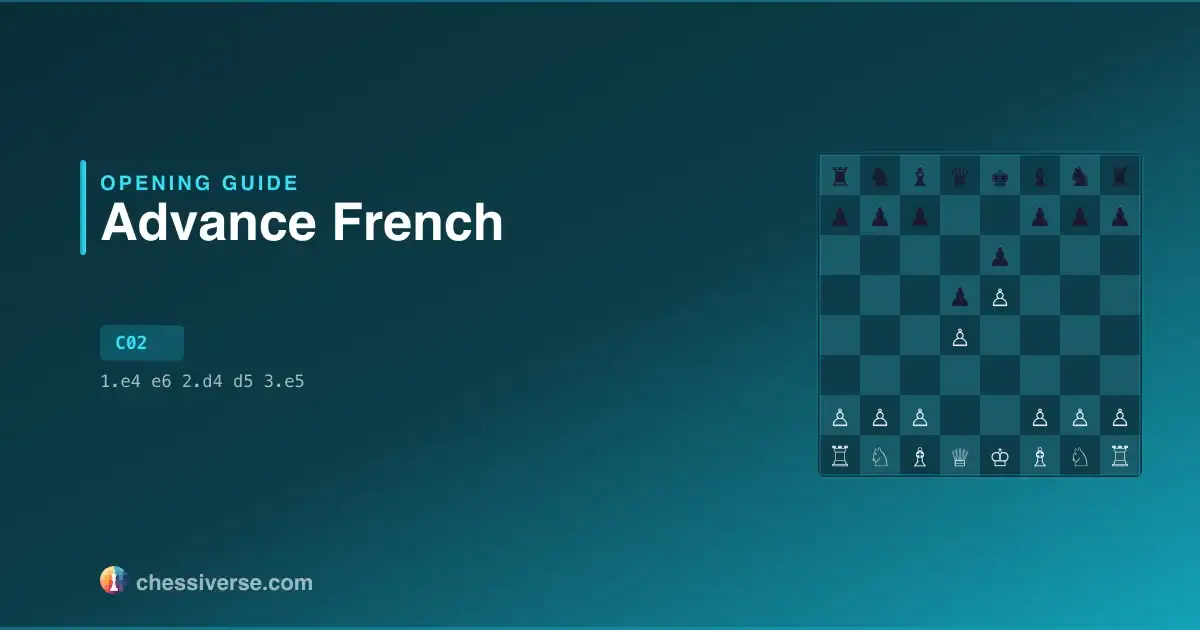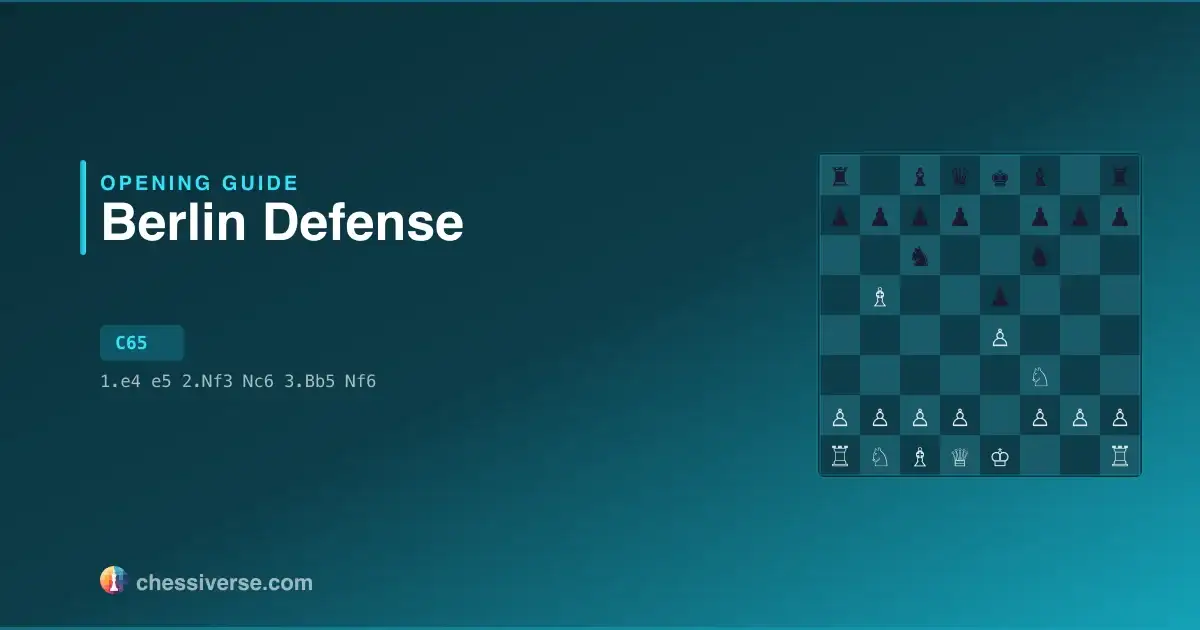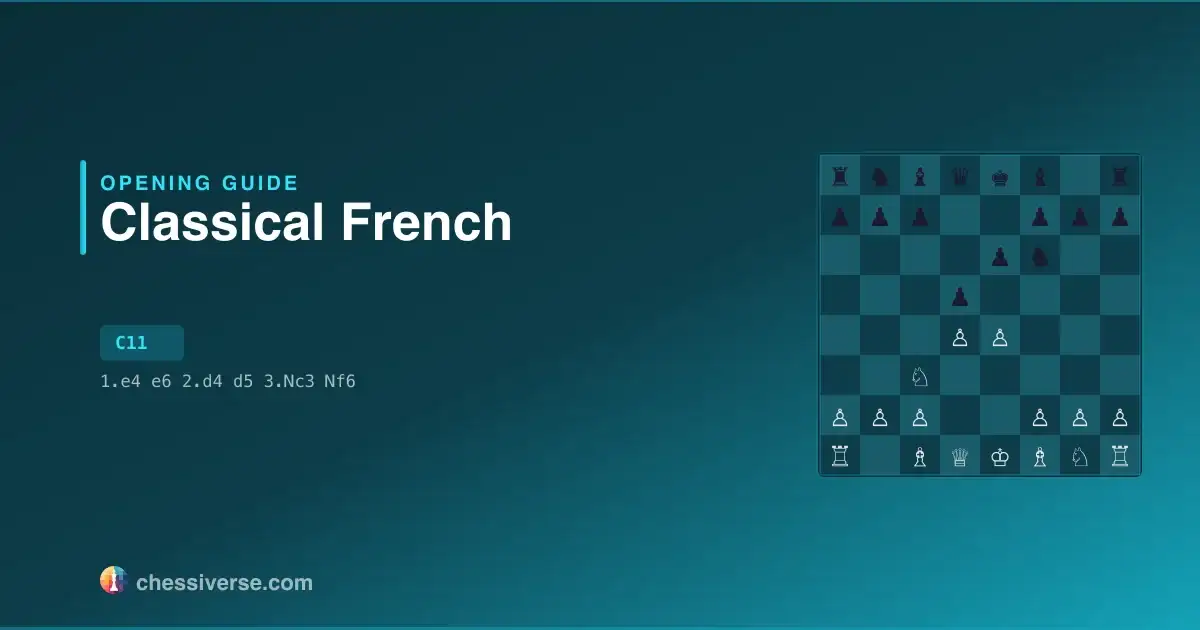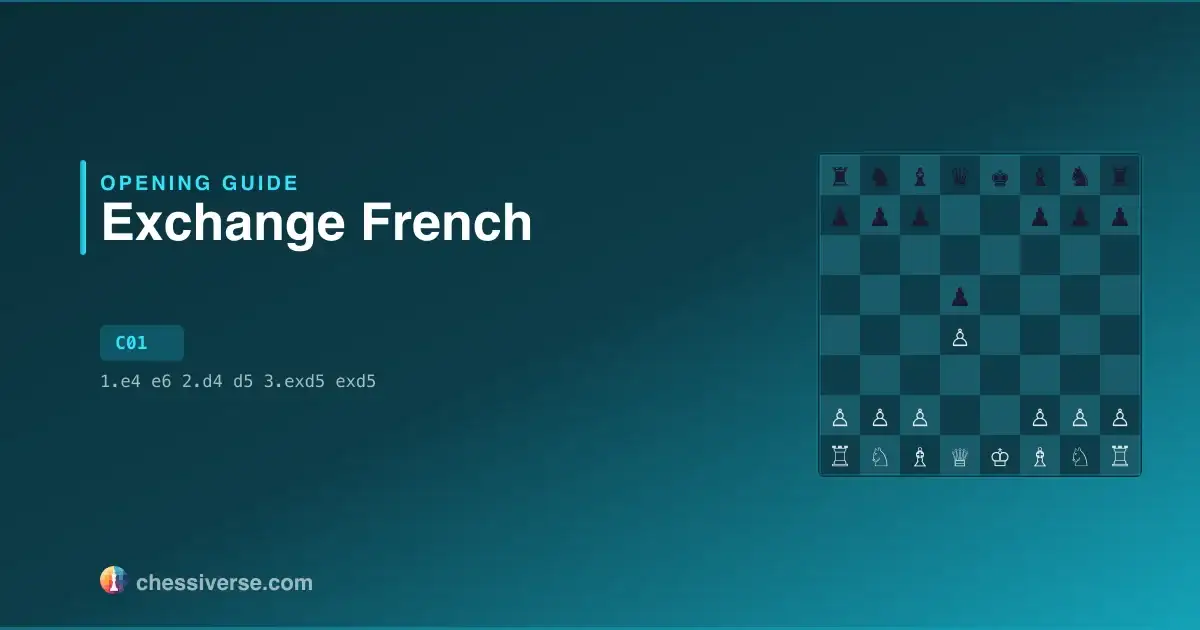




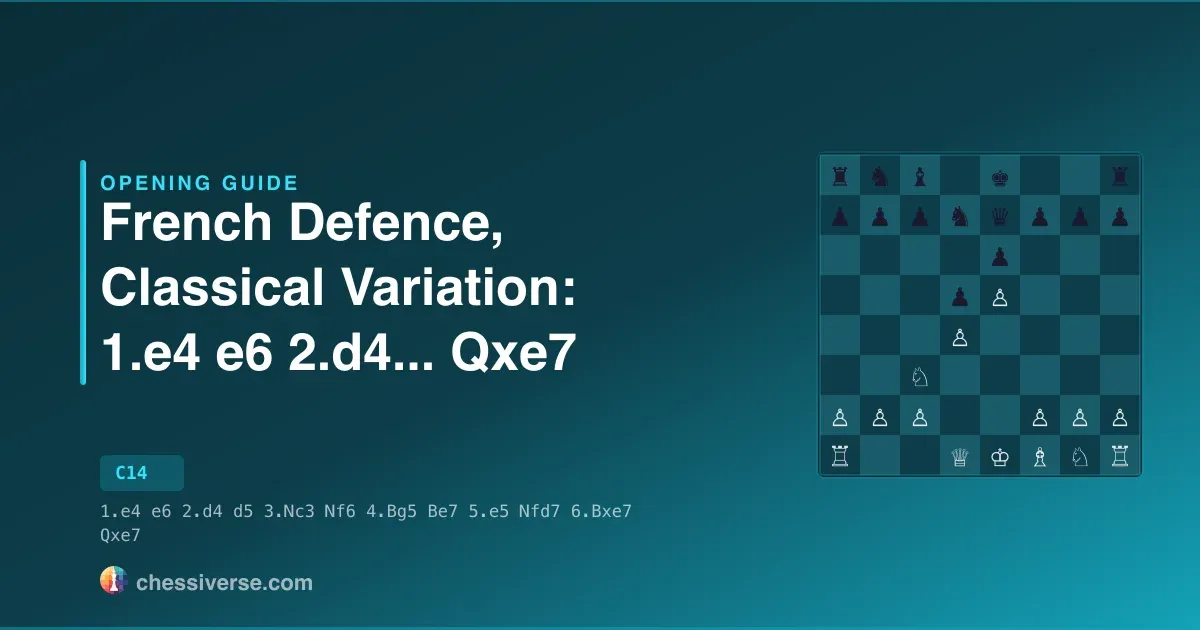
Starting from 1.e4 e6 2.d4 d5 3.Nc3 Nf6 4.Bg5 Be7 5.e5 Nfd7 6.Bxe7 Qxe7, players enter the French Defense: Classical Variation — ECO C14. The dark-squared bishops are off, the centre is fixed, and White faces a fork in the road: race for the king, prep queenside castling, or send the knight on a tour.
Strategic Overview
This is the parting of ways in the Classical French. With the bishops traded and the pawn chain set, the queen on e7 covers the dark squares, the knight is parked on d7, and Black's structural plan is clear: chip at the chain with ...c5 and ...f6 while completing development. White, on the other hand, has three serious tries that go in three different directions. 7.f4 is the Steinitz, the historical main line. White builds the kingside pawn shelter, plays Nf3, and aims at f5 in the long run. The game is positional and structural for both sides. 7.Qd2 is the Rubinstein, with explicit queenside castling in mind. Once Black castles short, you get opposite-side castling, pawn storms in both directions, and a sharp middlegame where every tempo on the wing matters. 7.Nb5 is the Alapin trick. The knight threatens c7 and forces Black to deal with it, then reroutes via a3 to c2 to reinforce d4. Black should be ready for all three setups. The unifying theme is that this is a French pawn chain endgame waiting to happen, and the player who handles the levers ...c5, ...f6, and the d4-d5 advance most accurately tends to win.
Key Ideas
A few ideas come up again and again in this opening:
- 7.f4 Steinitz is the classical main line — White builds a wall of pawns on the kingside and plans Nf3, eventually pressing for f5. This is the most positional and most common treatment.
- 7.Qd2 prepares opposite-side castling — The Rubinstein setup heads for O-O-O. If Black castles short, expect pawn storms on both wings and a race to the king.
- 7.Nb5 reroutes via the rim — The Alapin knight tour to c2 looks slow but reinforces d4 and frees up the queen's bishop. Black has to spend tempi kicking the knight away.
- Queen on e7 plugs the dark squares — After the bishop trade, Black's queen does double duty: it covers the dark holes and supports the eventual ...c5 break.
- The chain decides the game — Both sides plan around the d4-e5 vs e6-d5 pawn chain. Whoever wins the lever fights with ...c5 and ...f6 against c3 and f4 controls the middlegame.
History and Notable Players
It arises from the French Defense: Classical Variation, Normal Variation. Among the most prolific White practitioners are Ildiko Madl (13 games), Lajos Steiner (12 games), Janis Klovans (12 games). Black-side regulars include Evgeny Gleizerov (41 games), Mikhail Ulibin (37 games), Gideon Stahlberg (32 games).
Performance Across Rating Levels
The picture changes a lot as you climb the rating ladder. The 1200 bracket has 9,409 games (0.00% of all games at that level); White wins 48.8%, Black 47.7%, 3.5% are drawn. By 1800, popularity is 0.03% and White's score is 51.5% to Black's 43.7%. At 2500, 0.05% of games go into this opening; draws sit at 10% — the line is well-mapped at this level. Positions also become less sharp as level rises (sharpness 0.96 → 0.90).
Time Control Patterns
Look at the same opening across time controls and blitz stands out. In bullet, it appears in 0.01% of games (332,864); White wins 52.5%. Blitz shows 0.02% adoption across 678,253 games, White scoring 51.7%. In rapid, the share rises to 0.01% — 107,753 games, White 51.6%.
Move Diversity and Theory Depth
Looking at move selection shows how forcing — or not — the position really is. At 1200 Elo (9,409 games), the top reply is Nf3, played 45.7% of the time. Four other moves each take at least 5% of games, and the top three moves account for 68.9% of games. Entropy: 2.54. By 2500 (6,384 games), f4 takes over as the top reply at 70.3%; only three other moves still reach 5% and the top three moves account for 90.4% of games. Entropy drops to 1.52. That entropy collapse is the signature of a line where preparation pays off: at the top, players know the best move and play it.
Historical Trends
Year-over-year data tells you whether this opening is a contemporary fixture or a fading one. Adoption peaked in 2016 at 0.02% (14,963 games). By 2025 it sits at 0.01%, 38% below the peak and roughly back to its 2013 level, leaving the line flat over the full period.
Common Mistakes
- Drifting away from main theory — At 400 Elo, the three most-played moves cover 68% of games, against 81.5% at 2000. The most popular deviation is Bb5 (played 21.7% of the time at 400, much less so up top). It looks fine but quietly hands the better-prepared side an edge.
- Neglecting development — It can feel productive to make extra pawn moves early, but falling behind in piece development is what loses most amateur games — especially in open positions where active pieces find squares fast.
- Drifting into passivity — These openings are solid, but solid is not synonymous with passive. Look for the right moment to break with a central pawn advance — without it, your pieces stay cramped.
Practice on Chessiverse
Ready to try the French Defense: Classical Variation against a bot? Pick an opponent at your level and play a game.