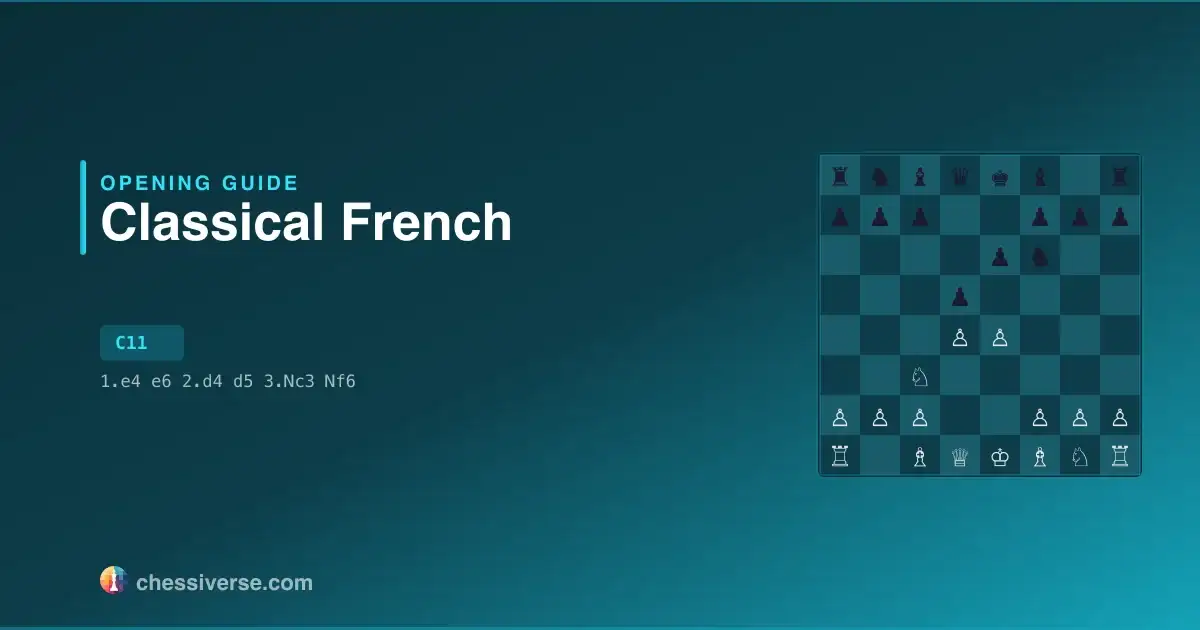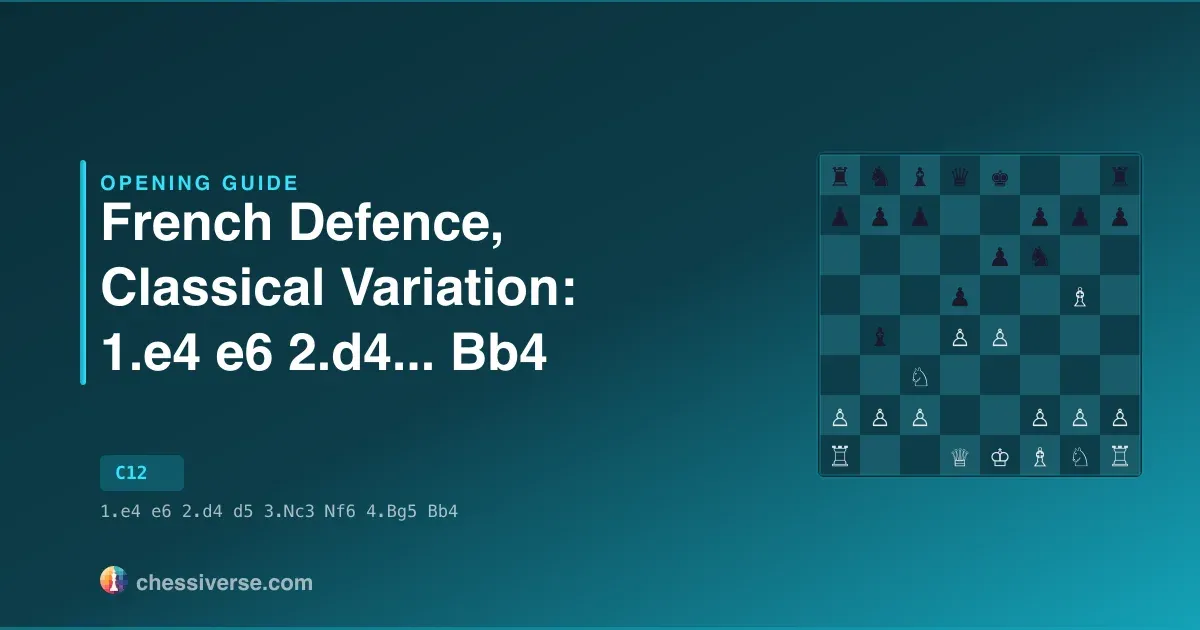
Starting from 1.e4 e6 2.d4 d5 3.Nc3 Nf6 4.Bg5 Bb4, players enter the French Defense: McCutcheon Variation — ECO C12. Black pins the knight back, copies White's idea on the other side of the board, and walks straight into one of the most theory-rich corners of the French.
Strategic Overview
The McCutcheon is what you reach for when you want to play the French but refuse to be told what to do. Instead of the polite 4...Be7 or the structural 4...dxe4, Black pins the c3 knight with the bishop, attacking the centre and asking White to make the first concession. The typical continuation features early tension on e4, an exchange on c3 that shatters White's queenside pawns, and a race between Black's queenside structure and White's central space plus bishop pair. Often White advances e4-e5 to kick the f6 knight, and the resulting positions feature locked centres, opposite-side castling, and full-on pawn storms. Black's compensation comes from doubled c-pawns for White, the bishop on the long diagonal, and dynamic piece play. The downsides are real too: Black's king can become a target if development stalls, and White's space advantage is permanent if not challenged early. Practically, this is a memorisation-heavy line. It rewards players who enjoy concrete tactical sequences and asymmetric structures rather than smooth, slow French manoeuvring.
Key Ideas
A few ideas come up again and again in this opening:
- Pin the knight, attack the centre — 4...Bb4 pins Nc3 to the king, which means the e4 pawn is suddenly under-defended. White has to address the threat before going back to a normal Classical setup.
- Bishop for knight on c3 is a structural deal — The standard trade leaves White with doubled c-pawns and the bishop pair. Black has long-term targets to attack, White has piece activity and central space.
- Opposite-side castling and pawn races — Many main lines feature White going long and Black short, or vice versa, with both sides storming pawns toward the other king. Theory is rich because the tactics are forcing.
- Black's king safety is the price of activity — While White's pawns wobble on the queenside, Black often has trouble getting castled. A slip in move order can lead to a quick mating attack.
History and Notable Players
It arises from the French Defense: Classical Variation. On the White side, Emanuel Lasker (15 games), Adam Horvath (12 games), Jonny Hector (12 games) top the database. Notable Black exponents: Igor Glek (61 games), Sergey Volkov (54 games), Martin Zumsande (24 games).
Performance Across Rating Levels
The picture changes a lot as you climb the rating ladder. Among 1200-rated players, it appears in 0.00% of games — 10,807 of them on record — with White winning 55.9% and Black 40.3%. By 1800, popularity is 0.01% and White's score is 45.6% to Black's 49.4%. At the top end (2500+ Elo), popularity is 0.09% with 9.7% draws — a clear sign of how much theory rules the line at master level. White's edge erodes by 8.6pp from 1200 to 2500 Elo, suggesting Black's counterplay is easier to find with experience.
Time Control Patterns
Time control matters here: blitz players reach for this opening more than others. In bullet, it appears in 0.01% of games (205,735); White wins 48.4%. Blitz shows 0.01% adoption across 465,993 games, White scoring 47.2%. In rapid, the share rises to 0.01% — 58,986 games, White 48.7%.
Move Diversity and Theory Depth
Looking at move selection shows how forcing — or not — the position really is. At 1200 Elo (10,807 games), the top reply is e5, played 64.2% of the time. Three other moves each take at least 5% of games, and the top three moves account for 76.2% of games. Entropy: 2.08. By 2500 (11,945 games), e5 dominates at 81.7% of replies; only two other moves still reach 5% and the top three moves account for 95.7% of games. Entropy drops to 1.03. The narrowing is significant — strong players consolidate around a small set of best moves, while amateurs scatter across many plausible-looking options.
Historical Trends
Year-over-year data tells you whether this opening is a contemporary fixture or a fading one. Adoption peaked in 2017 at 0.02% (20,849 games). By 2025 it sits at 0.01%, 52% below the peak and 29% under its 2013 level, leaving the line in decline.
Common Mistakes
- Drifting away from main theory — At 400 Elo, the three most-played moves cover 58.2% of games, against 92.7% at 2000. The most popular deviation is a3 (played 19.9% of the time at 400, much less so up top). It looks fine but quietly hands the better-prepared side an edge.
- Neglecting development — Extra pawn moves in the opening are tempting, especially when you "know the moves". Developing a piece each turn is the simple correction.
- Drifting into passivity — These openings are solid, but solid is not synonymous with passive. Look for the right moment to break with a central pawn advance — without it, your pieces stay cramped.
Practice on Chessiverse
Ready to try the French Defense: McCutcheon Variation against a bot? Pick an opponent at your level and play a game.