



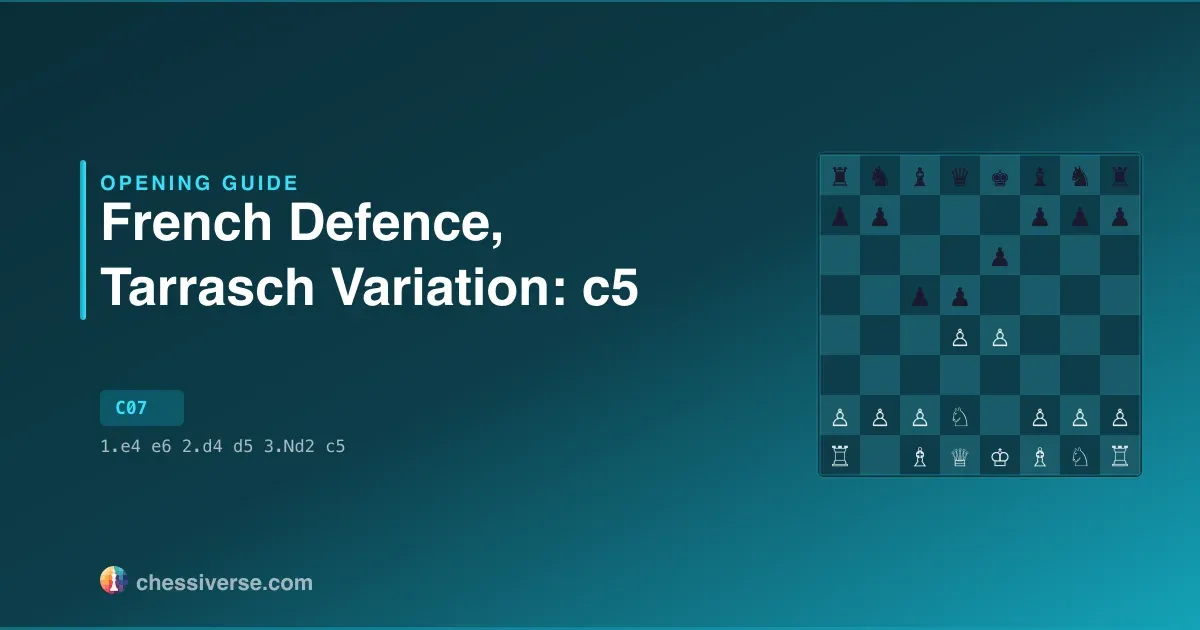
1.e4 e6 2.d4 d5 3.Nd2 c5 opens the French Defense: Tarrasch Variation, Open System (3...c5), ECO C07. Black strikes at d4 the moment White's knight commits to d2, exploiting the fact that the queen has lost sight of the d4 square and the natural c3-defence is no longer available.
Strategic Overview
3...c5 is the Open Tarrasch and the most principled answer to 3.Nd2. With the knight on d2 rather than c3, White's grip on the centre is thinner, and Black challenges d4 before White can consolidate. The main line 4.exd5 forces a structural decision. The old way is 4...exd5, which opens Black's light-squared bishop but accepts an isolated d-pawn after the inevitable trades on d4. The modern preference is 4...Qxd5, made possible because Nd2 cannot kick the queen with Nc3. White will usually win the d4 pawn back later, often with Nf3 and an early Bc4, but Black gets fast piece play and a free light-squared bishop in return. 4.Ngf3 is a major alternative aiming to recapture on d4 with the knight, but the lines tend to transpose. The pet attempt 4.c3 is playable but lets Black grab the centre with ...dxe4, leaving White stuck with an isolated d-pawn of his own. Strategically, this is a fight about who lives with an IQP and who attacks it. Both sides need to know exactly which trades are good for them and which simplify into a slow technical loss.
Key Ideas
When players succeed in this line, they usually do so by leaning on the following themes:
- Hit d4 before White can support it — With the knight on d2, White cannot reinforce d4 with c3 cleanly. Playing ...c5 immediately is the way to keep White from settling in the centre.
- 4...Qxd5 dodges the IQP — Recapturing with the queen avoids the isolated d-pawn structure. Black exploits the fact that Nd2 cannot harass the queen with Nc3 and grabs free development time.
- 4...exd5 frees the bishop but accepts an IQP — The older capture activates Black's light-squared bishop straight away. The cost is the classic isolated queen's pawn structure with all its long-term burdens.
- 4.Ngf3 usually transposes — The Euwe-Keres move can sidestep some of the Qxd5 lines, but after sensible play the game often ends up in the same structures as 4.exd5 anyway.
- Süchting 4.c3 lets Black turn the tables — Defending d4 with the pawn allows ...dxe4, and after the smoke clears it is White who is saddled with an isolated d-pawn. Not the recommended treatment.
History and Notable Players
It arises from the French Defense: Tarrasch Variation. Among the most prolific White practitioners are Michael Adams (82 games), Vlastimil Jansa (66 games), Sergei Tiviakov (66 games). Black-side regulars include Wolfgang Uhlmann (157 games), Rafael A Vaganian (118 games), Viktor Korchnoi (102 games).
Performance Across Rating Levels
Popularity and results vary sharply by rating level. At 1200 Elo, the opening shows up in 0.01% of games (46,448 samples). White scores 49.8%, Black 47%, draws 3.2%. At 1800 the opening surfaces in 0.08% of games; White wins 50.3%, Black 44.5%, draws 5.2%. At 2500, 0.36% of games go into this opening; draws sit at 12.1% — the line is well-mapped at this level. White's edge erodes by 4.6pp from 1200 to 2500 Elo, suggesting Black's counterplay is easier to find with experience.
Time Control Patterns
Look at the same opening across time controls and blitz stands out. In bullet, it appears in 0.03% of games (812,428); White wins 48.9%. Blitz shows 0.06% adoption across 2,032,834 games, White scoring 49.3%. In rapid, the share rises to 0.04% — 408,186 games, White 50.8%.
Move Diversity and Theory Depth
What players actually play after the opening moves depends heavily on rating. At 1200 Elo (46,448 games), the top reply is c3, played 42.5% of the time. Two other moves each take at least 5% of games, and the top three moves account for 89% of games. Entropy: 2.10. By 2500 (48,834 games), exd5 takes over as the top reply at 52.4%; only one other move still reaches 5% and the top three moves account for 96.4% of games. Entropy drops to 1.39. The narrowing is significant — strong players consolidate around a small set of best moves, while amateurs scatter across many plausible-looking options.
Historical Trends
Year-over-year data tells you whether this opening is a contemporary fixture or a fading one. Adoption peaked in 2017 at 0.08% (88,436 games). By 2025 it sits at 0.05%, 38% below the peak and roughly back to its 2013 level, leaving the line flat over the full period.
Main Lines and Variations
The main branches off 1.e4 e6 2.d4 d5 3.Nd2 c5 include:
Each branch leads to a different middlegame character — the resulting pawn structure decides what kind of game you get.
Common Mistakes
- Drifting away from main theory — At 400 Elo, the three most-played moves cover 69.8% of games, against 92.9% at 2000. The most popular deviation is dxc5 (played 12.4% of the time at 400, much less so up top). It looks fine but quietly hands the better-prepared side an edge.
- Neglecting development — It can feel productive to make extra pawn moves early, but falling behind in piece development is what loses most amateur games — especially in open positions where active pieces find squares fast.
- Drifting into passivity — These openings are solid, but solid is not synonymous with passive. Look for the right moment to break with a central pawn advance — without it, your pieces stay cramped.
Practice on Chessiverse
Ready to try the French Defense: Tarrasch Variation, Open System (3...c5) against a bot? Pick an opponent at your level and play a game.