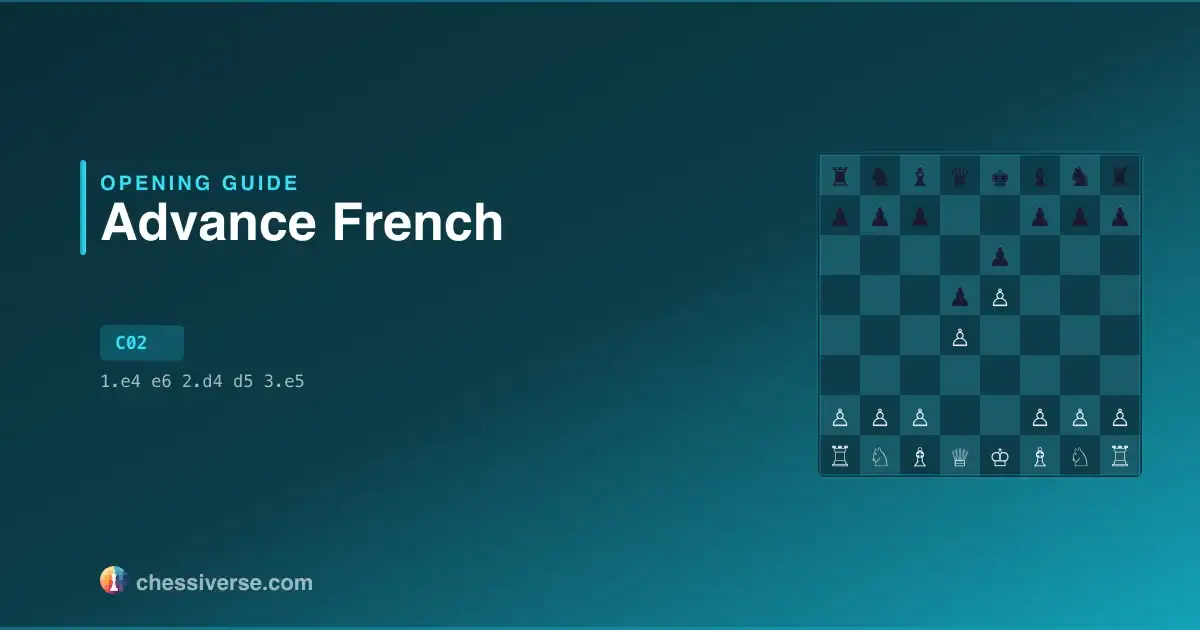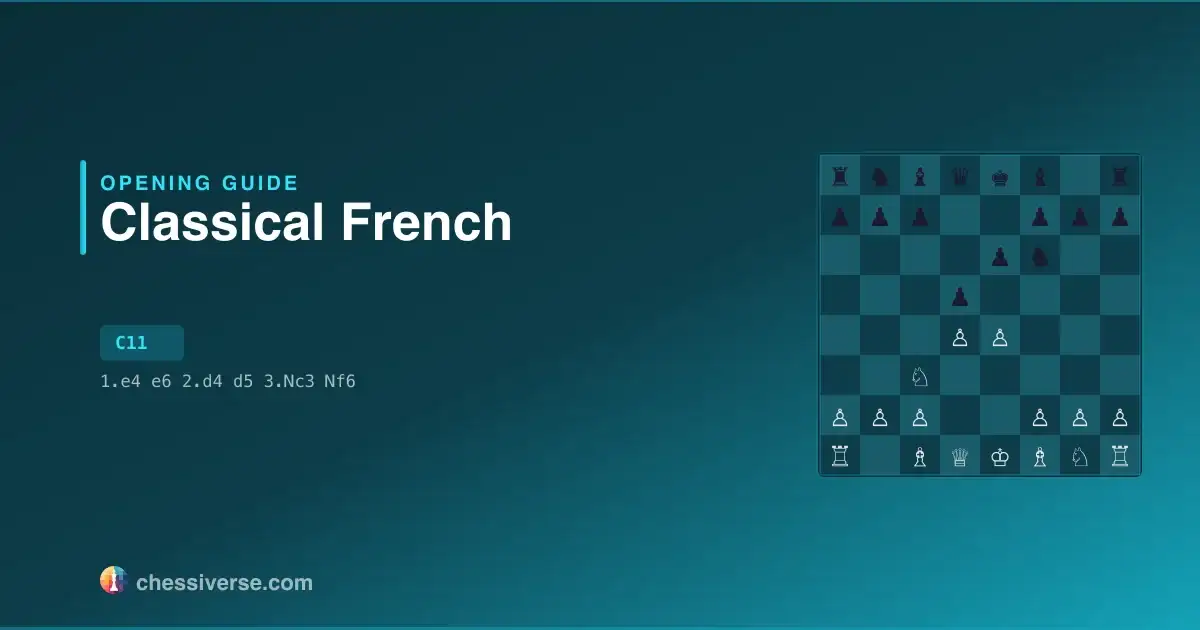




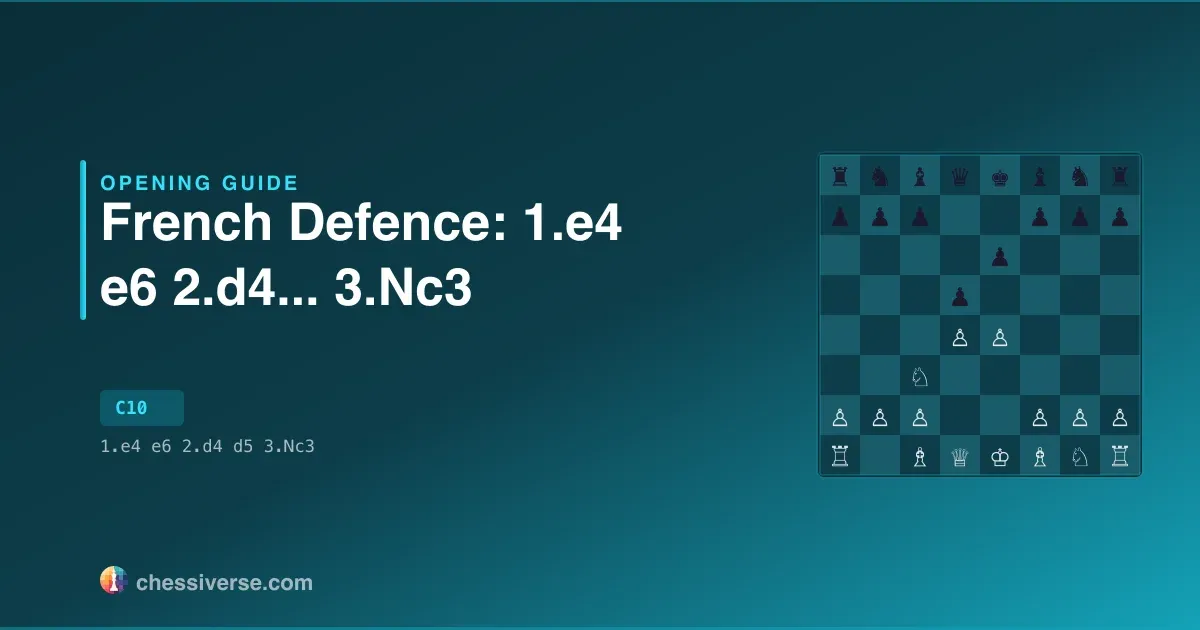
The French Defense: Paulsen Variation arises after 1.e4 e6 2.d4 d5 3.Nc3 and falls under ECO code C10. At the highest levels of play, 3. Nc3 stands as White's most frequently chosen and most demanding continuation against the French. By developing the knight here rather than to d2 (the Tarrasch Variation), White maintains open diagonals for both bishops while simultaneously defending e4 and increasing the pressure on d5. Black faces a critical decision at this juncture with three principal responses: 3...Nf6 leads to the Classical Variation, 3...Bb4 enters the Winawer Variation, and 3...dxe4 produces the Rubinstein Variation. The chief sideline is 3...Nc6, known as the Hecht-Reefschlaeger, which takes the game in a direction quite unlike typical French structures. The questionable 3...c5?! is also available, steering play toward either the Marshall Gambit of the French or a Sicilian transposition. With 24.3 million Lichess games across all rating levels, it is a well-established opening choice.
History and Notable Players
It arises from the French Defense. Among the most prolific practitioners on the White side are Jonny Hector (154 games), Robert Zelcic (129 games), Friso Nijboer (128 games). On the Black side, notable exponents include Ivan Farago (236 games), Wolfgang Uhlmann (214 games), Viktor Korchnoi (202 games).
Statistics
Based on 24.3 million Lichess games across all rating levels:
- White wins: 49.9%
- Black wins: 45.2%
- Draws: 4.9%
The statistics show a roughly balanced opening where both sides have equal chances.
Main Lines and Variations
After 1.e4 e6 2.d4 d5 3.Nc3, the main continuations include:
Each of these lines leads to distinct types of positions and requires its own understanding of the resulting pawn structures and piece placements.
Common Mistakes to Avoid
- Being too passive: While this opening is solid, playing without a plan can lead to a cramped position. Look for the right moment to break with a central pawn advance and free your pieces.
Practice on Chessiverse
The best way to learn the French Defense: Paulsen Variation is through practice. On Chessiverse, you can play chess against computer opponents that specialize in this opening. Our AI bots range from beginner to grandmaster level, each with unique playing styles — from aggressive attackers to solid defenders. Choose a bot that matches your rating and work your way up as you master the opening's key ideas.
Performance Across Rating Levels
The picture changes a lot as you climb the rating ladder. Among 1200-rated players, it appears in 0.24% of games — 1,613,122 of them on record — with White winning 49.7% and Black 46.6%. At 1800 the opening surfaces in 0.71% of games; White wins 50.4%, Black 45%, draws 4.7%. Among 2500-rated players the line appears in 1.82% of games and draws spike to 9.6%, indicating tight preparation.
Time Control Patterns
Look at the same opening across time controls and blitz stands out. In bullet, it appears in 0.47% of games (12,560,823); White wins 50.9%. Blitz shows 0.55% adoption across 19,624,507 games, White scoring 49.9%. In rapid, the share rises to 0.42% — 4,627,508 games, White 49.9%.
Move Diversity and Theory Depth
Looking at move selection shows how forcing — or not — the position really is. At 1200 Elo (1,613,122 games), the top reply is c5, played 28.4% of the time. Five other moves each take at least 5% of games, and the top three moves account for 68.3% of games. Entropy: 2.62. By 2500 (248,855 games), Nf6 takes over as the top reply at 40.6%; only two other moves still reach 5% and the top three moves account for 93% of games. Entropy drops to 1.87. The narrowing is significant — strong players consolidate around a small set of best moves, while amateurs scatter across many plausible-looking options.
Historical Trends
Tracking the French Defense: Paulsen Variation year over year shows a clear story. Adoption peaked in 2017 at 0.65% (745,582 games). By 2025 it sits at 0.53%, 20% below the peak and roughly back to its 2013 level, leaving the line flat over the full period.