



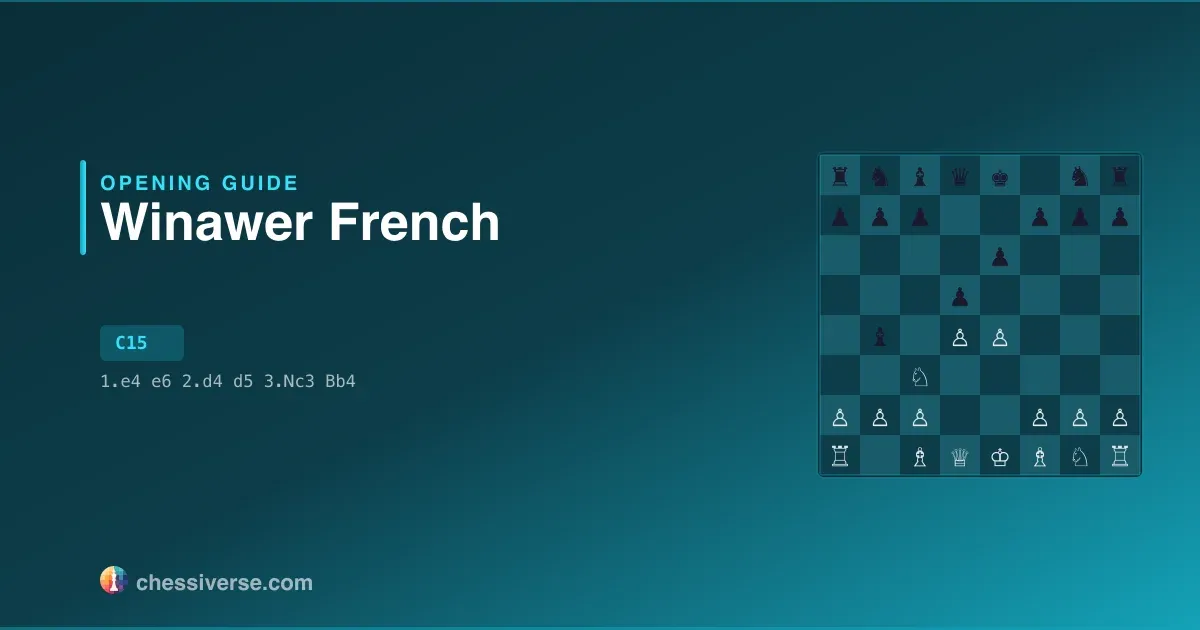
The French Defense: Winawer Variation arises after 1.e4 e6 2.d4 d5 3.Nc3 Bb4 and falls under ECO code C15. Black wastes no time targeting the c3 knight, and an exchange of bishop for knight is nearly unavoidable. The pin leaves the e4 pawn without adequate protection, so the main line sees White pushing 4. e5 to safeguard it. An important nuance is that the dark-squared bishop is Black's "good bishop," since the light-squared bishop is trapped behind the e6-d5 pawn chain. Surrendering it nonetheless offers compensation: after the typical sequence 4. e5 c5 5. a3 Bxc3+ 6. bxc3, Black obtains a solid, closed position where the queenside pawns are more mobile than White's congested centre. Following the flexible 6...Ne7, White must choose between the deeply tactical Poisoned Pawn Variation (7. Qg4) and quieter but still demanding lines with a4 or Nf3. Both paths produce rich, double-edged positions with ample chances for both sides. Beyond 4. e5, White has a range of alternatives for defending or even sacrificing the e-pawn. With 5.9 million Lichess games across all rating levels, it is a well-established opening choice.
- Black pins the c3-knight and usually trades bishop for knight after a3, saddling White with doubled c-pawns while hitting the center with ...c5.
- White accepts the damage in return for space from the e5 pawn and dark-square play, often attacking the kingside with Qg4, including the poisoned pawn line.
- The battle is unbalanced by French standards: Black's chances lie on the queenside, White's in the center and against Black's king.
History and Notable Players
It arises from the French Defense. Among the most prolific practitioners on the White side are Jonny Hector (87 games), Heikki MJ Westerinen (76 games), Robert Zelcic (68 games). On the Black side, notable exponents include Ivan Farago (223 games), Wolfgang Uhlmann (214 games), Rafael A Vaganian (144 games).
The variation is named for Szymon Winawer, a world-class Polish master of the late 1800s. The move 3...Bb4 gained ground after World War I, championed by Aron Nimzowitsch and later Mikhail Botvinnik as an active answer to the French's problem bishop.
Named after: Szymon Winawer, the Polish master who tied for first with Steinitz at Vienna 1882 and was among the world's best players for around 15 years.
Notable players: Aron Nimzowitsch, Mikhail Botvinnik
Winawer's name is stamped on more than one opening: besides this French line he has a Winawer Attack in the Ruy Lopez and introduced the Winawer Countergambit in the Slav at his final international tournament, Monte Carlo 1901.
Statistics
Based on 5.9 million Lichess games across all rating levels:
- White wins: 49.1%
- Black wins: 45.9%
- Draws: 5%
The statistics show a roughly balanced opening where both sides have equal chances.
Main Lines and Variations
After 1.e4 e6 2.d4 d5 3.Nc3 Bb4, the main continuations include:
Each of these lines leads to distinct types of positions and requires its own understanding of the resulting pawn structures and piece placements.
Common Mistakes to Avoid
- Being too passive: While this opening is solid, playing without a plan can lead to a cramped position. Look for the right moment to break with a central pawn advance and free your pieces.
Practice on Chessiverse
The best way to learn the French Defense: Winawer Variation is through practice. On Chessiverse, you can play chess against computer opponents that specialize in this opening. Our AI bots range from beginner to grandmaster level, each with unique playing styles — from aggressive attackers to solid defenders. Choose a bot that matches your rating and work your way up as you master the opening's key ideas.
Performance Across Rating Levels
The picture changes a lot as you climb the rating ladder. The 1200 bracket has 276,635 games (0.04% of all games at that level); White wins 48.5%, Black 47.8%, 3.6% are drawn. Move up to 1800 Elo and the share shifts to 0.17%, with White winning 49.9% versus Black's 45.6%. At 2500, 0.72% of games go into this opening; draws sit at 8.9% — the line is well-mapped at this level.
Time Control Patterns
Time control matters here: blitz players reach for this opening more than others. In bullet, it appears in 0.08% of games (2,050,834); White wins 49.8%. Blitz shows 0.14% adoption across 4,874,296 games, White scoring 49.1%. In rapid, the share rises to 0.09% — 1,036,759 games, White 49%.
Move Diversity and Theory Depth
Looking at move selection shows how forcing — or not — the position really is. At 1200 Elo (276,635 games), the top reply is Bd2, played 31.4% of the time. Four other moves each take at least 5% of games, and the top three moves account for 68% of games. Entropy: 2.83. By 2500 (98,761 games), e5 takes over as the top reply at 65.2%; only two other moves still reach 5% and the top three moves account for 90.7% of games. Entropy drops to 1.69. The narrowing is significant — strong players consolidate around a small set of best moves, while amateurs scatter across many plausible-looking options.
Historical Trends
Year-over-year data tells you whether this opening is a contemporary fixture or a fading one. Adoption peaked in 2016 at 0.19% (115,139 games). By 2025 it sits at 0.12%, 37% below the peak and roughly back to its 2013 level, leaving the line flat over the full period.