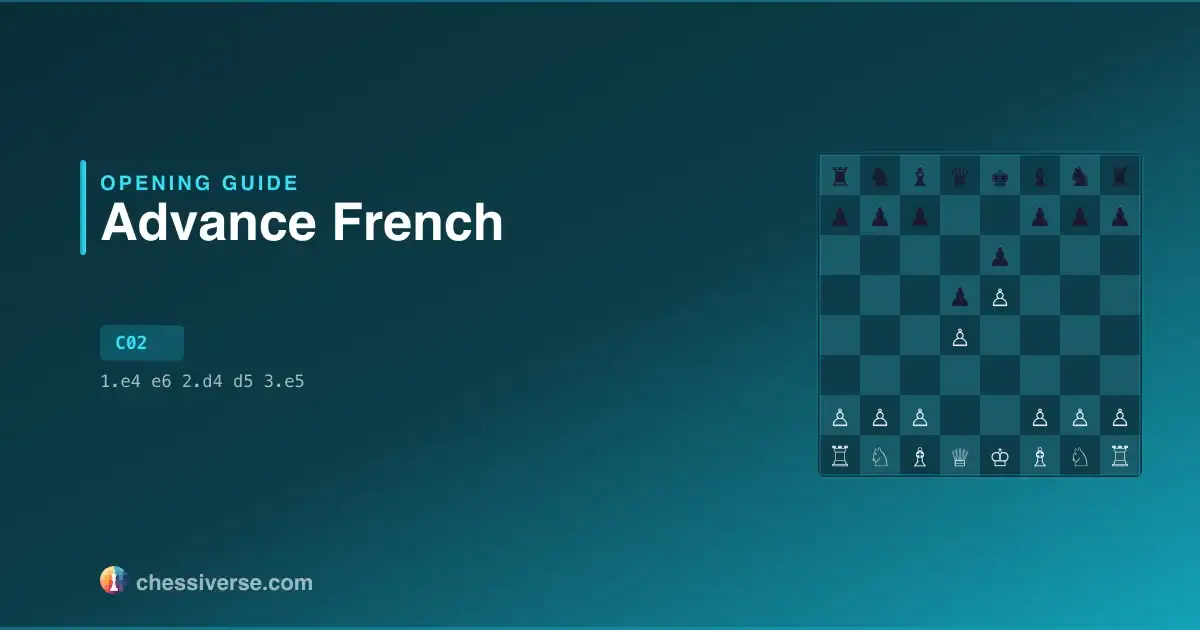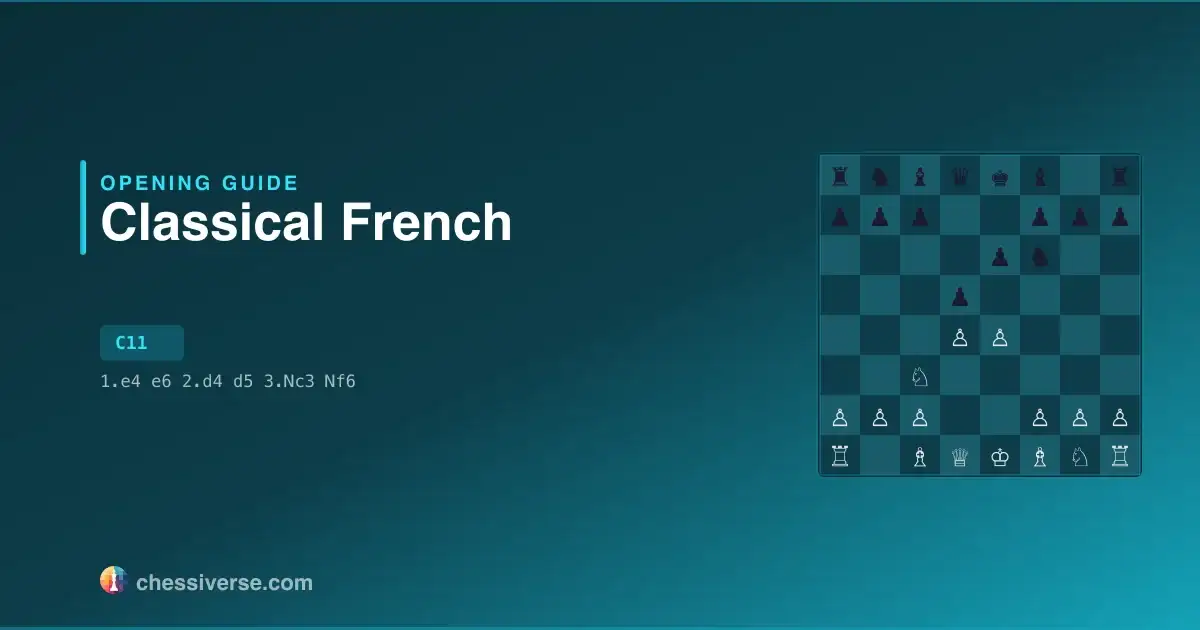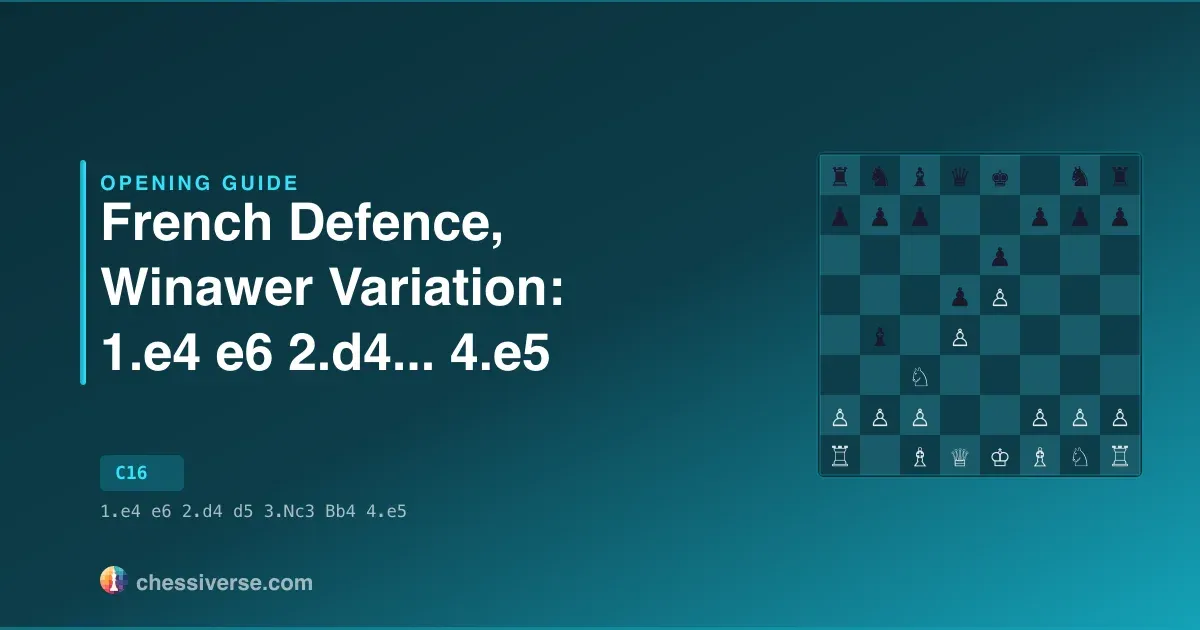
Starting from 1.e4 e6 2.d4 d5 3.Nc3 Bb4 4.e5, players enter the French Defense: Winawer Variation, Advance Variation (4.e5) — ECO C16. White pushes through, locks the centre, and dares Black to prove that the bishop on b4 is a real piece and not a stranded tourist.
Strategic Overview
4.e5 is the principled Winawer main line. White grabs space, defends e5 with d4, and accepts the structural cost: doubled c-pawns are coming after Black trades the bishop. The resulting pawn chain matches the Advance French in shape but with a critical twist. Because White's knight is already on c3, the usual Advance support move c3 is impossible. Black's standard reply 4...c5 therefore hits the base of the chain immediately, and White is left without the natural way to prop d4 up. The bishop on b4 has to come off, and the obvious tool is 5.a3, when Black trades on c3 and bxc3 leaves White with the bishop pair, doubled pawns, and a half-open b-file. From there the strategic battle is sharp and well-defined: White has space, central pawns, and long-term attacking chances against Black's king, often via Qg4 hitting g7. Black has structural targets on the queenside, the better minor piece coordination, and the option to put the king under cover on the queenside or castle into the storm. The Winawer is one of the most theory-heavy openings at the top level for a reason. It is the opening where both sides agree, on move four, to play a position where one wrong move can be decisive twenty moves later.
Key Ideas
A few ideas come up again and again in this opening:
- Space now, structure problem later — Advancing e5 gains kingside space and defines the centre, but White has already conceded that the c-pawns will be doubled once Black trades on c3.
- Knight on c3 blocks c3-defence — Unlike the normal Advance French, White cannot support d4 with c3 because the knight is in the way. That makes ...c5 a genuinely uncomfortable threat.
- ...c5 hits the base of the chain — Black's standard response presses where it hurts. Combined with the bishop trade on c3, it is the foundation of every serious Winawer plan for Black.
- Qg4 attack against g7 is the eternal theme — Once the dark-squared bishop is gone, Black's g7 pawn is permanently weak. The early Qg4 sortie defines a huge chunk of Winawer theory for both sides.
History and Notable Players
It arises from the French Defense: Winawer Variation. Among the most prolific White practitioners are Joseph G Gallagher (57 games), Janis Klovans (56 games), Nigel D Short (54 games). Black-side regulars include Ivan Farago (153 games), Wolfgang Uhlmann (139 games), Rafael A Vaganian (118 games).
Performance Across Rating Levels
The picture changes a lot as you climb the rating ladder. At 1200 Elo, the opening shows up in 0.01% of games (63,505 samples). White scores 52.9%, Black 43.7%, draws 3.4%. By 1800, popularity is 0.08% and White's score is 50.2% to Black's 45.5%. At 2500, 0.47% of games go into this opening; draws sit at 8.3% — the line is well-mapped at this level. White's edge erodes by 4.1pp from 1200 to 2500 Elo, suggesting Black's counterplay is easier to find with experience.
Time Control Patterns
The French Defense: Winawer Variation, Advance Variation (4.e5) skews toward blitz chess. In bullet, it appears in 0.04% of games (990,772); White wins 49.4%. Blitz shows 0.07% adoption across 2,485,286 games, White scoring 49.1%. In rapid, the share rises to 0.04% — 402,782 games, White 51.5%. White's score swings 2.4pp across formats, so time control isn't just a stylistic choice here — it shifts the actual results.
Move Diversity and Theory Depth
What players actually play after the opening moves depends heavily on rating. At 1200 Elo (63,505 games), the top reply is Bxc3+, played 33.3% of the time. Four other moves each take at least 5% of games, and the top three moves account for 72.6% of games. Entropy: 2.55. By 2500 (64,372 games), c5 takes over as the top reply at 68.6%; only two other moves still reach 5% and the top three moves account for 95% of games. Entropy drops to 1.38. The narrowing is significant — strong players consolidate around a small set of best moves, while amateurs scatter across many plausible-looking options.
Historical Trends
Tracking the French Defense: Winawer Variation, Advance Variation (4.e5) year over year shows a clear story. Adoption peaked in 2016 at 0.10% (59,186 games). By 2025 it sits at 0.05%, 43% below the peak and roughly back to its 2013 level, leaving the line flat over the full period.
Main Lines and Variations
After 1.e4 e6 2.d4 d5 3.Nc3 Bb4 4.e5, the established follow-ups are:
Each branch leads to a different middlegame character — the resulting pawn structure decides what kind of game you get.
Common Mistakes
- Drifting away from main theory — At 400 Elo, the three most-played moves cover 69.6% of games, against 94.5% at 2000. The most popular deviation is Nc6 (played 20.2% of the time at 400, much less so up top). It looks fine but quietly hands the better-prepared side an edge.
- Neglecting development — It can feel productive to make extra pawn moves early, but falling behind in piece development is what loses most amateur games — especially in open positions where active pieces find squares fast.
- Drifting into passivity — These openings are solid, but solid is not synonymous with passive. Look for the right moment to break with a central pawn advance — without it, your pieces stay cramped.
Practice on Chessiverse
Ready to try the French Defense: Winawer Variation, Advance Variation (4.e5) against a bot? Pick an opponent at your level and play a game.