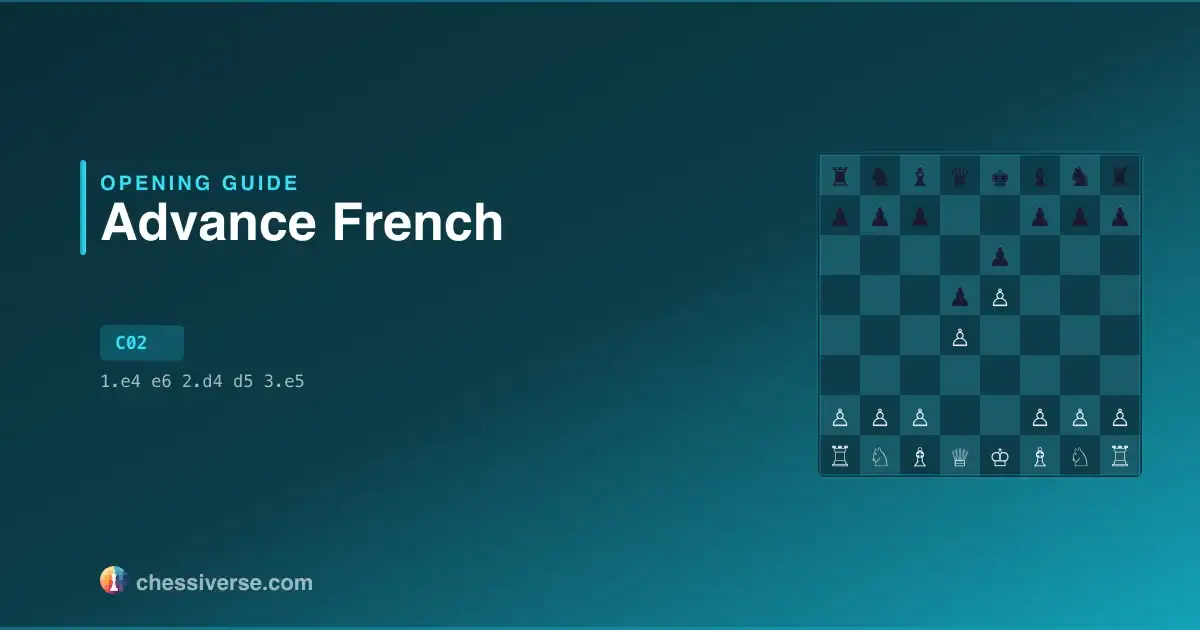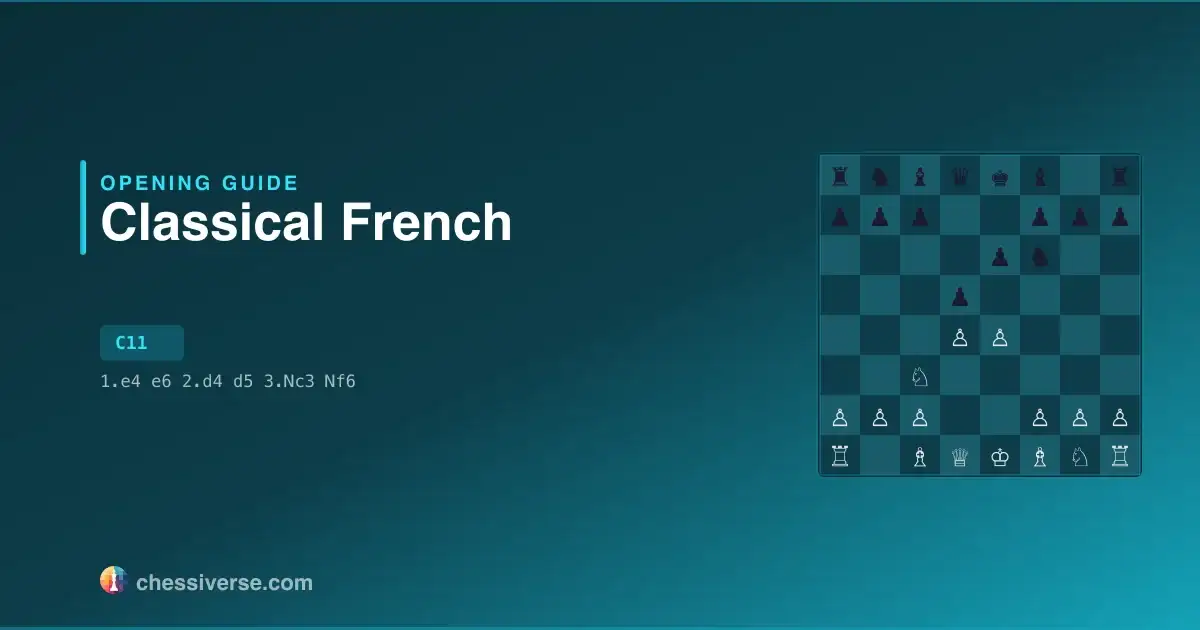




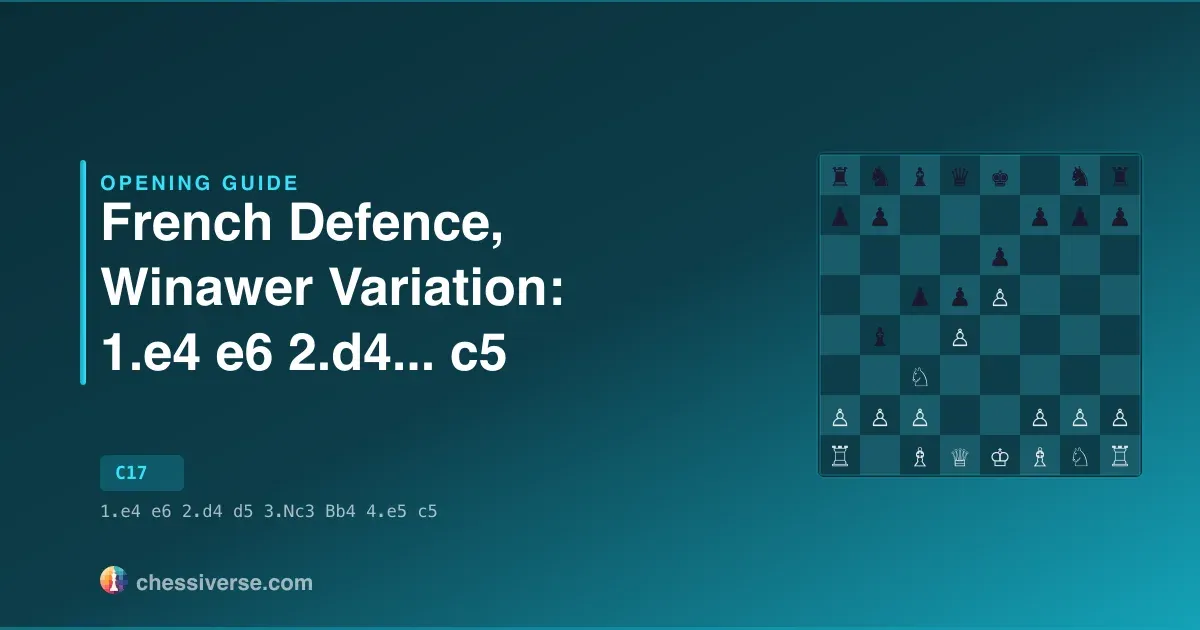
The French Defense: Winawer Variation, Advance Variation (4...c5) begins with 1.e4 e6 2.d4 d5 3.Nc3 Bb4 4.e5 c5 (ECO C17). Black goes straight for the throat of White's pawn chain, knowing the knight on c3 blocks the natural defensive resource.
Strategic Overview
4...c5 is the defining move of the Winawer main line. The pawn chain just put up by White depends on d4, and Black challenges it before White can build any support around it. Because the knight is sitting on c3, the standard Advance French defence c2-c3 is unavailable, so the central pawns are under genuine pressure. White's typical answer is 5.a3, kicking the bishop and forcing a decision. The bishop has nowhere safe to go that keeps the structure intact, so Black almost always trades on c3, accepts that bxc3 strengthens White's centre, and counts on the queenside damage to White's pawns as long-term compensation. The strategic picture is clear: White ends up with the bishop pair, a half-open b-file, and a kingside attacking plan; Black has the better pawn structure, the b- and c-files to work with, and a king-safety problem to solve. Both sides know what they are signing up for. The Winawer is not a finesse opening; it is a positional war where each side has a clear advantage to lean on and a clear weakness to defend.
Key Ideas
When players succeed in this line, they usually do so by leaning on the following themes:
- Hit the base of the chain immediately — ...c5 attacks d4 before White can support it. The knight on c3 prevents the natural c3 defence, so White has nowhere to dig in.
- Bishop on b4 has no safe retreat — Once ...c5 closes the diagonal, the b4 bishop is committed. After 5.a3 it almost always takes on c3 because retreating just loses tempo.
- Trade gives White the centre but ruins his structure — 5.a3 Bxc3+ 6.bxc3 leaves White with strong central pawns and the bishop pair, but doubled c-pawns and a long-term liability on the queenside.
- Two-way game from move five — Both sides know exactly what they are getting: White attacks kingside, Black presses queenside. The winner is whoever executes their plan faster.
History and Notable Players
It arises from the French Defense: Winawer Variation, Advance Variation (4.e5). On the White side, Nigel D Short (39 games), Thomas Ernst (38 games), Bela Lengyel (36 games) top the database. Notable Black exponents: Smbat G Lputian (71 games), Predrag Nikolic (68 games), Emanuel Berg (67 games).
Performance Across Rating Levels
The picture changes a lot as you climb the rating ladder. The 1200 bracket has 15,301 games (0.00% of all games at that level); White wins 48%, Black 48.9%, 3.1% are drawn. By 1800, popularity is 0.06% and White's score is 49% to Black's 46.6%. At the top end (2500+ Elo), popularity is 0.32% with 8.2% draws — a clear sign of how much theory rules the line at master level. Positions also become less sharp as level rises (sharpness 0.97 → 0.92).
Time Control Patterns
The French Defense: Winawer Variation, Advance Variation (4...c5) skews toward blitz chess. In bullet, it appears in 0.03% of games (702,031); White wins 48.8%. Blitz shows 0.05% adoption across 1,755,180 games, White scoring 48.5%. In rapid, the share rises to 0.02% — 245,009 games, White 49.3%.
Move Diversity and Theory Depth
Move choice is far from uniform in the French Defense: Winawer Variation, Advance Variation (4...c5). At 1200 Elo (15,301 games), the top reply is a3, played 37.8% of the time. Four other moves each take at least 5% of games, and the top three moves account for 72.7% of games. Entropy: 2.53. By 2500 (44,117 games), a3 dominates at 82.5% of replies; only one other move still reaches 5% and the top three moves account for 97.7% of games. Entropy drops to 0.89. The narrowing is significant — strong players consolidate around a small set of best moves, while amateurs scatter across many plausible-looking options.
Main Lines and Variations
The main branches off 1.e4 e6 2.d4 d5 3.Nc3 Bb4 4.e5 c5 include:
Each branch leads to a different middlegame character — the resulting pawn structure decides what kind of game you get.
Common Mistakes
- Drifting away from main theory — At 400 Elo, the three most-played moves cover 67.5% of games, against 91.1% at 2000. The most popular deviation is Nf3 (played 24.8% of the time at 400, much less so up top). It looks fine but quietly hands the better-prepared side an edge.
- Neglecting development — Extra pawn moves in the opening are tempting, especially when you "know the moves". Developing a piece each turn is the simple correction.
- Drifting into passivity — These openings are solid, but solid is not synonymous with passive. Look for the right moment to break with a central pawn advance — without it, your pieces stay cramped.
Practice on Chessiverse
Ready to try the French Defense: Winawer Variation, Advance Variation (4...c5) against a bot? Pick an opponent at your level and play a game.