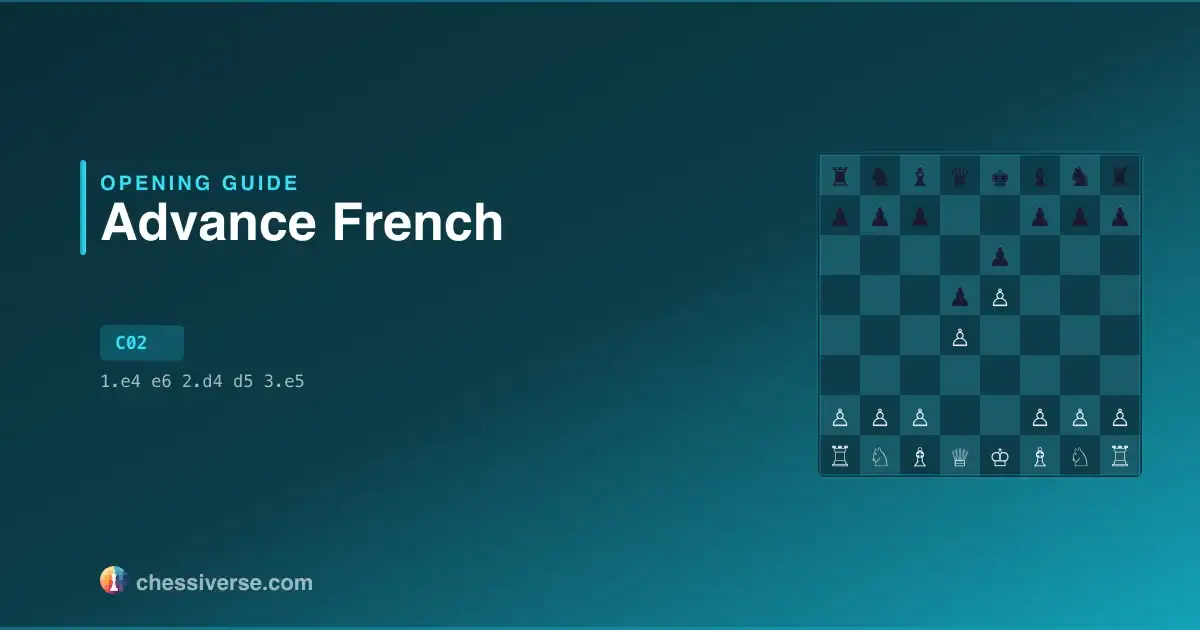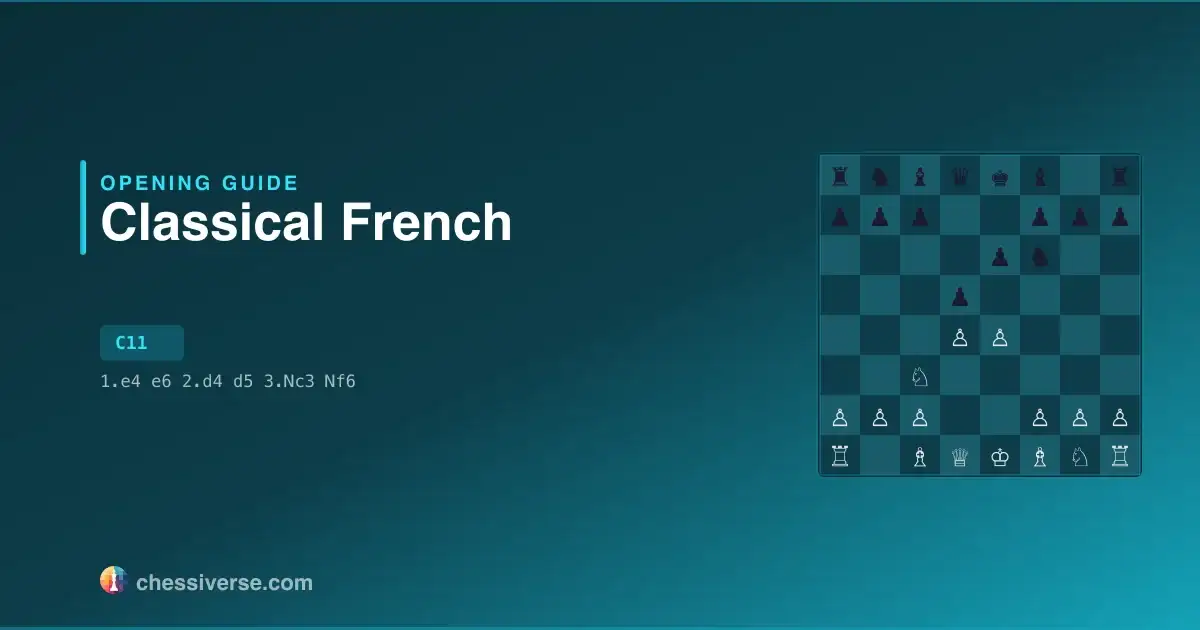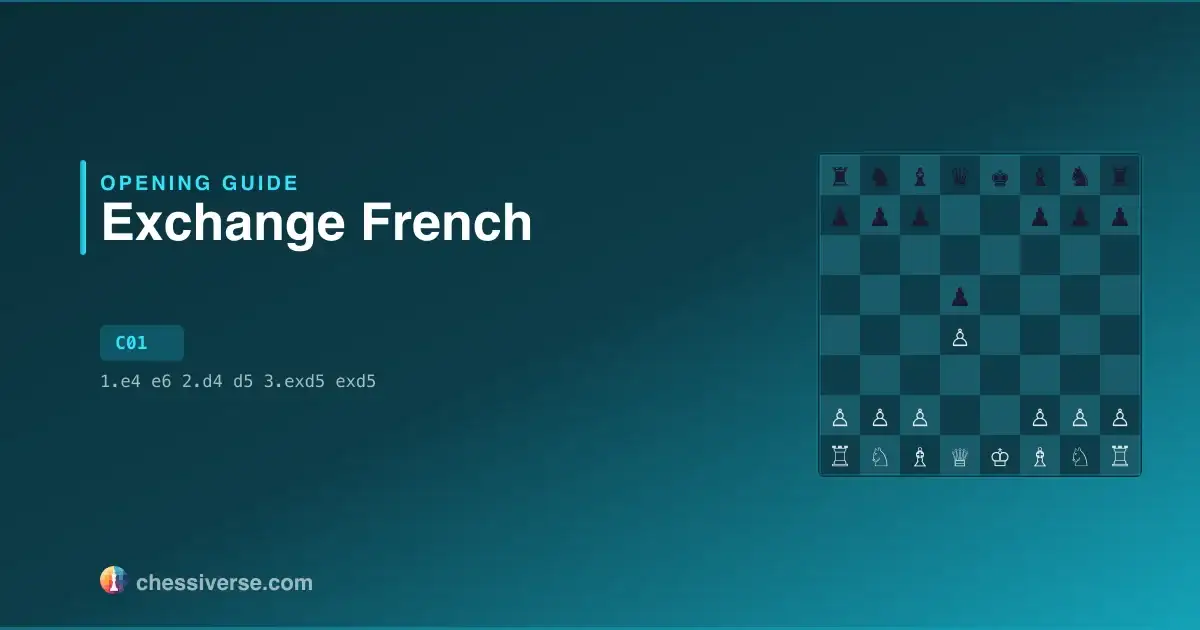




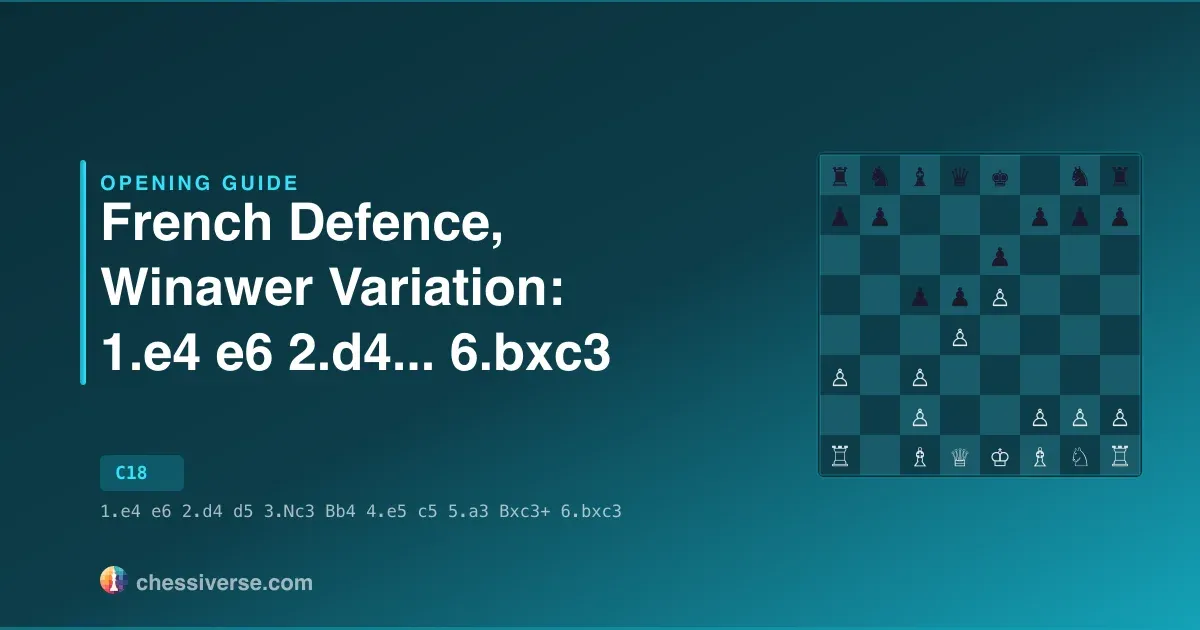
1.e4 e6 2.d4 d5 3.Nc3 Bb4 4.e5 c5 5.a3 Bxc3+ 6.bxc3 opens the French Defense: Winawer Variation, Advance Variation (6.bxc3), ECO C18. The pieces have been swapped, the structure is set, and now Black has to choose how to deal with the immediate threat of Qg4 grabbing g7.
Strategic Overview
We have arrived at the Winawer main-line crossroads. White's centre is wide and intimidating, the bishop pair is on the board, but the queenside pawn structure is permanently damaged. Black's job is to develop sensibly without losing the g7 pawn to Qg4. Three main approaches define modern theory. 6...Ne7 is the principal try: the knight defends g8, prepares to swing to f5 to pressure d4 and e5, and accepts that Black must navigate a sharp middlegame. 6...Qc7, the Classical, supports the c-pawn, develops the queen actively, and prepares ...b6/Bb7 development. 6...Qa5, the Portisch-Hook, eyes the doubled c-pawns directly and tries to provoke further weaknesses before Black even thinks about kingside development. Whichever Black plays, the structural balance is the same: White has space and the bishop pair, Black has a target-rich queenside and a long-term pawn-structure advantage. The middlegame depends almost entirely on king safety. If Black survives the Qg4 attack and gets the king out of trouble, the structural pluses tend to tell in the endgame. If White can blow the position open before Black is coordinated, the bishops decide the game.
Key Ideas
The recurring motifs below distinguish a confident handler of this opening from a beginner:
- Qg4 is the immediate threat — With the dark-squared bishop traded, White's queen aims at g7. Every Black sixth move has to take this attack seriously, even if it does not address it directly.
- 6...Ne7 is the modern main line — The knight covers g8, prepares the ...Nf5 reroute, and keeps Black flexible. Most current top-level theory runs through this move.
- 6...Qc7 protects the c-file and prepares queenside play — The Classical line backs up the c-pawn, brings the queen out actively, and supports a queenside-fianchetto development for Black's pieces.
- 6...Qa5 puts pressure on the doubled pawns — The Portisch-Hook gets the queen out with a target in mind: the weak c-pawns. It often provokes White into further structural concessions early.
- King safety vs structure is the eternal trade — Black has the better pawns; White has the better attacking chances. The Winawer is decided by whoever wins their side of that trade fast enough.
History and Notable Players
It arises from the French Defense: Winawer Variation, Advance Variation (4...c5). On the White side, Nick E De Firmian (32 games), Friso Nijboer (30 games), Joanna Dworakowska (29 games) top the database. Notable Black exponents: Predrag Nikolic (65 games), Emanuel Berg (52 games), Yuri Shulman (52 games).
Performance Across Rating Levels
The picture changes a lot as you climb the rating ladder. The 1200 bracket has 3,708 games (0.00% of all games at that level); White wins 51.7%, Black 45.5%, 2.8% are drawn. By 1800, popularity is 0.03% and White's score is 49.2% to Black's 46.5%. At 2500, 0.24% of games go into this opening; draws sit at 7.9% — the line is well-mapped at this level. Positions also become less sharp as level rises (sharpness 0.97 → 0.92).
Time Control Patterns
Look at the same opening across time controls and blitz stands out. In bullet, it appears in 0.01% of games (371,485); White wins 48%. Blitz shows 0.03% adoption across 925,947 games, White scoring 48%. In rapid, the share rises to 0.01% — 104,659 games, White 49.8%.
Move Diversity and Theory Depth
What players actually play after the opening moves depends heavily on rating. At 1200 Elo (3,708 games), the top reply is cxd4, played 23.9% of the time. Five other moves each take at least 5% of games, and the top three moves account for 60.8% of games. Entropy: 2.81. By 2500 (32,509 games), Ne7 takes over as the top reply at 51.1%; only three other moves still reach 5% and the top three moves account for 87% of games. Entropy drops to 1.81. The narrowing is significant — strong players consolidate around a small set of best moves, while amateurs scatter across many plausible-looking options.
Historical Trends
Tracking the French Defense: Winawer Variation, Advance Variation (6.bxc3) year over year shows a clear story. Adoption peaked in 2016 at 0.03% (19,883 games). By 2025 it sits at 0.02%, 41% below the peak but still 25% above its 2013 level, so the line is up over the full period despite easing from the high.
Main Lines and Variations
From the position after 1.e4 e6 2.d4 d5 3.Nc3 Bb4 4.e5 c5 5.a3 Bxc3+ 6.bxc3, the recognised continuations are:
Each branch leads to a different middlegame character — the resulting pawn structure decides what kind of game you get.
Common Mistakes
- Drifting away from main theory — At 400 Elo, the three most-played moves cover 62.6% of games, against 80.6% at 2000. The most popular deviation is c4 (played 20.7% of the time at 400, much less so up top). It looks fine but quietly hands the better-prepared side an edge.
- Neglecting development — Extra pawn moves in the opening are tempting, especially when you "know the moves". Developing a piece each turn is the simple correction.
- Drifting into passivity — These openings are solid, but solid is not synonymous with passive. Look for the right moment to break with a central pawn advance — without it, your pieces stay cramped.
Practice on Chessiverse
Ready to try the French Defense: Winawer Variation, Advance Variation (6.bxc3) against a bot? Pick an opponent at your level and play a game.