

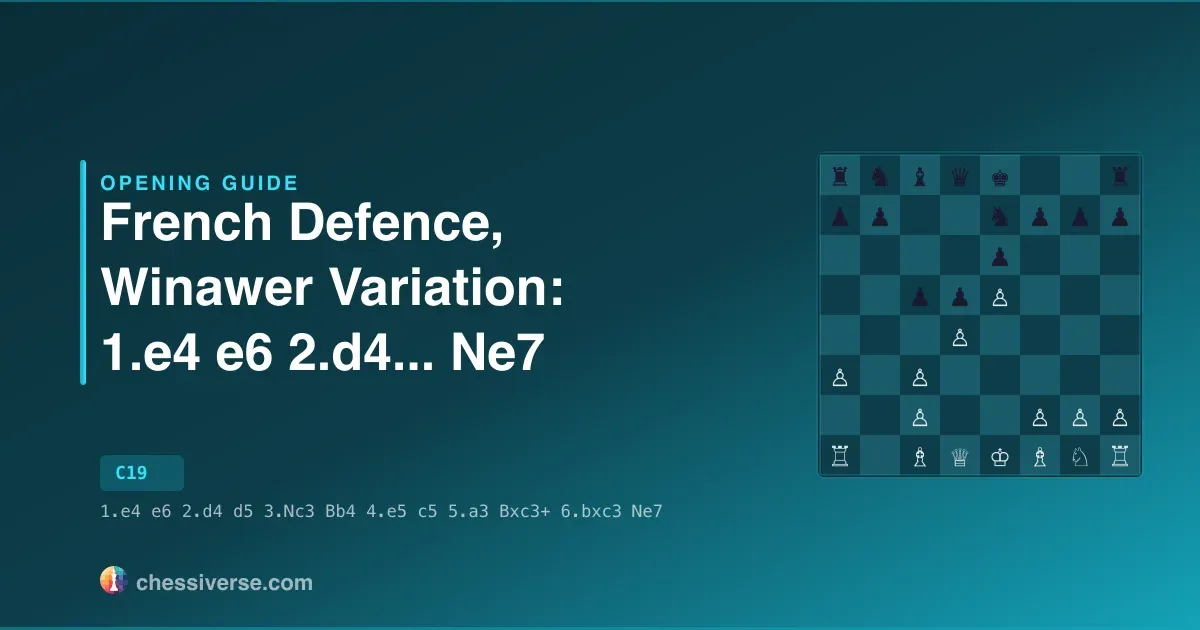
Starting from 1.e4 e6 2.d4 d5 3.Nc3 Bb4 4.e5 c5 5.a3 Bxc3+ 6.bxc3 Ne7, players enter the French Defense: Winawer Variation, Advance Variation (6...Ne7) — ECO C19. Black puts the knight on its best square, ignores the c-pawn for now, and waits to see whether White will gamble on Qg4 or just keep developing.
Strategic Overview
6...Ne7 is the workhorse of the modern Winawer. The knight stays out of the way of the kingside structure, covers g8, and is one move from f5 where it pressures both d4 and the e5 spearhead. Black is unbothered by the loose c5 pawn because the obvious 7.dxc5 only adds a third pawn to the wreckage on the c-file; tripled pawns plus a half-open c-file is no kind of compensation, and Black recovers the material easily by rerouting the queen's knight to d7 and back to e5 or c5. The serious White options are three. 7.Qg4 is the aggressive main line, going straight at g7 and forcing concrete defensive decisions from Black. 7.Nf3 is the calm setup, preparing short castling and keeping the position flexible. 7.a4 is the third major path, with the idea of Ba3 to develop the bishop actively and pressure Black's dark squares before the queenside pieces come out. Black's plans across all three are similar: catch up in development, get the king to safety (often castling short and accepting the storm, sometimes going long), and use the queenside pawn weaknesses as a long-term resource. The position rewards precise move orders and a willingness to defend creatively.
Key Ideas
The recurring motifs below distinguish a confident handler of this opening from a beginner:
- Ne7 is the best square for the knight — It defends g8, supports the future ...Nf5 reroute, and stays out of the way of Black's kingside development. There is no better square in this structure.
- Tripled c-pawns make dxc5 a non-threat — Taking on c5 only adds another isolated pawn to White's broken queenside. Black recovers the material with ...Nbd7 and never feels the pressure.
- 7.Qg4 is the principled attack on g7 — The most ambitious continuation. White ignores development to threaten the pawn on g7, forcing Black to commit to a precise defensive plan early.
- 7.Nf3 is the safe development setup — White prepares short castling and quiet manoeuvring, content to rely on the bishop pair and central space. Less ambitious but solid.
- 7.a4 supports a Ba3 plan — Pushing the rook's pawn frees a3 for the bishop, where it pressures Black's dark squares and discourages queenside development.
History and Notable Players
It arises from the French Defense: Winawer Variation, Advance Variation (6.bxc3). Among the most prolific White practitioners are Janis Klovans (35 games), Nick E De Firmian (33 games), Nigel D Short (33 games). Black-side regulars include Wolfgang Uhlmann (121 games), Ivan Farago (109 games), Milan Drasko (90 games).
Performance Across Rating Levels
Popularity and results vary sharply by rating level. At 1200 Elo, the opening shows up in 0.00% of games (756 samples). White scores 48.4%, Black 48.7%, draws 2.9%. Move up to 1800 Elo and the share shifts to 0.01%, with White winning 46% versus Black's 49.5%. At 2500, 0.16% of games go into this opening; draws sit at 8.3% — the line is well-mapped at this level. Positions also become less sharp as level rises (sharpness 0.97 → 0.92).
Time Control Patterns
Look at the same opening across time controls and blitz stands out. In bullet, it appears in 0.01% of games (236,571); White wins 47.2%. Blitz shows 0.02% adoption across 543,107 games, White scoring 46.5%. In rapid, the share rises to 0.00% — 50,834 games, White 45.6%.
Move Diversity and Theory Depth
What players actually play after the opening moves depends heavily on rating. At 1200 Elo (756 games), the top reply is Qg4, played 38% of the time. Four other moves each take at least 5% of games, and the top three moves account for 71.8% of games. Entropy: 2.65. By 2500 (21,333 games), Qg4 dominates at 56.8% of replies; only three other moves still reach 5% and the top three moves account for 89.2% of games. Entropy drops to 1.78. The narrowing is significant — strong players consolidate around a small set of best moves, while amateurs scatter across many plausible-looking options.
Historical Trends
Tracking the French Defense: Winawer Variation, Advance Variation (6...Ne7) year over year shows a clear story. Adoption peaked in 2015 at 0.02% (4,211 games). By 2025 it sits at 0.01%, 44% below the peak but still 45% above its 2013 level, so the line is up over the full period despite easing from the high.
Common Mistakes
- Drifting away from main theory — At 1000 Elo, the three most-played moves cover 62.4% of games, against 81% at 2000. The most popular deviation is Nf3 (played 24.8% of the time at 1000, less so up top). It looks fine but quietly hands the better-prepared side an edge.
- Neglecting development — It can feel productive to make extra pawn moves early, but falling behind in piece development is what loses most amateur games — especially in open positions where active pieces find squares fast.
- Drifting into passivity — These openings are solid, but solid is not synonymous with passive. Look for the right moment to break with a central pawn advance — without it, your pieces stay cramped.
Practice on Chessiverse
Ready to try the French Defense: Winawer Variation, Advance Variation (6...Ne7) against a bot? Pick an opponent at your level and play a game.