




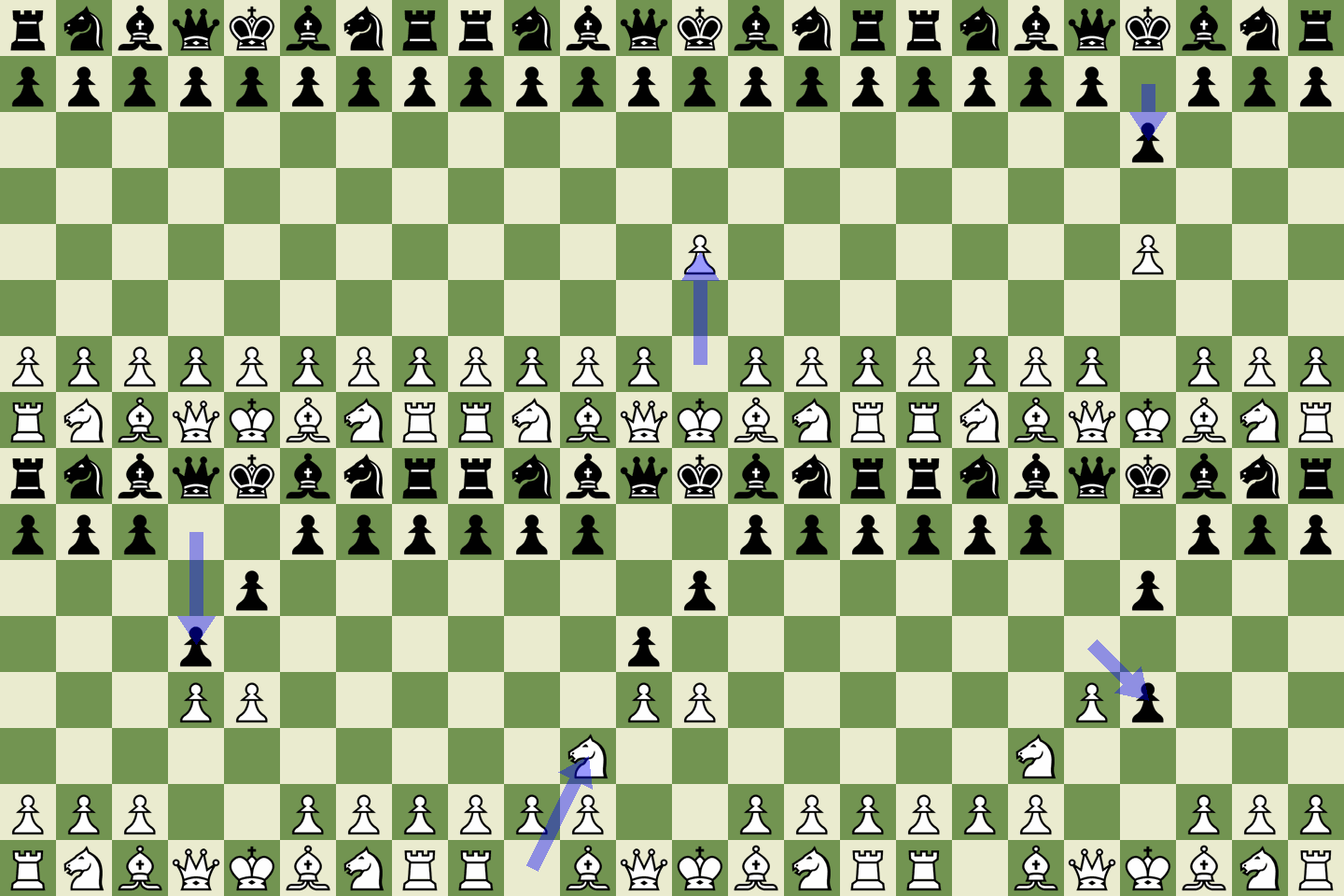
The French Defense: Rubinstein Variation arises after 1.e4 e6 2.d4 d5 3.Nc3 dxe4 and falls under ECO code C10. By capturing on e4, Black resolves the central tension and opens up the position immediately. A practical advantage of this sideline is that Black can employ the same response against both 3. Nc3 and 3. Nd2 (the Tarrasch Variation), since the resulting positions transpose once White recaptures. After 3...dxe4, the recapture 4. Nxe4 is virtually the only move seen in practice. White does have the rare option of gambiting the pawn with 4. f3!? exf3 5. Nxf3 Nf6, which transposes into the Blackmar-Diemer Gambit accepted. With 5.7 million Lichess games across all rating levels, it is a well-established opening choice.
- By capturing on e4 right away Black releases the central tension and opens the position.
- It is a low-theory choice: the same capture works against both 3.Nc3 and the Tarrasch 3.Nd2, so one setup covers two White systems.
- After 4.Nxe4 Black usually continues 4...Nd7, reaching positions much like the Burn Variation but without the bishop pair Black enjoys there.
History and Notable Players
It arises from the French Defense. Among the most prolific practitioners on the White side are Jonny Hector (154 games), Robert Zelcic (129 games), Friso Nijboer (128 games). On the Black side, notable exponents include Ivan Farago (236 games), Wolfgang Uhlmann (214 games), Viktor Korchnoi (202 games).
Named after: Named after Akiba Rubinstein, counted among the players who historically shaped the theory of the French Defence.
Notable players: Akiba Rubinstein
A sub-line in which Black activates the light-squared bishop with ...Bd7 and ...Bc6 carries the memorable name Fort Knox Variation.
Statistics
Based on 5.7 million Lichess games across all rating levels:
- White wins: 50.5%
- Black wins: 44.1%
- Draws: 5.4%
White holds a moderate edge statistically, though Black has good practical chances.
Common Mistakes to Avoid
- Being too passive: While this opening is solid, playing without a plan can lead to a cramped position. Look for the right moment to break with a central pawn advance and free your pieces.
Practice on Chessiverse
The best way to learn the French Defense: Rubinstein Variation is through practice. On Chessiverse, you can play chess against computer opponents that specialize in this opening. Our AI bots range from beginner to grandmaster level, each with unique playing styles — from aggressive attackers to solid defenders. Choose a bot that matches your rating and work your way up as you master the opening's key ideas.
Performance Across Rating Levels
How well the French Defense: Rubinstein Variation works depends on what level you're playing at. The 1200 bracket has 396,711 games (0.06% of all games at that level); White wins 50%, Black 46.1%, 3.9% are drawn. Move up to 1800 Elo and the share shifts to 0.18%, with White winning 51% versus Black's 43.7%. At 2500, 0.23% of games go into this opening; draws sit at 11.9% — the line is well-mapped at this level.
Time Control Patterns
Look at the same opening across time controls and bullet stands out. In bullet, it appears in 0.17% of games (4,583,847); White wins 52%. Blitz shows 0.13% adoption across 4,627,766 games, White scoring 50.6%. In rapid, the share rises to 0.09% — 1,027,943 games, White 50.2%.
Move Diversity and Theory Depth
Move choice is far from uniform in the French Defense: Rubinstein Variation. At 1200 Elo (396,711 games), the top reply is Nxe4, played 84% of the time. One other move takes at least 5% of games, and the top three moves account for 97.3% of games. Entropy: 0.87. By 2500 (31,914 games), Nxe4 dominates at 98.7% of replies; no other move reaches 5% and the top three moves account for 99.9% of games. Entropy drops to 0.11. The narrowing is significant — strong players consolidate around a small set of best moves, while amateurs scatter across many plausible-looking options.
Historical Trends
Long-term, the trajectory of this opening is informative. Adoption peaked in 2016 at 0.135% (82,995 games). By 2025 it sits at 0.133%, 2% below the peak but still 30% above its 2013 level, so the line is up over the full period despite easing from the high.