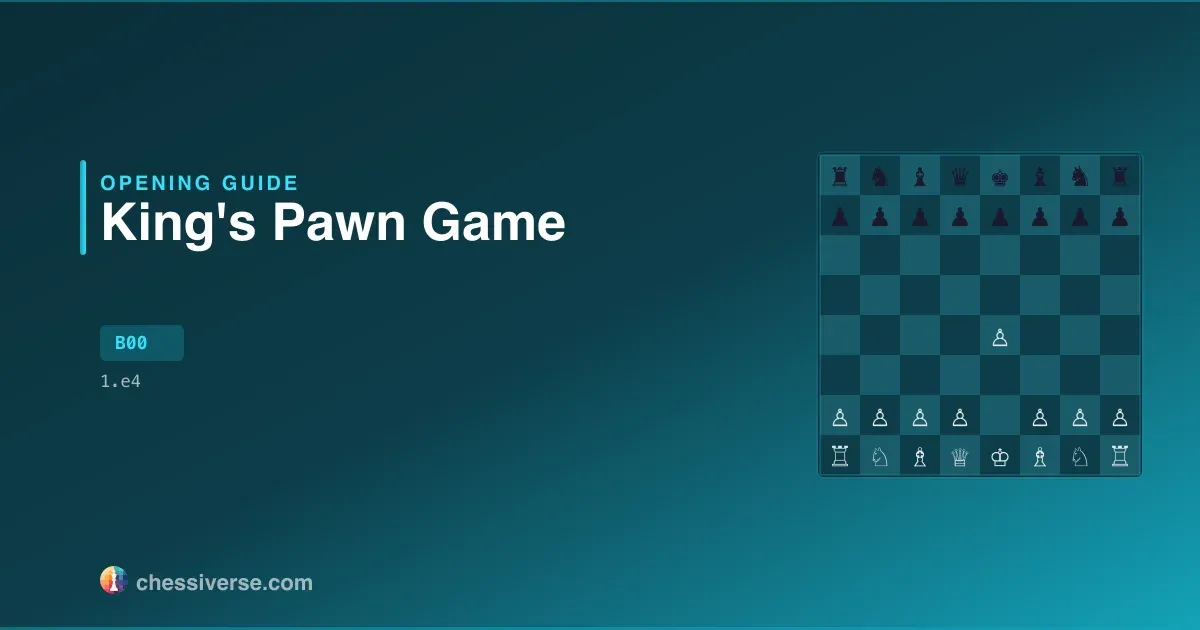
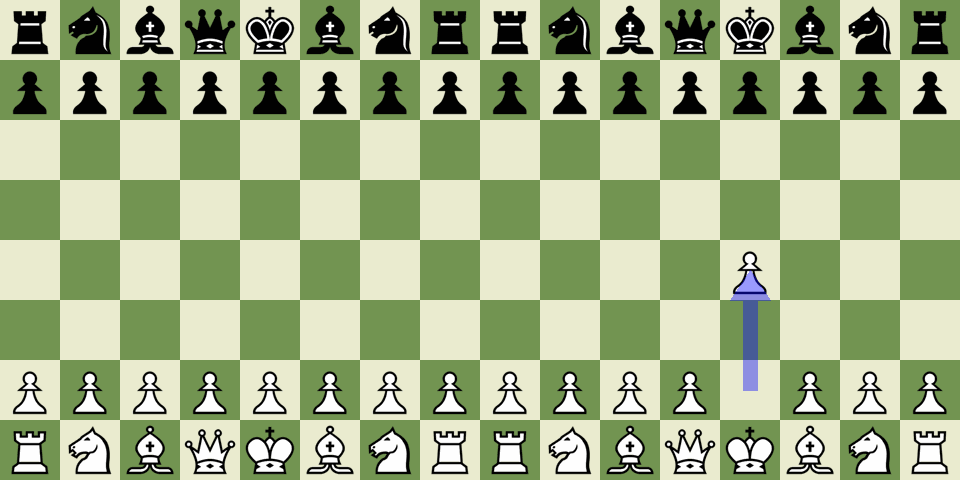
The King's Pawn Game arises after 1.e4 and falls under ECO code B00. Known as the King's Pawn Opening, 1.e4 is the single most popular first move across all levels of chess. It immediately opens diagonals for both the queen and the king's bishop while contesting central squares. The pawn directly covers d5 and f5, though Black can neutralize that influence with moves like 1...e6. Perhaps even more important is that the pawn occupies e4 itself: with a white pawn stationed there, Black cannot place a pawn on e4, which means White's g1-knight can safely develop to f3 without risk of being chased away by a pawn advance. Black has numerous responses available, but the central challenge is to prevent White from building or maintaining a two-pawn center with pawns on both e4 and d4. If Black can establish a pawn on d4, it becomes very difficult for White to sustain that ideal central formation. With 2921.1 million Lichess games across all rating levels, it is one of the most popular openings.
- The pawn on e4 stakes a claim in the centre and controls d5
- It immediately opens lines for the queen and king's bishop, allowing both to develop
- Black's reply sets the character of the game: 1...e5 leads to Open Games, while moves like the Sicilian, French or Caro-Kann give Semi-Open Games
History and Notable Players
Among the most prolific practitioners on the White side are Viswanathan Anand (1534 games), Vlastimil Jansa (1449 games), Heikki MJ Westerinen (1409 games). On the Black side, notable exponents include Viktor Korchnoi (999 games), Loek Van Wely (853 games), Vassily Ivanchuk (835 games).
1.e4 is the most popular first move in chess. Bobby Fischer declared it best by test. In modern practice the Sicilian Defence has become Black's most common reply, ahead of the classical 1...e5.
Named after: Named for the pawn in front of White's king, which advances two squares to e4 on the first move.
Notable players: Bobby Fischer
Bobby Fischer famously annotated 1.e4 as best by test and once claimed, With 1.e4! I win.
Statistics
Based on 2921.1 million Lichess games across all rating levels:
- White wins: 49.5%
- Black wins: 46.2%
- Draws: 4.3%
The statistics show a roughly balanced opening where both sides have equal chances.
Main Lines and Variations
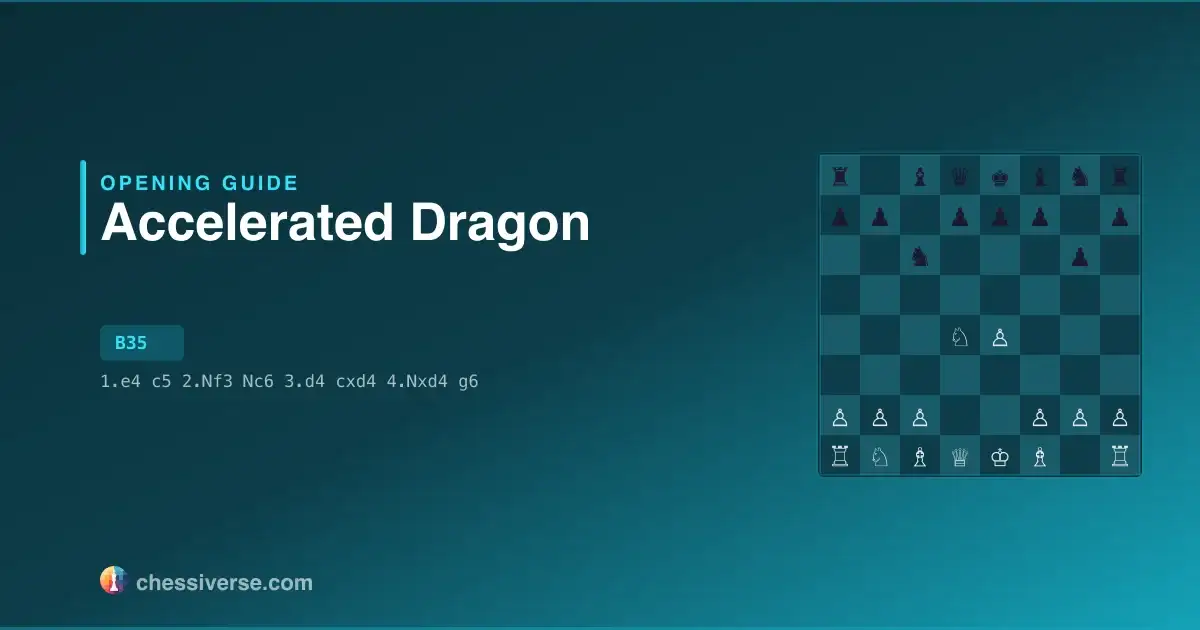
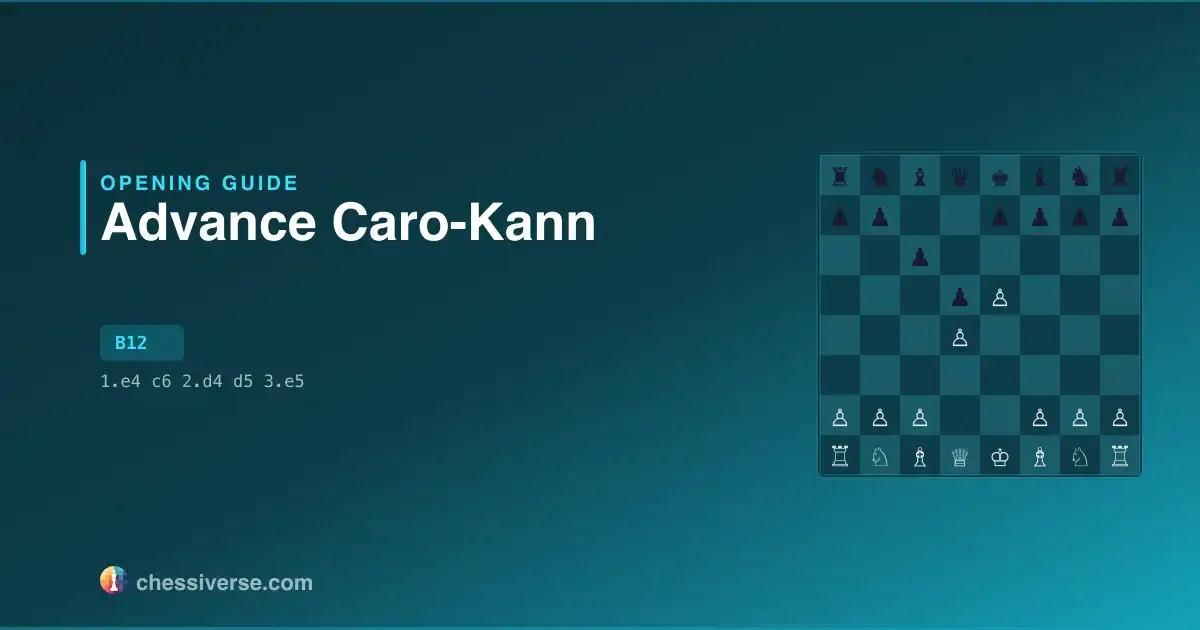
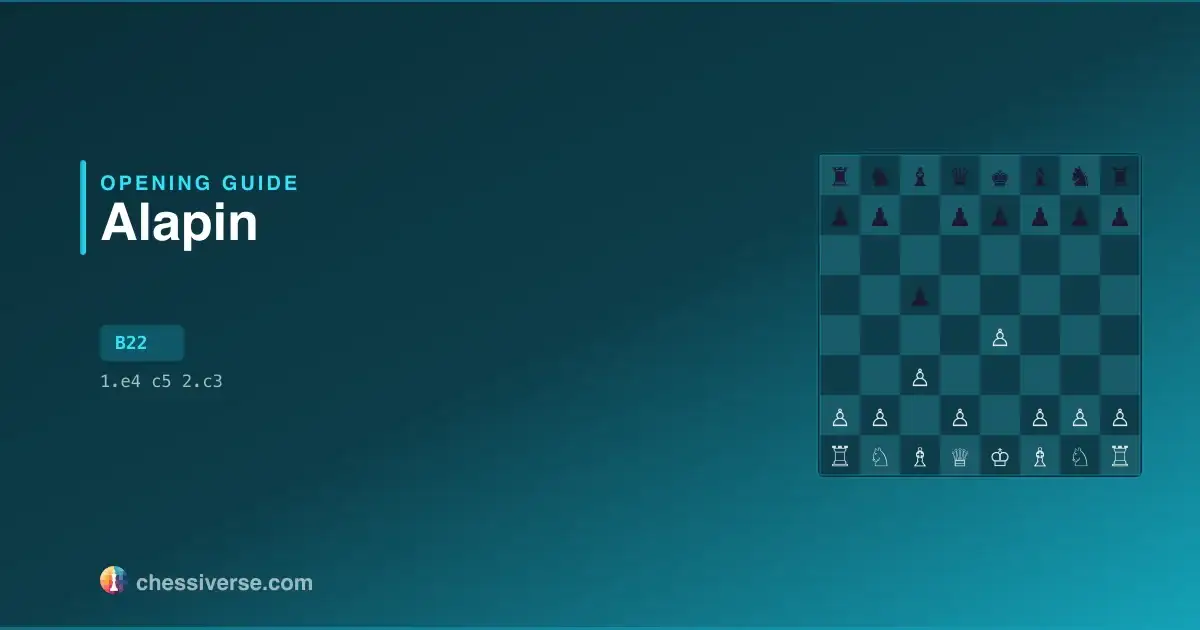
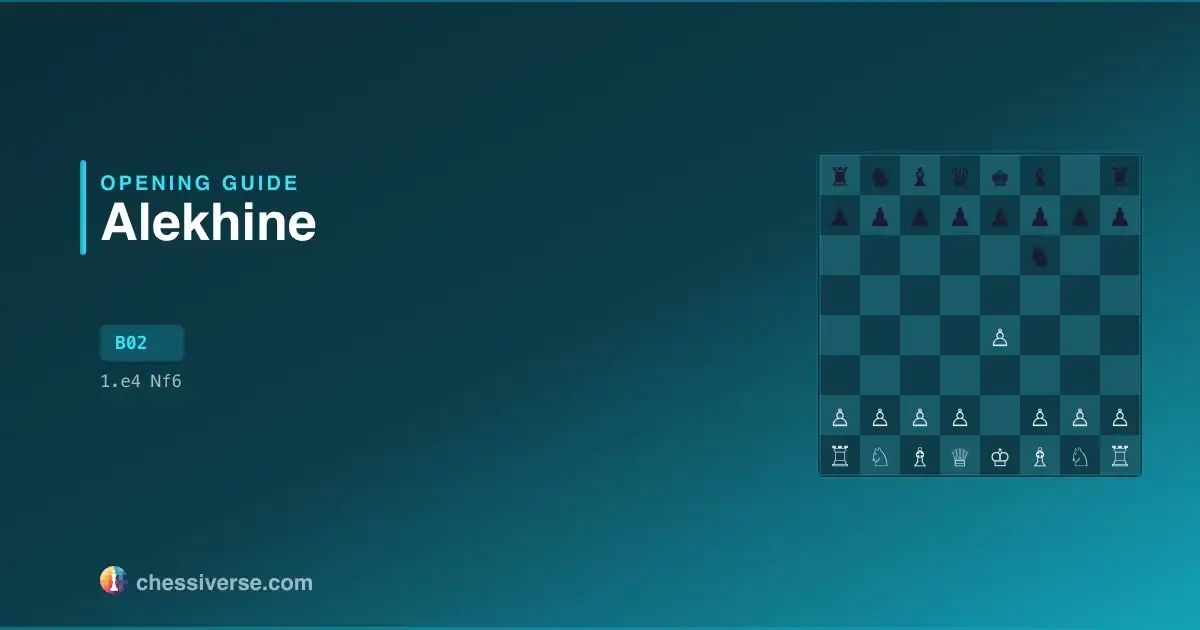
After 1.e4, the main continuations include:
Each of these lines leads to distinct types of positions and requires its own understanding of the resulting pawn structures and piece placements.
Practice on Chessiverse
The best way to learn the King's Pawn Game is through practice. On Chessiverse, you can play chess against computer opponents that specialize in this opening. Our AI bots range from beginner to grandmaster level, each with unique playing styles — from aggressive attackers to solid defenders. Choose a bot that matches your rating and work your way up as you master the opening's key ideas.
Performance Across Rating Levels
The picture changes a lot as you climb the rating ladder. At 1200 Elo, the opening shows up in 66.13% of games (446,122,602 samples). White scores 50.1%, Black 46.1%, draws 3.8%. Move up to 1800 Elo and the share shifts to 59.43%, with White winning 48.9% versus Black's 46.5%. At 2500, 44.57% of games go into this opening; draws sit at 9.6% — the line is well-mapped at this level.
Time Control Patterns
Look at the same opening across time controls and rapid stands out. In bullet, it appears in 52.53% of games (1,396,403,298); White wins 49.3%. Blitz shows 60.88% adoption across 2,188,702,574 games, White scoring 49.4%. In rapid, the share rises to 66.19% — 732,369,449 games, White 49.7%.
Move Diversity and Theory Depth
Move choice is far from uniform in the King's Pawn Game. At 1200 Elo (446,122,602 games), the top reply is e5, played 57% of the time. Four other moves each take at least 5% of games, and the top three moves account for 77.7% of games. Entropy: 2.21. By 2500 (6,077,630 games), c5 takes over as the top reply at 38.2%; only three other moves still reach 5% and the top three moves account for 70.3% of games. Entropy rises to 2.61. Even elite players don't fully agree on the best continuation here, which keeps the position dynamic.