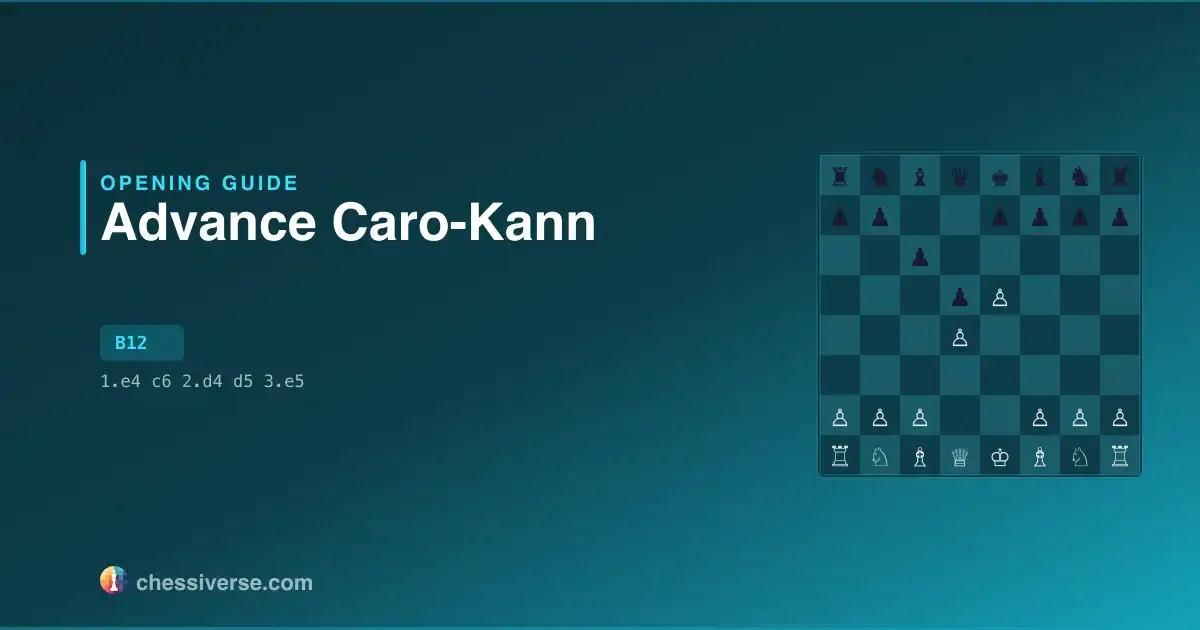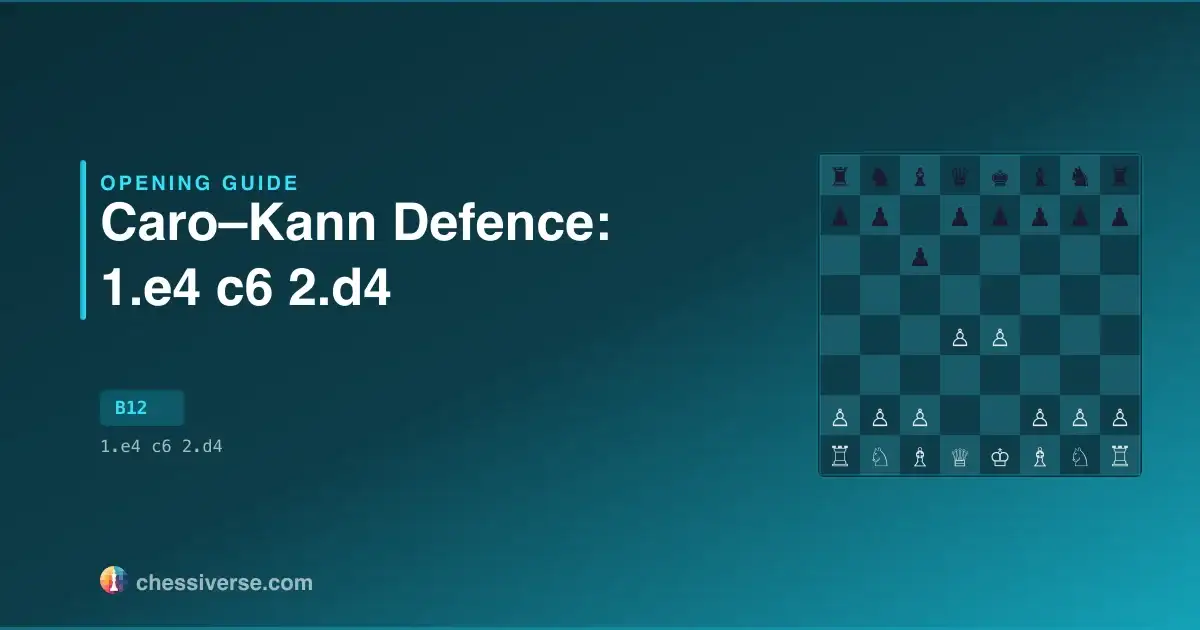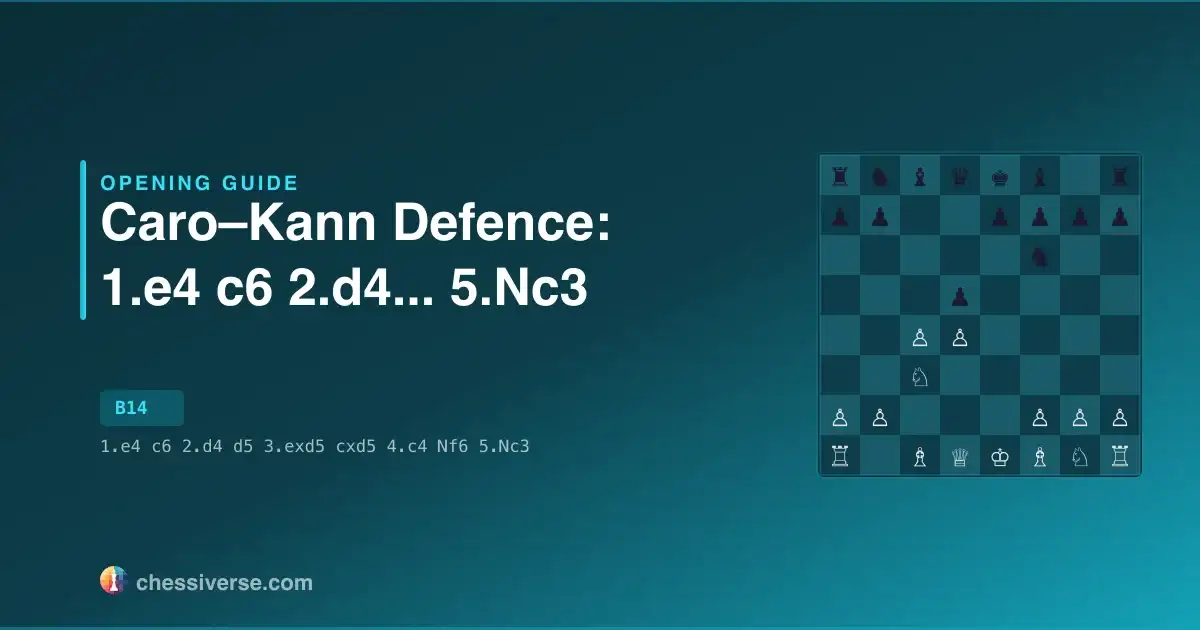




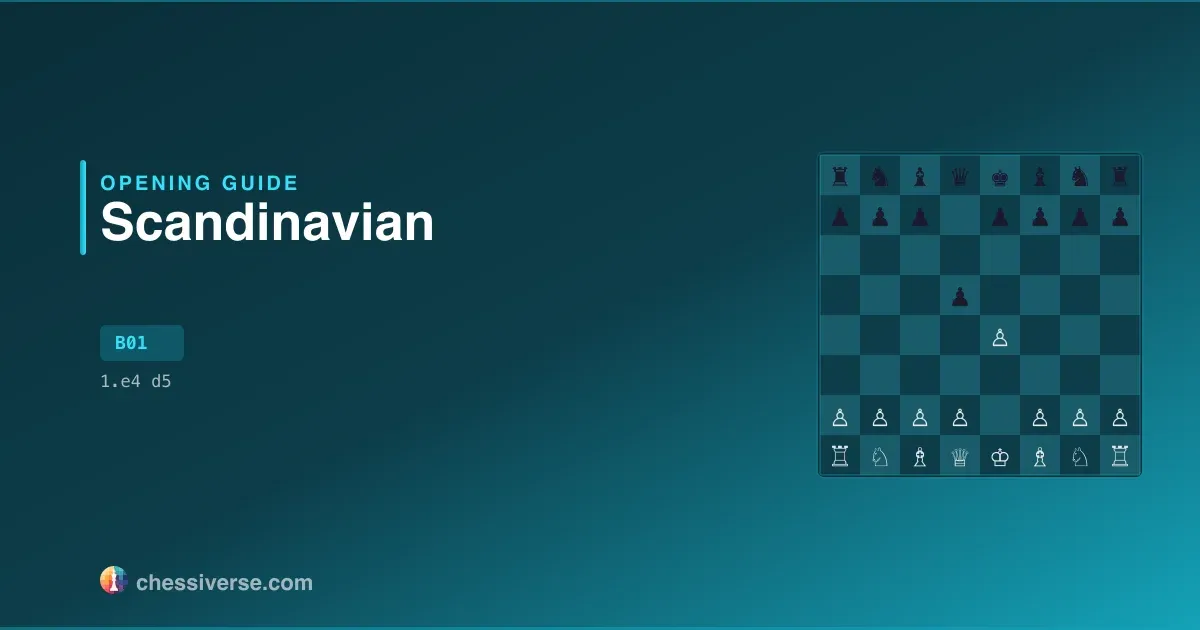
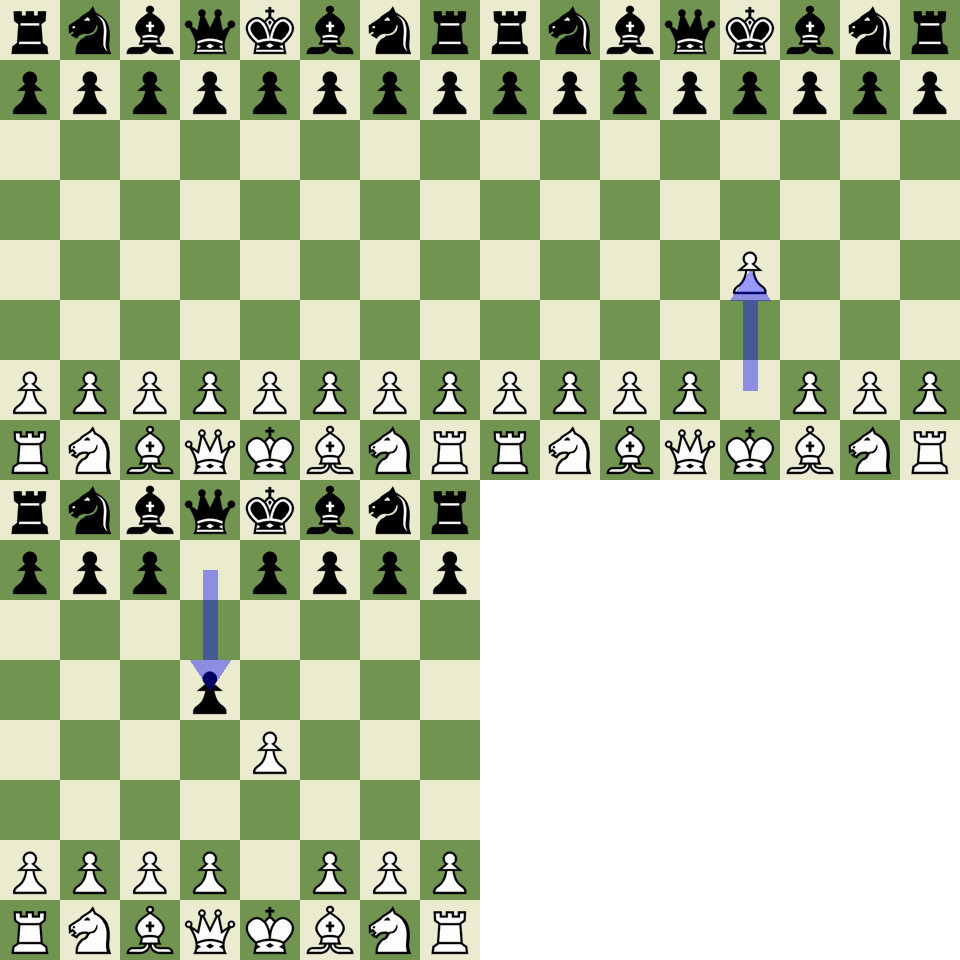
The Scandinavian Defense arises after 1.e4 d5 and falls under ECO code B01. Black confronts White's centre directly from the first move, willing to sacrifice central pawn ambitions and potentially lose tempo in order to disrupt White's plans and open the position immediately. White can capture, defend, or gambit the e-pawn, but 1...d5 is so forcing that the capture 2. exd5 is played in the overwhelming majority of games. The most natural recapture, 2...Qxd5, reveals the opening's main drawback: the queen enters the game too early and becomes a target, allowing White to develop with tempo via 3. Nc3. To avoid this problem, the Modern Variation uses 2...Nf6, planning to exchange knights before recapturing on d5 with the queen so that 5. Nc3 is no longer available as a developing move with tempo. With 268.4 million Lichess games across all rating levels, it is a well-established opening choice.
- Black strikes at e4 on move one to stop White from setting up a pawn centre, steering the game into open positions.
- In the main line Black's queen recaptures on d5 and retreats to a5 when hit by Nc3, trading a tempo for free and easy development.
- With pawns on c6 and e6 Black gets a Caro-Kann-like structure, which is why many Caro-Kann players have added this line to their repertoire.
History and Notable Players
Among the most prolific practitioners on the White side are Sergei Movsesian (31 games), Oleg Korneev (30 games), Robert Zelcic (29 games). On the Black side, notable exponents include Sergei Krivoshey (138 games), Eric Prie (128 games), Sergei Tiviakov (122 games).
The opening features in the earliest recorded game under modern chess rules, in the Catalan poem Scachs d'amor from around 1475, and in Lucena's 1497 manual. Scandinavian masters restored its reputation in the late 1800s, and Anand reached an excellent position with it against Kasparov in their 1995 world championship match.
Named after: Named for Scandinavia; the name replaced Center Counter Defense in recognition of Ludvig Collijn, who played it with success in the late 19th century.
Notable players: Ludvig Collijn, Jacques Mieses, Bent Larsen, Viswanathan Anand
Bent Larsen beat world champion Anatoly Karpov with the Scandinavian at Montreal 1979, a win that spurred a rise in the opening's popularity.
Statistics
Based on 268.4 million Lichess games across all rating levels:
- White wins: 49%
- Black wins: 46.5%
- Draws: 4.4%
The statistics show a roughly balanced opening where both sides have equal chances.
Practice on Chessiverse
The best way to learn the Scandinavian Defense is through practice. On Chessiverse, you can play chess against computer opponents that specialize in this opening. Our AI bots range from beginner to grandmaster level, each with unique playing styles — from aggressive attackers to solid defenders. Choose a bot that matches your rating and work your way up as you master the opening's key ideas.
Performance Across Rating Levels
How well the Scandinavian Defense works depends on what level you're playing at. Among 1200-rated players, it appears in 6.28% of games — 42,357,622 of them on record — with White winning 50.1% and Black 45.9%. By 1800, popularity is 5.40% and White's score is 48.2% to Black's 47%. Among 2500-rated players the line appears in 1.93% of games and draws spike to 10.3%, indicating tight preparation. White's edge erodes by 4.2pp from 1200 to 2500 Elo, suggesting Black's counterplay is easier to find with experience.
Time Control Patterns
The Scandinavian Defense skews toward bullet chess. In bullet, it appears in 7.24% of games (192,479,631); White wins 48.4%. Blitz shows 5.86% adoption across 210,540,924 games, White scoring 48.8%. In rapid, the share rises to 5.23% — 57,843,796 games, White 49.9%.
Move Diversity and Theory Depth
Looking at move selection shows how forcing — or not — the position really is. At 1200 Elo (42,357,622 games), the top reply is exd5, played 59.9% of the time. Three other moves each take at least 5% of games, and the top three moves account for 84.8% of games. Entropy: 1.96. By 2500 (263,836 games), exd5 dominates at 89.4% of replies; only one other move still reaches 5% and the top three moves account for 96.6% of games. Entropy drops to 0.71. That entropy collapse is the signature of a line where preparation pays off: at the top, players know the best move and play it.
Historical Trends
Year-over-year data tells you whether this opening is a contemporary fixture or a fading one. Adoption peaked in 2025 at 6.05% (44,854,876 games). 2025 marks the high — the opening is rising, currently at 6.05%.