
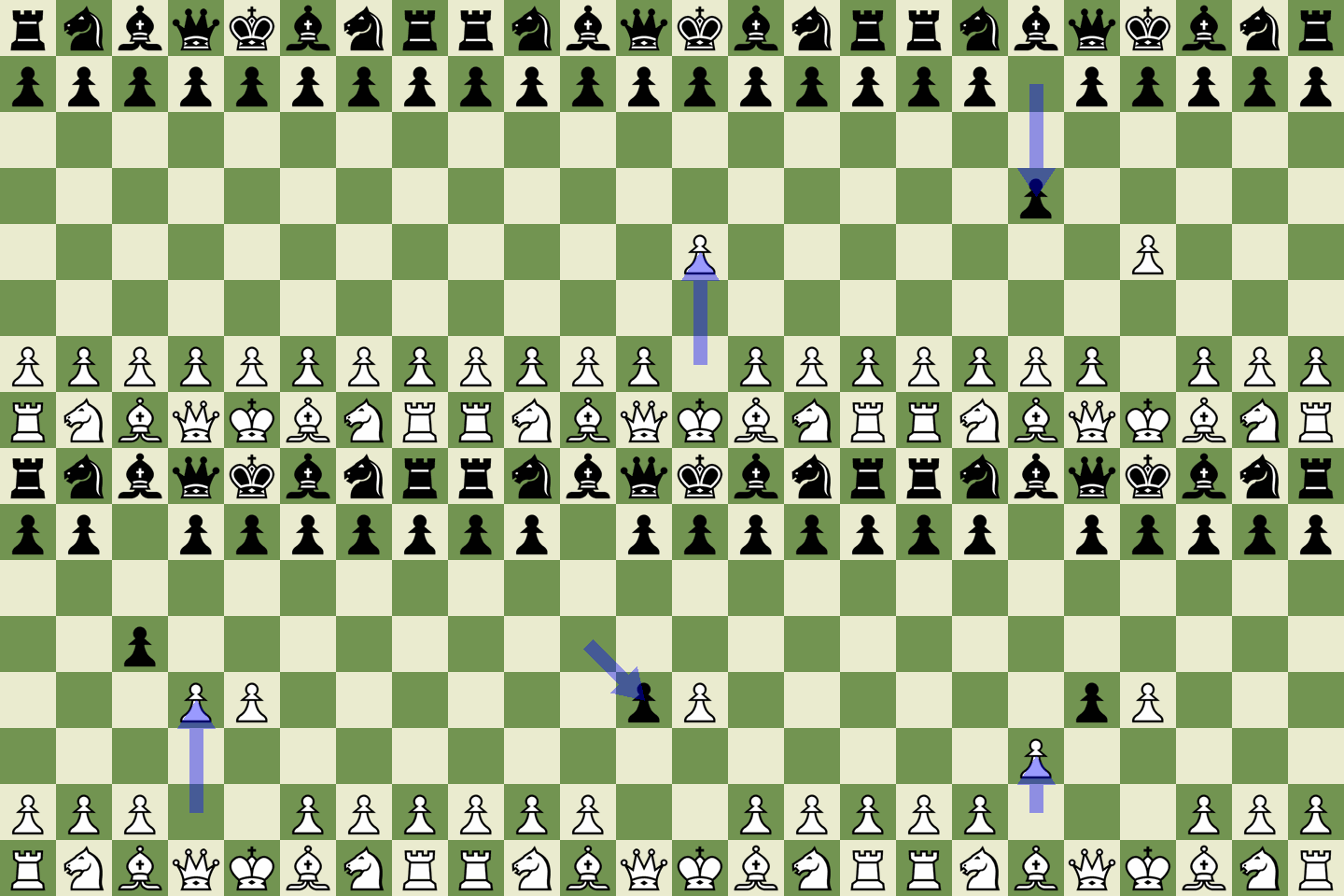
The Sicilian Defense: Smith-Morra Gambit arises after 1.e4 c5 2.d4 cxd4 3.c3 and falls under ECO code B21. White sacrifices a pawn in exchange for accelerated development and open lines on the c- and d-files. Black faces a choice between accepting with 3...dxc3 or declining, most commonly via 3...d3. Since the c3 pawn still occupies the knight's natural developing square, White will spend a tempo on recapturing before the knight can reach c3. With 16.5 million Lichess games across all rating levels, it is a specialized opening choice.
- White gives up a pawn for fast development and a long-lasting initiative, aiming to attack before Black gets castled.
- Rooks press down the c- and d-files, squeezing Black's queenside and center.
- The bishop on c4 eyes f7, feeding tactics against Black's king.
History and Notable Players
It arises from the Sicilian Defense. Among the most prolific practitioners on the White side are Dieter Villing (60 games), Mark L Hebden (54 games), Hafizulhelmi Mas (49 games). On the Black side, notable exponents include Louis Charles Mahe De Labourdonnais (14 games), Howard Staunton (13 games), Lubomir Ftacnik (9 games).
Pierre Morra put out a booklet and articles on the gambit around 1950, and Ken Smith later wrote nine books and forty-nine articles about it. Older labels like Tartakower Gambit and Matulovic Gambit have faded, and the line still surfaces at the top: Nakamura wielded it against Caruana in rapid games at the 2023 Chessable Masters.
Named after: Named for Pierre Morra (1900-1969), a French player who published on it around 1950, and Ken Smith (1930-1999) of the Dallas Chess Club.
Notable players: Ken Smith, Marc Esserman, Hikaru Nakamura
When Ken Smith trotted out his beloved gambit against Byrne, Evans and Mecking at San Antonio 1972, he lost all three games; yet decades later IM Marc Esserman used it to beat grandmasters including Loek van Wely.
Statistics
Based on 16.5 million Lichess games across all rating levels:
- White wins: 50.3%
- Black wins: 45.5%
- Draws: 4.2%
The statistics show a roughly balanced opening where both sides have equal chances.
Common Mistakes to Avoid
- Overextending without backup: When playing a gambit, each attacking move should have a purpose. Random checks and threats without coordination can leave your own position exposed once the initiative fades.
Practice on Chessiverse
The best way to learn the Sicilian Defense: Smith-Morra Gambit is through practice. On Chessiverse, you can play chess against computer opponents that specialize in this opening. Our AI bots range from beginner to grandmaster level, each with unique playing styles — from aggressive attackers to solid defenders. Choose a bot that matches your rating and work your way up as you master the opening's key ideas.
Performance Across Rating Levels
Popularity and results vary sharply by rating level. At 1200 Elo, the opening shows up in 0.10% of games (642,277 samples). White scores 51%, Black 46.2%, draws 2.9%. At 1800 the opening surfaces in 0.60% of games; White wins 50.8%, Black 45.1%, draws 4.1%. At 2500, 0.43% of games go into this opening; draws sit at 8.2% — the line is well-mapped at this level. White's edge erodes by 3.3pp from 1200 to 2500 Elo, suggesting Black's counterplay is easier to find with experience.
Time Control Patterns
Time control matters here: blitz players reach for this opening more than others. In bullet, it appears in 0.27% of games (7,265,216); White wins 50.8%. Blitz shows 0.38% adoption across 13,721,209 games, White scoring 50.3%. In rapid, the share rises to 0.25% — 2,753,418 games, White 50.4%.
Move Diversity and Theory Depth
Move choice is far from uniform in the Sicilian Defense: Smith-Morra Gambit. At 1200 Elo (642,277 games), the top reply is dxc3, played 70.6% of the time. One other move takes at least 5% of games, and the top three moves account for 90.7% of games. Entropy: 1.54. By 2500 (59,153 games), dxc3 is still the top reply, at 40.8%; three other moves reach 5% and the top three moves account for 85.2% of games. Entropy rises to 2.21. Even elite players don't fully agree on the best continuation here, which keeps the position dynamic.
Historical Trends
Tracking the Sicilian Defense: Smith-Morra Gambit year over year shows a clear story. Adoption peaked in 2015 at 0.39% (87,025 games). By 2025 it sits at 0.34%, 14% below the peak but still 91% above its 2013 level, so the line is up over the full period despite easing from the high.