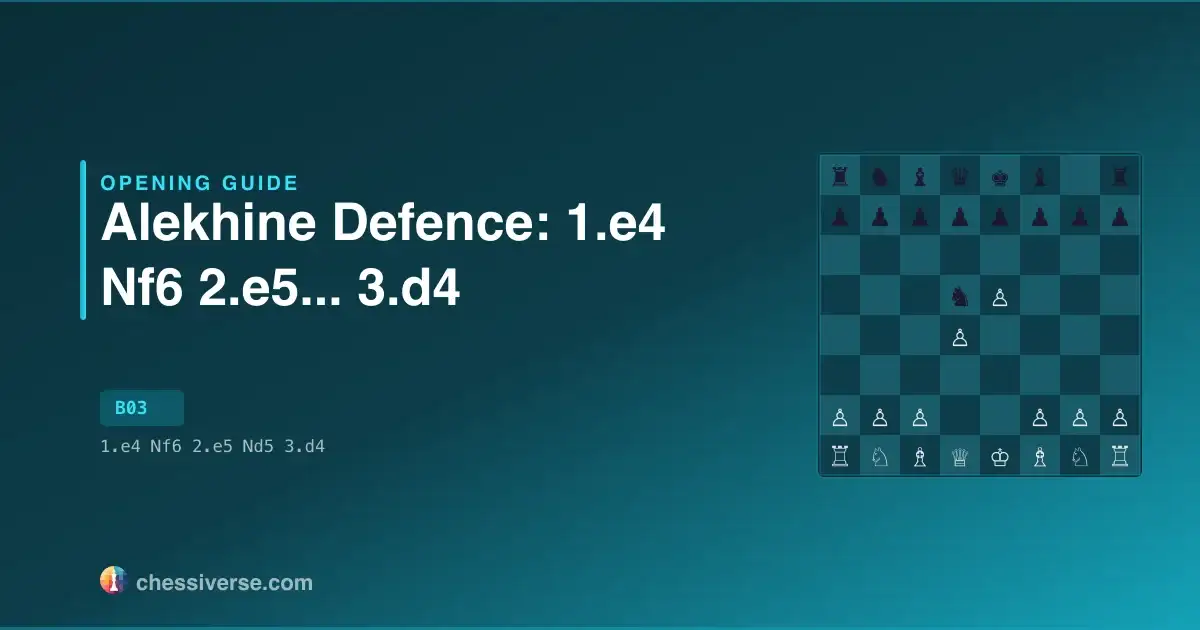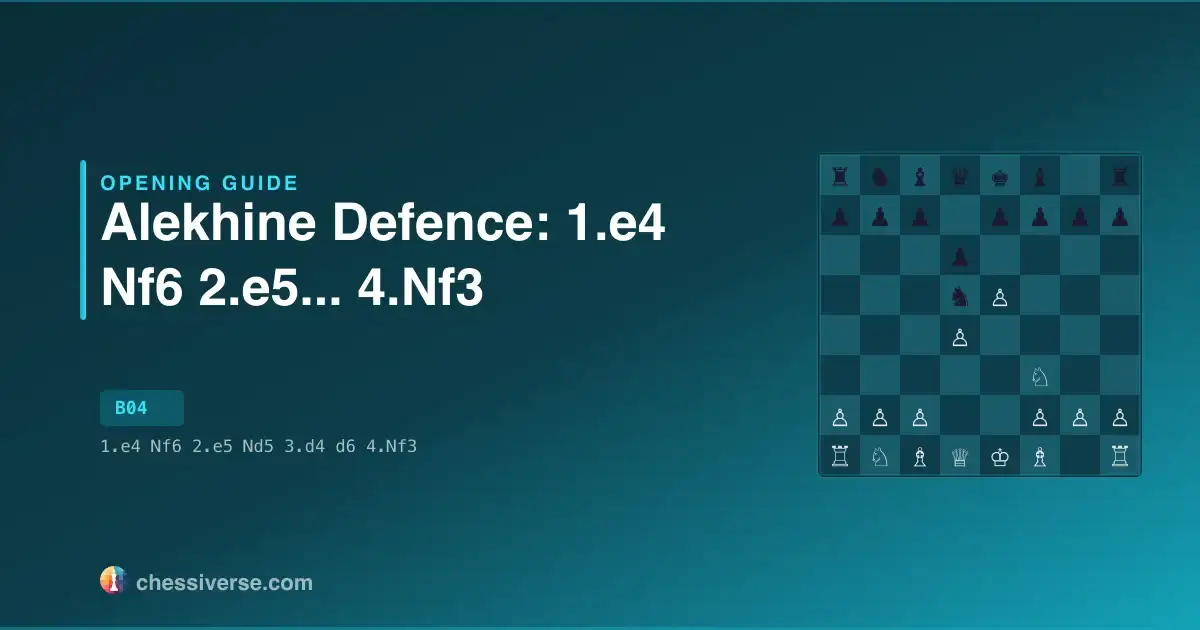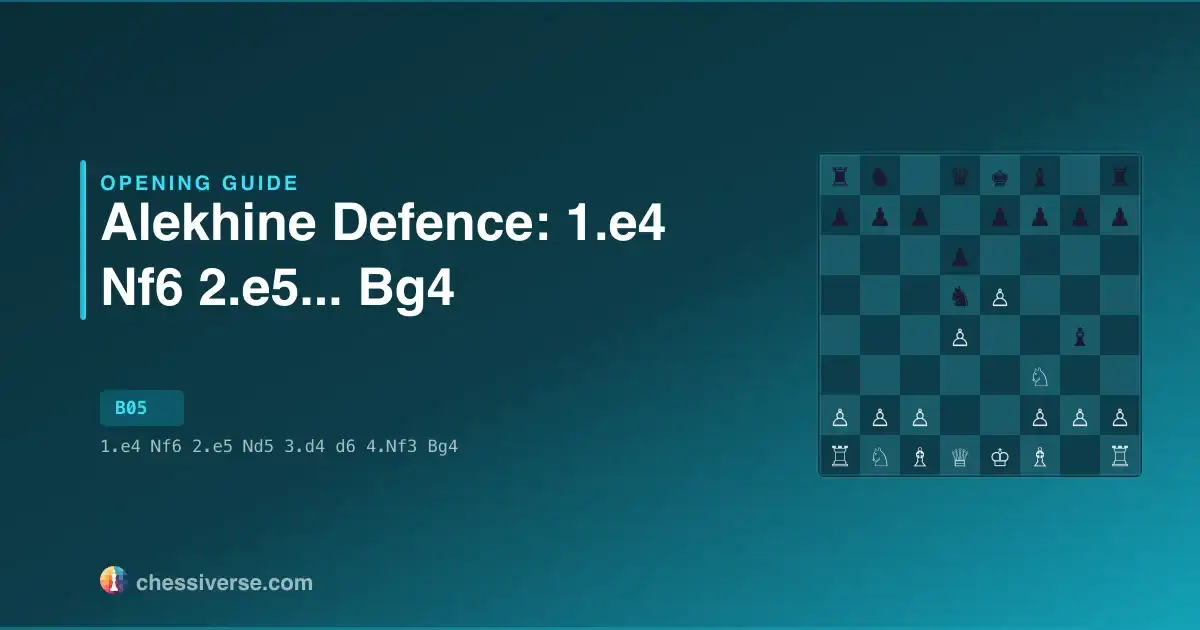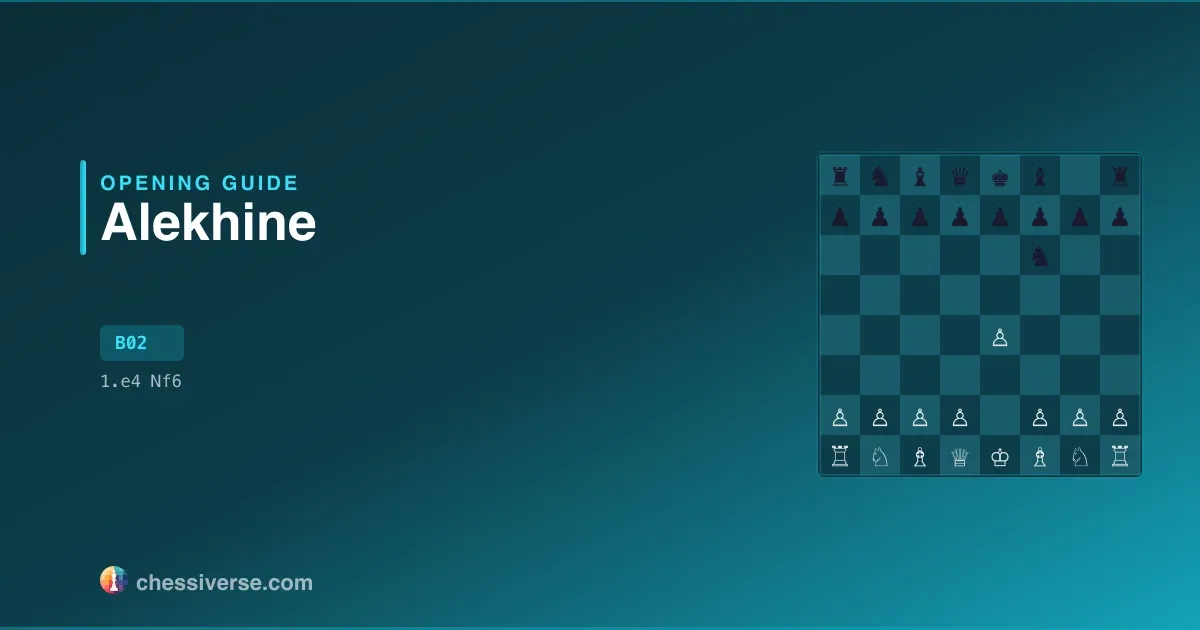
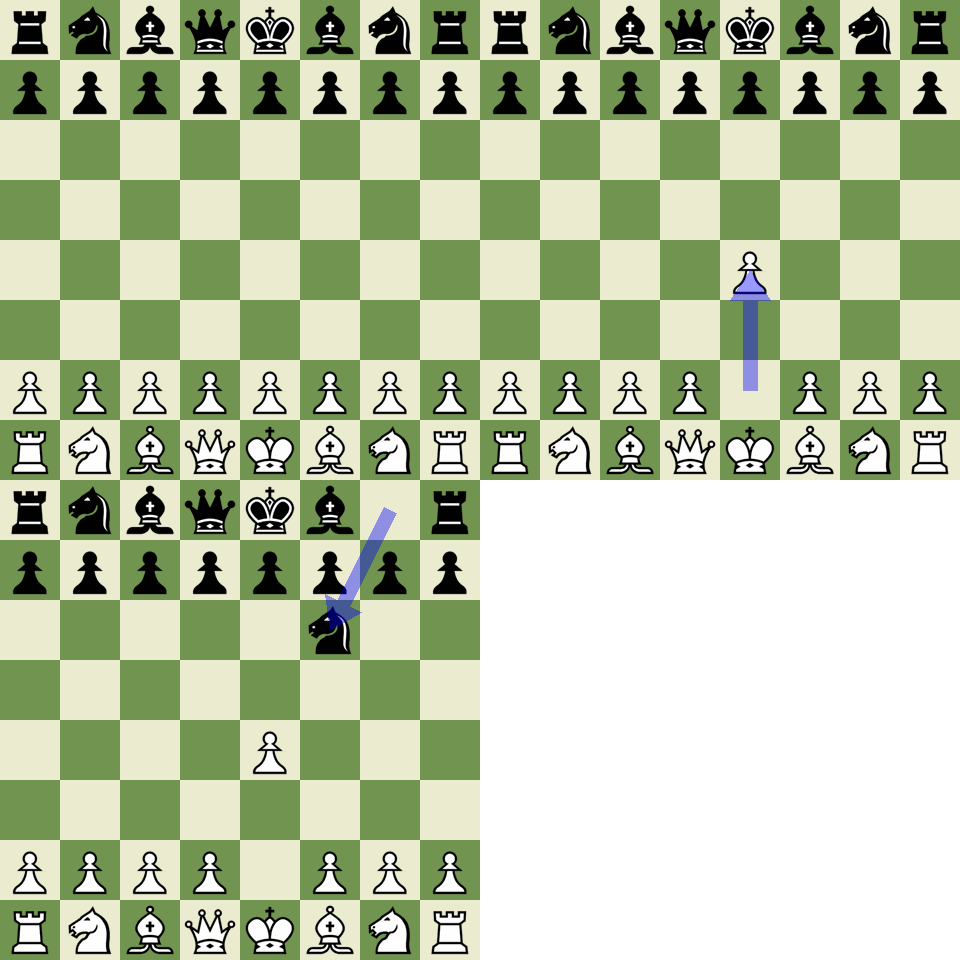
The Alekhine Defense arises after 1.e4 Nf6 and falls under ECO code B02. The central concept behind the Alekhine is to invite White to push their center pawns forward, creating targets that Black intends to chip away at later. Although uncommon at the master level, the opening is fundamentally sound. White's most frequent reply is 2. e5, gaining space and aspiring to build a broad center with d4, then c4, and occasionally even f4, while Black bides time before counterattacking the overextended pawn chain. If White prefers to sidestep the main line, 2. Nc3 is a solid alternative that can transpose into the Vienna Game. There is also the sharp Krejcik Variation with 2. Bc4, which appears to offer a pawn but actually sets a trap: after 2...Nxe4, White plays 3. Bxf7+ Kxf7 4. Qh5+, regaining the material and stripping Black of castling rights. The opening bears the name of Alexander Alekhine, who first employed it in 1921, though the detailed theory and main lines were developed considerably later. With 47 million Lichess games across all rating levels, it is a well-established opening choice.
- Black invites White's pawns to advance and build a big centre, planning to undermine and attack it later
- White must decide how ambitiously to chase the knight, since an overextended pawn centre can become a target
History and Notable Players
Among the most prolific practitioners on the White side are Eduardas Rozentalis (35 games), Heikki MJ Westerinen (34 games), Gyula Sax (32 games). On the Black side, notable exponents include Zoltan Varga (204 games), Vladimir Sergeev (184 games), Alexander Baburin (179 games).
Alekhine unveiled the defence at Budapest 1921 in games against Steiner and Saemisch, and 1920s theory found it bizarre and contrary to classical principles. Fischer used it twice against Spassky in the 1972 World Championship and Korchnoi kept it in his repertoire, which gave it a respectable reputation, though it is less common at the top level today.
Named after: Alexander Alekhine, who introduced it at the Budapest tournament of 1921.
Notable players: Alexander Alekhine, Bobby Fischer, Viktor Korchnoi, Vassily Ivanchuk
One of the oldest recorded games with this defence is attributed to Napoleon Bonaparte in the 19th century, long before Alekhine gave it his name, and Napoleon won the game.
Statistics
Based on 47 million Lichess games across all rating levels:
- White wins: 48.4%
- Black wins: 46.9%
- Draws: 4.6%
The statistics show a roughly balanced opening where both sides have equal chances.
Main Lines and Variations
After 1.e4 Nf6, the main continuations include:
Each of these lines leads to distinct types of positions and requires its own understanding of the resulting pawn structures and piece placements.
Practice on Chessiverse
The best way to learn the Alekhine Defense is through practice. On Chessiverse, you can play chess against computer opponents that specialize in this opening. Our AI bots range from beginner to grandmaster level, each with unique playing styles — from aggressive attackers to solid defenders. Choose a bot that matches your rating and work your way up as you master the opening's key ideas.
Performance Across Rating Levels
Popularity and results vary sharply by rating level. The 1200 bracket has 4,981,775 games (0.74% of all games at that level); White wins 52.3%, Black 43.8%, 3.8% are drawn. By 1800, popularity is 1.11% and White's score is 45.6% to Black's 49.7%. At 2500, 1.32% of games go into this opening; draws sit at 9.4% — the line is well-mapped at this level. White's edge erodes by 5.1pp from 1200 to 2500 Elo, suggesting Black's counterplay is easier to find with experience.
Time Control Patterns
The Alekhine Defense skews toward bullet chess. In bullet, it appears in 1.41% of games (37,581,394); White wins 48.6%. Blitz shows 1.04% adoption across 37,245,662 games, White scoring 47.9%. In rapid, the share rises to 0.88% — 9,740,625 games, White 50.3%. White's score swings 2.4pp across formats, so time control isn't just a stylistic choice here — it shifts the actual results.
Move Diversity and Theory Depth
What players actually play after the opening moves depends heavily on rating. At 1200 Elo (4,981,775 games), the top reply is Nc3, played 39.9% of the time. Three other moves each take at least 5% of games, and the top three moves account for 80% of games. Entropy: 2.33. By 2500 (179,896 games), e5 takes over as the top reply at 76%; only one other move still reaches 5% and the top three moves account for 98.5% of games. Entropy drops to 1.06. That entropy collapse is the signature of a line where preparation pays off: at the top, players know the best move and play it.
Historical Trends
Long-term, the trajectory of this opening is informative. Adoption peaked in 2016 at 1.13% (699,683 games). By 2025 it sits at 0.94%, 17% below the peak and roughly back to its 2013 level, leaving the line flat over the full period.