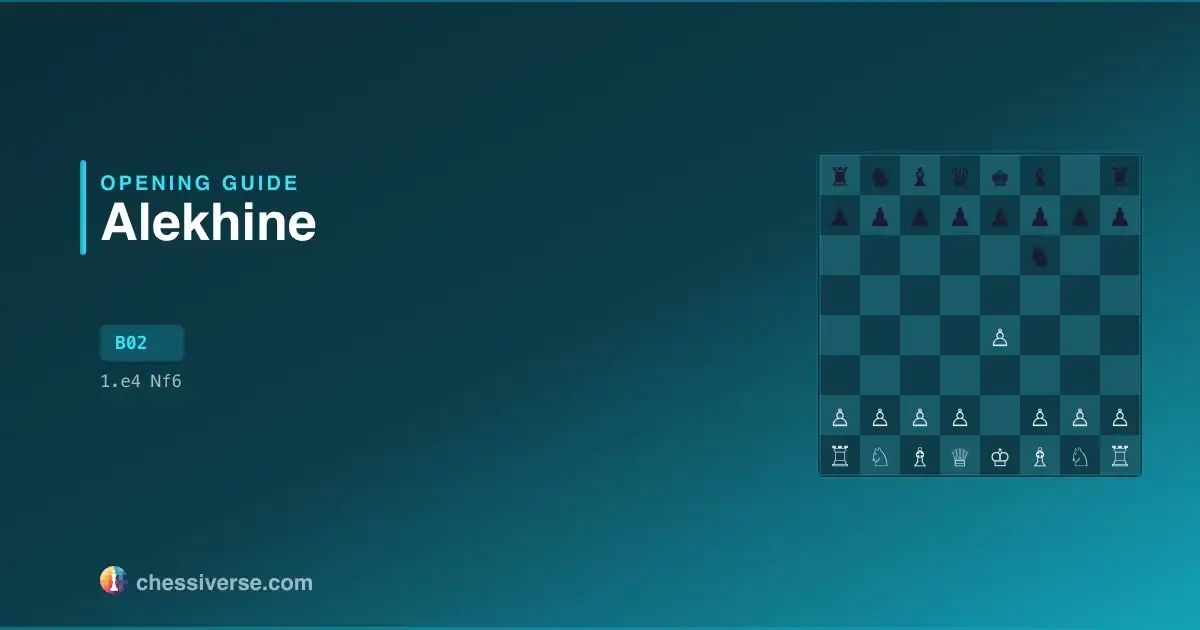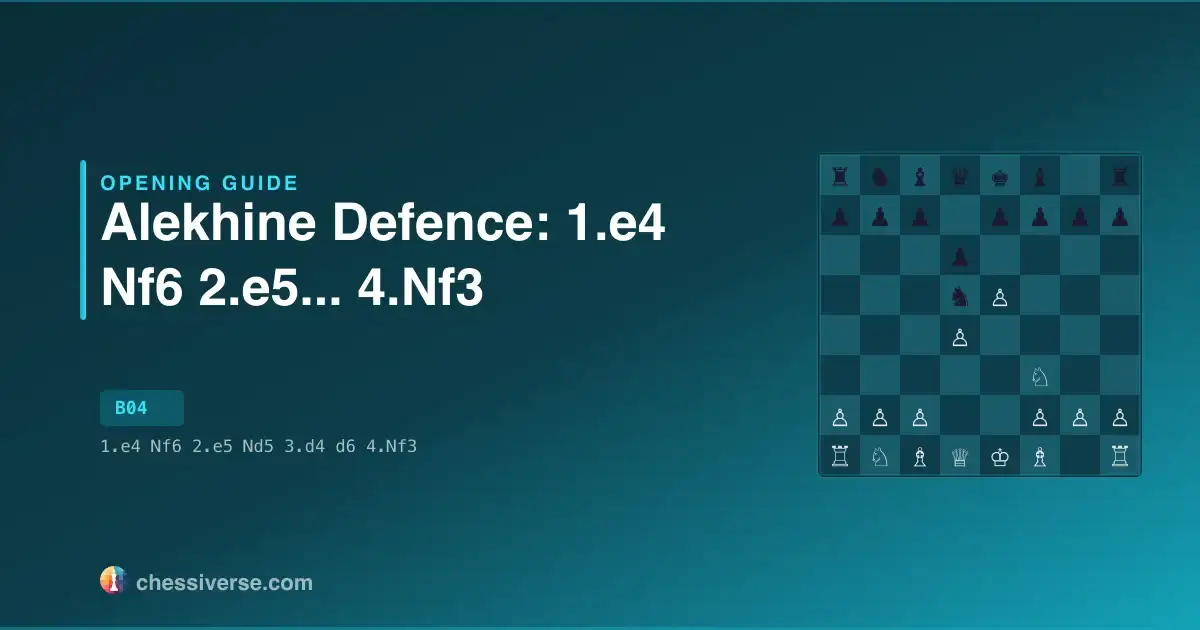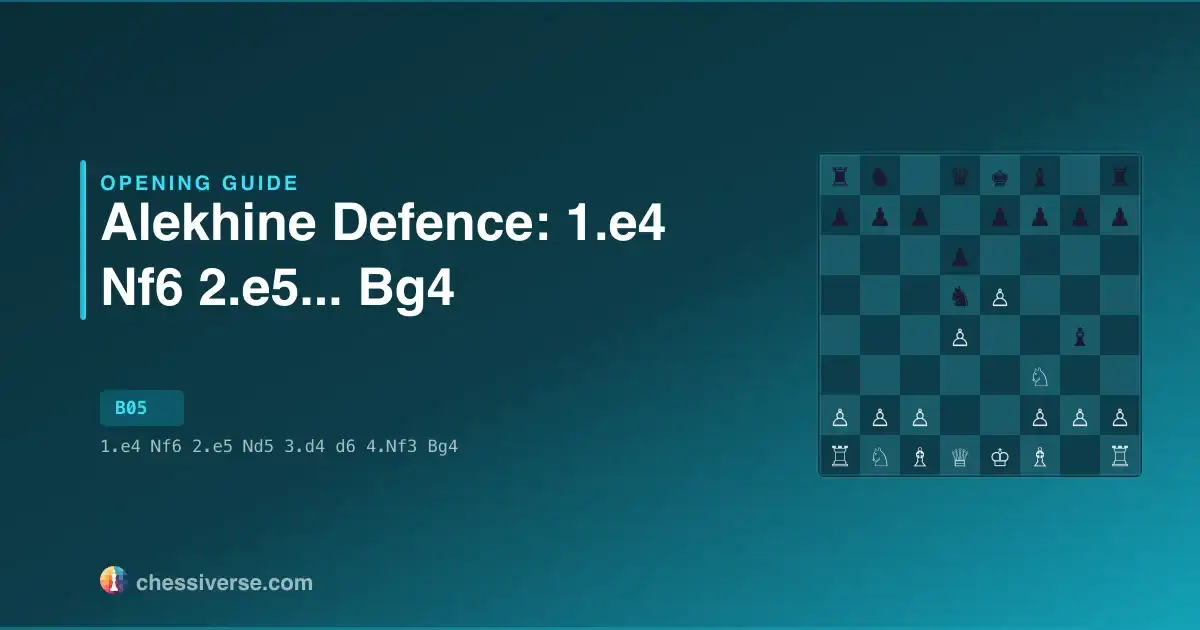


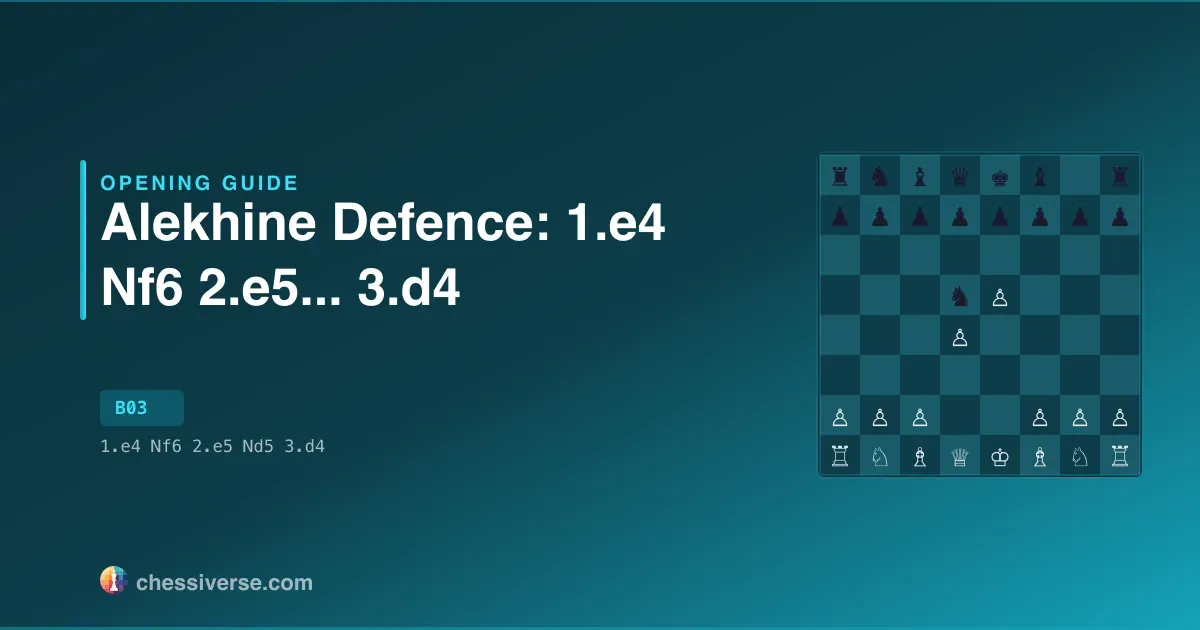
Starting from 1.e4 Nf6 2.e5 Nd5 3.d4, players enter the Alekhine Defense — ECO B03. White grabs the full center while Black's knight sits on d5, daring Black to break it down before it consolidates. The whole opening lives or dies on Black's central counterstrike.
Strategic Overview
With the knight finally tucked safely on d5, Black starts attacking the center White has been encouraged to build. The two main counters are 3...d6 and 3...e6 — both immediately challenge e5 and force White to commit to a structure. 3...d6 is the modern main line; it undermines e5 directly and prepares the standard Alekhine middlegame where Black accepts less space in return for clear targets. 3...e6 is more compact and flexible, often transposing into French-like structures. The strategic story is that White is overextended on purpose: he's accepted a big center knowing it can become a target, and his bet is that the lead in space and development will outweigh any structural concessions. Black, on the other hand, is happy to provoke pawn advances and then chip away with ...c5, ...c6, ...Nb6, ...Nc6, and timely piece pressure on d4 and e5. The fight is between White's mass and Black's piece activity. The 3...b5 O'Sullivan Gambit is a curiosity — it's tricky and has surprised plenty of opponents, but it's not theoretically sound, and against accurate play White comes out clearly better.
Key Ideas
A few ideas come up again and again in this opening:
- 3...d6 is the main strike — Hitting e5 immediately is the principled approach. It forces White to make a structural decision — push, exchange, or maintain — and gives Black a clear plan for chipping away at the big center.
- 3...e6 keeps things flexible — A quieter approach that often transposes into French-like positions. Black trades a bit of dynamism for a more solid structure and avoids the sharpest theoretical lines.
- Provoke, then punish — Black's whole opening philosophy is to invite White's pawns forward so they become targets. The d5-knight isn't running away, it's daring the center to overcommit.
- Space versus activity — White has more room and a faster development, Black has clearer targets and active piece play. Whoever gets the structure they want first usually dictates the middlegame.
- Skip the O'Sullivan — 3...b5 is tricky as a surprise weapon but objectively dubious. Against prepared opposition Black just ends up worse without compensation.
History and Notable Players
It arises from the Alekhine Defense. On the White side, Gyula Sax (30 games), Lothar Vogt (30 games), Viktor D Kupreichik (29 games) top the database. Notable Black exponents: Zoltan Varga (157 games), Alexander Baburin (136 games), Lev O Alburt (124 games).
Performance Across Rating Levels
Popularity and results vary sharply by rating level. The 1200 bracket has 444,188 games (0.07% of all games at that level); White wins 53.2%, Black 43.4%, 3.4% are drawn. At 1800 the opening surfaces in 0.25% of games; White wins 45.8%, Black 49.7%, draws 4.5%. At 2500, 0.60% of games go into this opening; draws sit at 9.4% — the line is well-mapped at this level. White's edge erodes by 5.0pp from 1200 to 2500 Elo, suggesting Black's counterplay is easier to find with experience.
Time Control Patterns
The Alekhine Defense skews toward bullet chess. In bullet, it appears in 0.23% of games (6,057,630); White wins 49%. Blitz shows 0.19% adoption across 6,838,431 games, White scoring 47.4%. In rapid, the share rises to 0.10% — 1,101,578 games, White 49.3%.
Move Diversity and Theory Depth
Move choice is far from uniform in the Alekhine Defense (3.d4). At 1200 Elo (444,188 games), the top reply is d6, played 38.5% of the time. Two other moves each take at least 5% of games, and the top three moves account for 79.2% of games. Entropy: 2.48. By 2500 (81,419 games), d6 dominates at 91.4% of replies; only one other move still reaches 5% and the top three moves account for 98.6% of games. Entropy drops to 0.54. The narrowing is significant — strong players consolidate around a small set of best moves, while amateurs scatter across many plausible-looking options.
Main Lines and Variations
From the position after 1.e4 Nf6 2.e5 Nd5 3.d4, the recognised continuations are:
Each branch leads to a different middlegame character — the resulting pawn structure decides what kind of game you get.
Common Mistakes
- Drifting away from main theory — At 400 Elo, the three most-played moves cover 72.6% of games, against 95.1% at 2000. The most popular deviation is e6 (played 26.6% of the time at 400, much less so up top). It looks fine but quietly hands the better-prepared side an edge.
- Neglecting development — Extra pawn moves in the opening are tempting, especially when you "know the moves". Developing a piece each turn is the simple correction.
- Playing without a plan — Each Alekhine Defense middlegame demands a specific approach. Decide whether the position calls for attack, manoeuvre, or simplification before reaching for a move.
Practice on Chessiverse
Ready to try the Alekhine Defense against a bot? Pick an opponent at your level and play a game.