



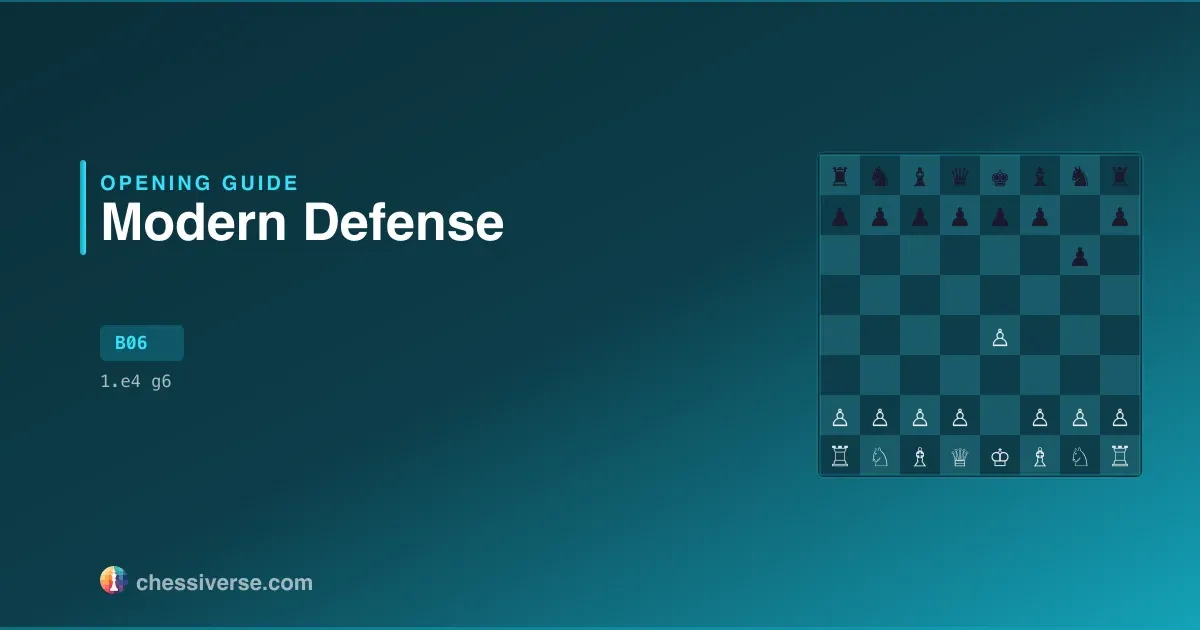
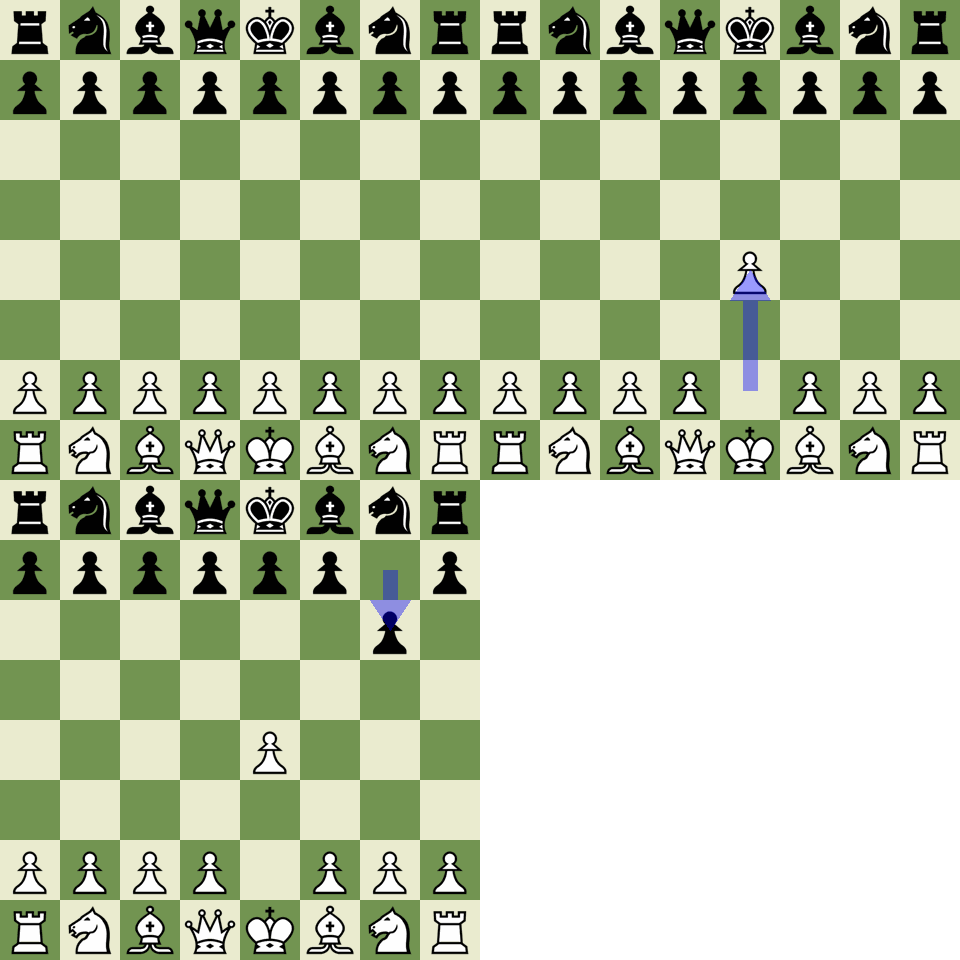
The Modern Defense arises after 1.e4 g6 and falls under ECO code B06. Also called the Robatsch Defense after Karl Robatsch, this hypermodern opening sees Black preparing to fianchetto the bishop to g7, conceding space and a classical centre to White with the intention of undermining it later. The concept resembles the Pirc (1...d6), where Black also aims to fianchetto and pressure e4 with ...Nf6, but needs ...d6 first to prevent e5. In the Modern, Black sidesteps this by delaying any commitment on the g8 knight, prioritizing 1...g6 and 2...Bg7 instead, with ...d6 and ...Nf6 potentially following later. White typically occupies the centre with 2. d4, after which Black completes the fianchetto with 2...Bg7. From here, 3. Nc3 d6 is the usual continuation, but because Black has not yet played ...Nf6 to threaten e4, White can also try 3. c4, reaching a structure more commonly associated with the King's Indian Defense, or 3. Nf3. Historically, the earliest Modern Defences appeared in the 19th century using a 1...g6 and 2...e6 setup, which fared poorly in an era dominated by open, tactical chess, and the opening's reputation suffered notably when Wilhelm Steinitz dispatched Augustus Mongredien's Modern Defense in under 30 moves. It took decades before players learned to harness the opening's flexibility and dynamic potential. With 78 million Lichess games across all rating levels, it is a well-established opening choice.
History and Notable Players
It arises from the King's Pawn Game. Among the most prolific practitioners on the White side are Heikki MJ Westerinen (62 games), Michele Godena (54 games), Evgeny Sveshnikov (44 games). On the Black side, notable exponents include Colin Anderson McNab (323 games), Boris Chatalbashev (187 games), Peter Petran (182 games).
Statistics
Based on 78 million Lichess games across all rating levels:
- White wins: 48.9%
- Black wins: 46.8%
- Draws: 4.3%
The statistics show a roughly balanced opening where both sides have equal chances.
Main Lines and Variations
After 1.e4 g6, the main continuations include:
Each of these lines leads to distinct types of positions and requires its own understanding of the resulting pawn structures and piece placements.
Common Mistakes to Avoid
- Allowing White to build an overwhelming center: Hypermodern openings allow White space in the center, but you need to strike back at the right moment. Delaying the counterattack too long can leave you without active play.
Practice on Chessiverse
The best way to learn the Modern Defense is through practice. On Chessiverse, you can play chess against computer opponents that specialize in this opening. Our AI bots range from beginner to grandmaster level, each with unique playing styles — from aggressive attackers to solid defenders. Choose a bot that matches your rating and work your way up as you master the opening's key ideas.
Performance Across Rating Levels
Popularity and results vary sharply by rating level. The 1200 bracket has 9,693,157 games (1.44% of all games at that level); White wins 48.7%, Black 47.4%, 3.9% are drawn. At 1800 the opening surfaces in 1.89% of games; White wins 49.3%, Black 46.2%, draws 4.5%. Among 2500-rated players the line appears in 1.59% of games and draws spike to 8.5%, indicating tight preparation.
Time Control Patterns
Time control matters here: bullet players reach for this opening more than others. In bullet, it appears in 2.60% of games (69,239,622); White wins 48.5%. Blitz shows 1.79% adoption across 64,191,206 games, White scoring 48.8%. In rapid, the share rises to 1.25% — 13,845,656 games, White 49%.
Move Diversity and Theory Depth
Looking at move selection shows how forcing — or not — the position really is. At 1200 Elo (9,693,157 games), the top reply is d4, played 34.6% of the time. Three other moves each take at least 5% of games, and the top three moves account for 78.7% of games. Entropy: 2.47. By 2500 (217,509 games), d4 dominates at 81% of replies; only one other move still reaches 5% and the top three moves account for 92.1% of games. Entropy drops to 1.15. The narrowing is significant — strong players consolidate around a small set of best moves, while amateurs scatter across many plausible-looking options.
Historical Trends
Year-over-year data tells you whether this opening is a contemporary fixture or a fading one. Adoption peaked in 2024 at 1.72% (12,817,395 games). By 2025 it sits at 1.71%, 1% below the peak and roughly back to its 2013 level, leaving the line flat over the full period.