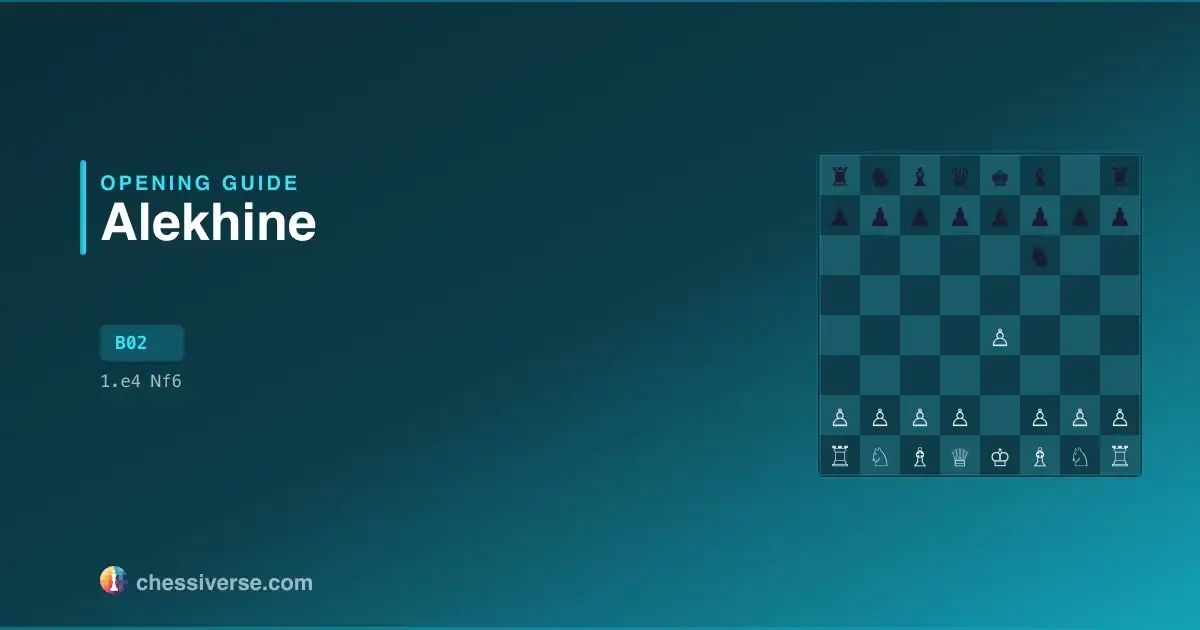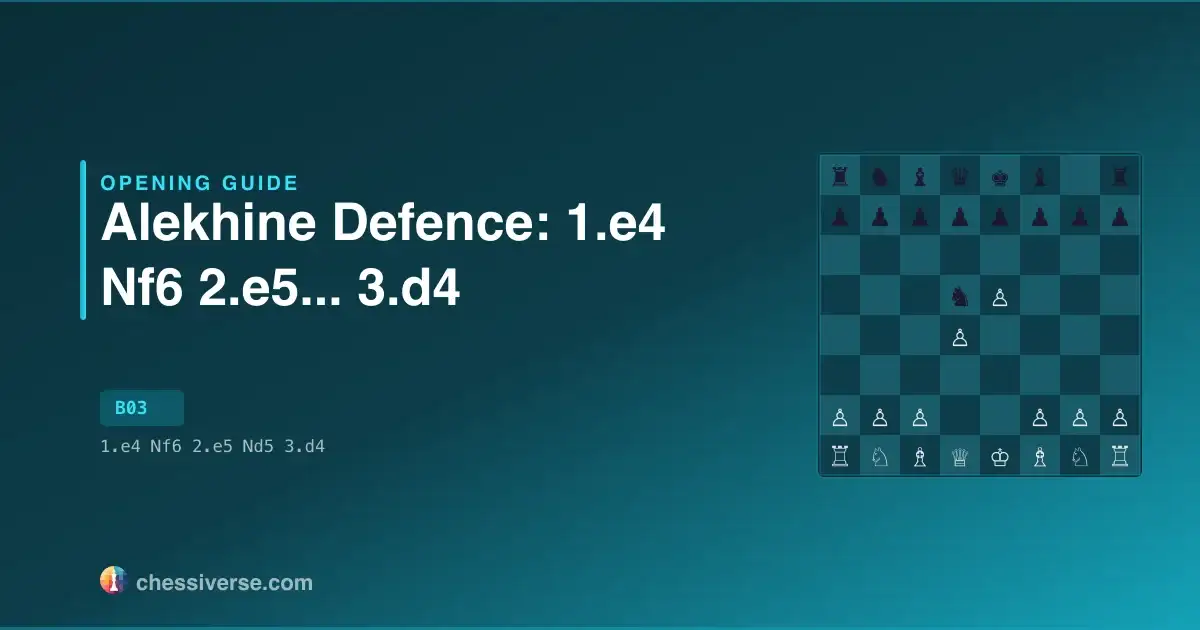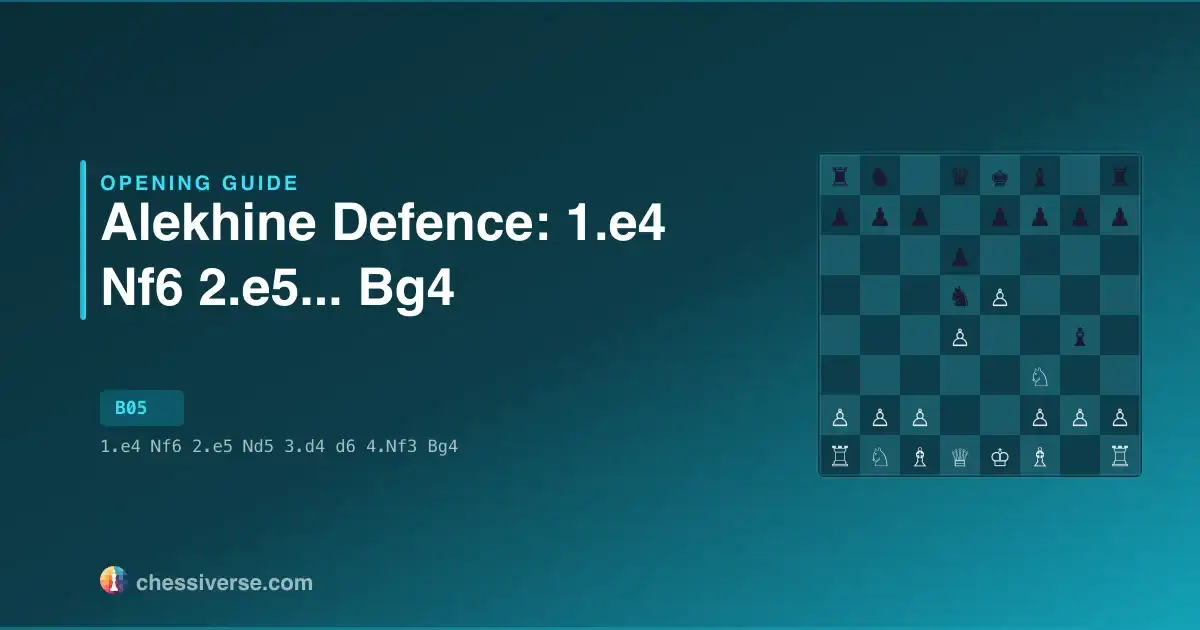




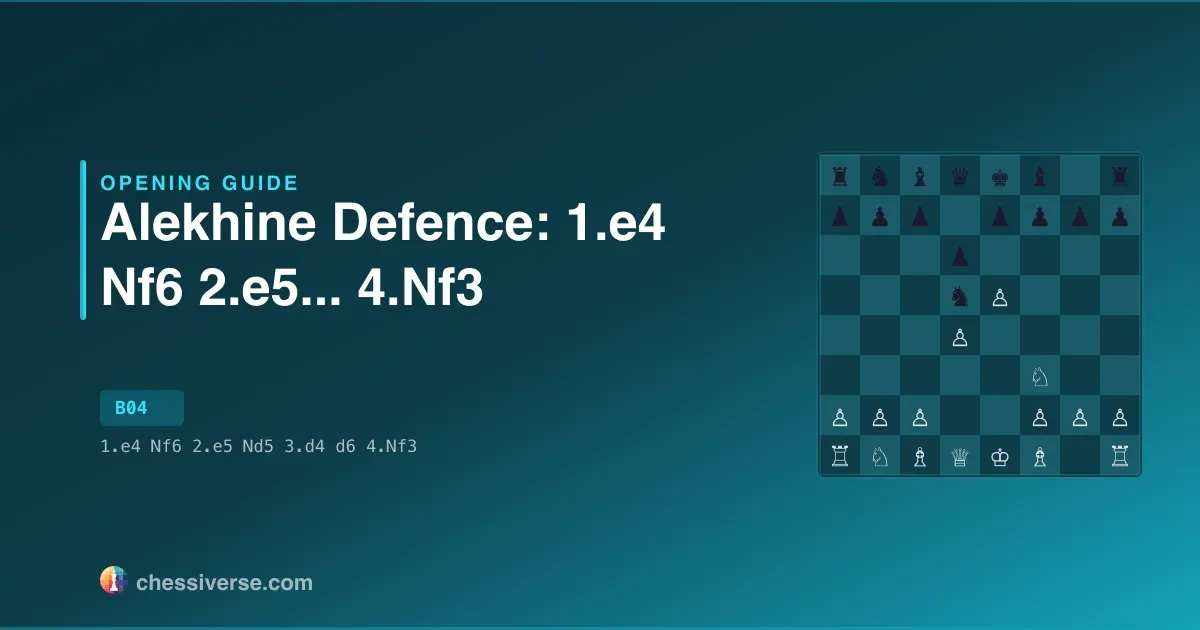
1.e4 Nf6 2.e5 Nd5 3.d4 d6 4.Nf3 opens the Alekhine Defense: Modern Variation, ECO B04. White takes the calm route — develop the kingside knight, keep the center intact, and let Black's space disadvantage do the work over time. The danger for Black is sliding into passivity.
Strategic Overview
The Modern Variation with 4.Nf3 is White's most respected setup against the Alekhine. Rather than charging forward with the Four Pawns Attack, White settles for a slightly smaller but rock-solid center and focuses on harmonious development. The plan is straightforward: Nf3, Be2, 0-0, c4 or h3 depending on Black's setup, and pressure the cramped position. Black has to be careful here because his pieces don't have much room — the knight on d5 needs to find a sensible square, the c8-bishop wants out, and ...c6, ...e6, or the sharp ...Bg4 are all standard ways to free things up. The 4...Bg4 line in particular is the most active reply, pinning the f3-knight and threatening to dent White's structure by trading bishop for knight. Black's standard counterplay involves chipping at e5 with ...c6 and ...Nb6, or contesting the center with ...g6, ...Bg7 and a kingside fianchetto. The whole opening is a slow-burn positional struggle: White has space and easier development, Black has the targets to work with, and the player who handles the maneuvering better tends to win. Passive defense loses; active piece play keeps things balanced.
Key Ideas
A few ideas come up again and again in this opening:
- Avoid passive play at all costs — Black's biggest enemy in this line isn't White's attack, it's the space disadvantage. Without active piece play and timely pawn breaks, the position slowly suffocates. Every move has to fight for activity.
- Black has less space and must use it well — Cramped positions are tolerable if every piece is well placed. The knight on d5 needs a stable square, the c8-bishop needs an outlet, and trades that ease the congestion are usually welcome.
- White trades space for solidity — By choosing 4.Nf3 over the Four Pawns Attack, White accepts a less ambitious setup in exchange for fewer structural risks. The bet is that Black's cramped position is harder to play than White's.
- Pawn breaks are Black's lifeline — Without ...c5, ...c6, or ...e6 at the right moment, Black just sits in a worse position. Picking the right break against White's specific setup is the central strategic decision.
History and Notable Players
It arises from the Alekhine Defense (3.d4). On the White side, Lothar Vogt (30 games), Michele Godena (26 games), Vlastimil Jansa (23 games) top the database. Notable Black exponents: Lev O Alburt (106 games), Zoltan Varga (98 games), Vladimir Bagirov (87 games).
Performance Across Rating Levels
Popularity and results vary sharply by rating level. The 1200 bracket has 63,481 games (0.01% of all games at that level); White wins 51.5%, Black 44.6%, 3.9% are drawn. Move up to 1800 Elo and the share shifts to 0.05%, with White winning 46% versus Black's 49%. At the top end (2500+ Elo), popularity is 0.31% with 10% draws — a clear sign of how much theory rules the line at master level. Positions also become less sharp as level rises (sharpness 0.96 → 0.90).
Time Control Patterns
Look at the same opening across time controls and blitz stands out. In bullet, it appears in 0.04% of games (1,016,863); White wins 50%. Blitz shows 0.04% adoption across 1,519,956 games, White scoring 47.5%. In rapid, the share rises to 0.02% — 214,142 games, White 47.8%. White's score swings 2.5pp across formats, so time control isn't just a stylistic choice here — it shifts the actual results.
Move Diversity and Theory Depth
Move choice is far from uniform in the Alekhine Defense: Modern Variation. At 1200 Elo (63,481 games), the top reply is dxe5, played 36.8% of the time. Three other moves each take at least 5% of games, and the top three moves account for 77% of games. Entropy: 2.54. By 2500 (42,105 games), Bg4 takes over as the top reply at 34.4%; only two other moves still reach 5% and the top three moves account for 88.5% of games. Entropy drops to 2.13.
Main Lines and Variations
The main branches off 1.e4 Nf6 2.e5 Nd5 3.d4 d6 4.Nf3 include:
Each branch leads to a different middlegame character — the resulting pawn structure decides what kind of game you get.
Common Mistakes
- Drifting away from main theory — At 400 Elo, the three most-played moves cover 69.7% of games, against 83% at 2000. The most popular deviation is f6 (played 9.5% of the time at 400, much less so up top). It looks fine but quietly hands the better-prepared side an edge.
- Neglecting development — Extra pawn moves in the opening are tempting, especially when you "know the moves". Developing a piece each turn is the simple correction.
- Playing without a plan — Each Alekhine Defense: Modern Variation middlegame demands a specific approach. Decide whether the position calls for attack, manoeuvre, or simplification before reaching for a move.
Practice on Chessiverse
Ready to try the Alekhine Defense: Modern Variation against a bot? Pick an opponent at your level and play a game.