

Alekhine Defence: 1.e4 Nf6 2.e5...... Bg4

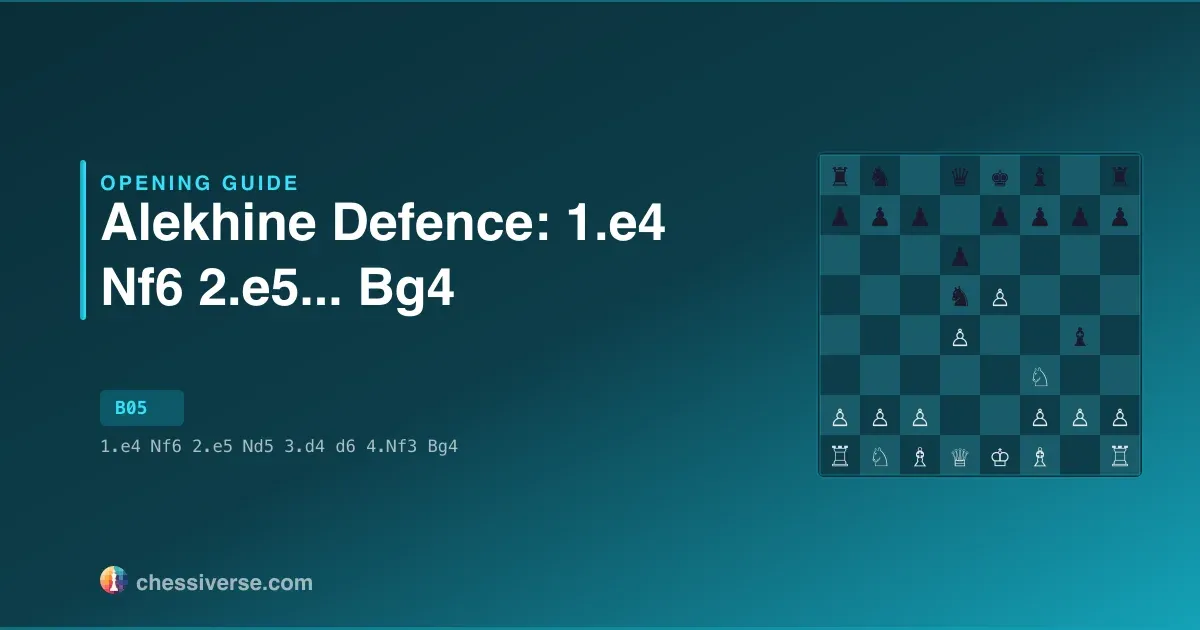
B051.e4 Nf6 2.e5 Nd5 3.d4 d6 4.Nf3 Bg4
Nov 24, 2027
TL;DR

Black's ...Bg4 is the soundest reply in the Modern Alekhine, pinning the f3-knight and forcing White to choose between Be2 development or grabbing space with c4. The bishop-for-knight trade is on the table from move four onward.

Reviewed by

IM John Bartholomew
IM John BartholomewCo-Founder & Chess Educator

International Master and chess educator. Co-founded Chessable and joined Chessiverse as co-founder. Best known for his "Climbing the Rating Ladder" YouTube series and structured opening courses.

Alekhine Defence: 1.e4 Nf6 2.e5...... Bg4: A Complete Guide
Alekhine Defence: 1.e4 Nf6 2.e5...... Bg4 - Opening Moves
Summary

1.e4 Nf6 2.e5 Nd5 3.d4 d6 4.Nf3 Bg4 opens the Alekhine Defence: 1.e4 Nf6 2.e5... Bg4, ECO B05. Black pins the f3-knight before White can finish solidifying. The bishop trade for the knight is on the table, and so are doubled f-pawns if White isn't careful.

Strategic Overview

This is the Modern Variation main line, and 4...Bg4 is Black's most active and theoretically respected continuation. The point of the pin is to either force a structural concession or extract real value from the bishop-for-knight trade. White's usual responses are 5.Be2, breaking the pin and preparing castling, or 5.c4 to grab more space and use the queen on c2 or b3 ideas. In many lines Black voluntarily plays ...Bxf3 — often after gxf3 — accepting the bishop pair for White in return for fractured kingside pawns and a clear long-term target. The doubled f-pawns aren't terminal for White; the half-open g-file and bishop pair give real compensation, but Black has a clear plan and clear weaknesses to aim at. Black's typical follow-up involves ...e6, ...Nc6, ...Be7, and castling, with pressure building against e5 and d4. The middlegame becomes a battle between Black's better structure and White's bishop pair and space — both have something concrete to work with, which is why this line has been respected by everyone from Fischer to Carlsen. It's the soundest way for Black to play the Alekhine and avoid the worst of the cramped middlegames.

Key Ideas

A few ideas come up again and again in this opening:

  • The pin on f3 is the whole point — Pinning the knight forces White to commit to a defense early. Either Be2 to break the pin, or accepting the trade ...Bxf3 with structural consequences. Black gets to dictate the character of the position.
  • Doubled f-pawns are a long-term target — If White recaptures with gxf3, the structure is permanently compromised. Black gets a clear endgame plan and an obvious set of squares to aim at, balancing White's bishop pair.
  • Black trades the bishop for structure — The light-squared bishop usually has no great future in Alekhine positions, so swapping it for the f3-knight is a good deal when it inflicts structural damage. Pieces for pawns work both ways.
  • Pressure on e5 is constant — The e5-pawn is the central thing keeping White's position alive. Black builds up against it with ...e6, ...Nc6, and timely piece pressure, hoping to force exchanges or undermine the support chain.

History and Notable Players

It arises from the Alekhine Defence: 1.e4 Nf6 2.e5... 4.Nf3. On the White side, Lothar Vogt (18 games), Milan Matulovic (13 games), Gyula Sax (12 games) top the database. Notable Black exponents: Vladimir Bagirov (60 games), Jorge Szmetan (42 games), Lev O Alburt (41 games).

Performance Across Rating Levels

How well the Alekhine Defence: 1.e4 Nf6 2.e5... Bg4 works depends on what level you're playing at. At 1200 Elo, the opening shows up in 0.00% of games (15,732 samples). White scores 50.9%, Black 45.4%, draws 3.7%. Move up to 1800 Elo and the share shifts to 0.02%, with White winning 45.8% versus Black's 49.2%. At 2500, 0.11% of games go into this opening; draws sit at 9.2% — the line is well-mapped at this level. Positions also become less sharp as level rises (sharpness 0.96 → 0.91).

Time Control Patterns

The Alekhine Defence: 1.e4 Nf6 2.e5... Bg4 skews toward blitz chess. In bullet, it appears in 0.01% of games (310,683); White wins 49.8%. Blitz shows 0.02% adoption across 605,144 games, White scoring 47%. In rapid, the share rises to 0.01% — 85,349 games, White 46.7%. White's score swings 3.1pp across formats, so time control isn't just a stylistic choice here — it shifts the actual results.

Move Diversity and Theory Depth

What players actually play after the opening moves depends heavily on rating. At 1200 Elo, the top reply is Be2, played 34.7% of the time. There are 5 other moves seeing meaningful share, and 76.4% of games stick to established theory. Entropy: 2.60. By 2500, Be2 dominates at 78.8% of replies; only 3 viable alternatives remain and 93% of moves are theory. Entropy drops to 1.17. The narrowing is significant — strong players consolidate around a small set of best moves, while amateurs scatter across many plausible-looking options.

Tracking the Alekhine Defence: 1.e4 Nf6 2.e5... Bg4 year over year shows a clear story. Adoption peaked in 2017 at 0.02% (26,032 games). By 2025 it sits at 0.01% — a 5% shift overall, leaving the line flat.

Common Mistakes

  • Neglecting development — Extra pawn moves in the opening are tempting, especially when you "know the moves". Developing a piece each turn is the simple correction.
  • Playing without a plan — Each Alekhine Defence: 1.e4 Nf6 2.e5... Bg4 middlegame demands a specific approach. Decide whether the position calls for attack, manoeuvre, or simplification before reaching for a move.

Practice on Chessiverse

Ready to try the Alekhine Defence: 1.e4 Nf6 2.e5... Bg4 against a bot? Pick an opponent at your level and play a game.

Quick Facts

Main Line1.e4 Nf6 2.e5 Nd5 3.d4 d6 4.Nf3 Bg4
DifficultyIntermediate
Style

Hypermodern openings let the opponent occupy the center with pawns, then attack it from the flanks with pieces and fianchettoed bishops. Control is exerted from a distance rather than by direct occupation.

690,493games on Lichess
47%
5.8%
47.2%
White wins Draws Black wins

Top Players

As White
As Black

Data from Lichess opening explorer (blitz & rapid)

Most Popular At2500
SharpnessBalanced

Popularity by Rating

Percentage of all games at each rating bracket that feature this opening.

Data from Lichess opening explorer (blitz & rapid games)

Theory Adherence by Rating

How often players choose the single most popular move at this position. Higher = more predictable play.

White to move after the opening line

Popularity Over Time

Share of all Lichess blitz + rapid games featuring this opening, by year.

Top Moves by Rating

White to move after the opening line

RatingMost Popular2nd3rd
400Be236%h322.9%Bc419.8%
1000Be234.5%h323.1%Bc421%
1200Be234.7%h322.5%Bc419.3%
1400Be236.3%h319%Bc417.7%
1600Be239.9%Bc416.3%h314%
1800Be248.2%Bc415.3%exd612.4%
2000Be259.7%Bc413.5%exd610.1%
2200Be272.7%Bc48.6%h37.5%
2500Be278.8%h38.3%Bc45.9%

Popularity by Time Control

Bullet
0.01%311K
Blitz
0.02%605K
Rapid
<0.01%85K
2% more decisive in bullet
Raw data tables (Lichess blitz + rapid)
Alekhine Defence: 1.e4 Nf6 2.e5...... Bg4: popularity and win rates by player rating
Rating (Elo)Share %GamesWhite win %Black win %Draw %Sharpness
4000.001,56653.642.83.60.964
10000.005,54153.542.24.30.957
12000.0015,73250.945.43.70.963
14000.0042,16747.948.33.80.962
16000.0188,30845.750.14.10.959
18000.02166,56645.849.25.00.950
20000.04203,22847.146.86.10.939
22000.09152,91147.844.57.80.922
25000.1114,47449.641.29.20.908
Alekhine Defence: 1.e4 Nf6 2.e5...... Bg4: move-choice theory adherence by rating
Rating (Elo)Top moveTop move %Viable movesTheory %Entropy
400Be236.0378.72.576
1000Be234.5478.62.577
1200Be234.7576.42.598
1400Be236.3573.02.603
1600Be239.9570.12.521
1800Be248.2575.92.259
2000Be259.7583.31.890
2200Be272.7488.91.437
2500Be278.8393.01.174
Alekhine Defence: 1.e4 Nf6 2.e5...... Bg4: popularity over time
YearShare %GamesWhite win %Black win %Draw %
20130.0138045.551.13.4
20140.021,72948.146.45.5
20150.024,35346.348.55.2
20160.0213,84745.549.84.6
20170.0226,03246.548.15.4
20180.0237,97346.948.15.0
20190.0248,55747.147.75.2
20200.0296,88147.146.86.1
20210.01110,70647.047.06.0
20220.01104,21947.346.85.9
20230.01104,34047.047.05.9
20240.0198,88747.047.06.0
20250.0193,03346.847.45.8
Alekhine Defence: 1.e4 Nf6 2.e5...... Bg4: popularity by time control
FormatShare %GamesWhite win %Black win %Draw %Sharpness
bullet0.01310,68349.846.43.80.962
blitz0.02605,14447.047.25.70.943
rapid0.0185,34946.747.16.20.938
Alekhine Defence: 1.e4 Nf6 2.e5...... Bg4: top candidate moves by rating bracket
Rating (Elo)1st move1st %2nd move2nd %3rd move3rd %
400Be236.0h322.9Bc419.8
1000Be234.5h323.1Bc421.0
1200Be234.7h322.5Bc419.3
1400Be236.3h319.0Bc417.7
1600Be239.9Bc416.3h314.0
1800Be248.2Bc415.3exd612.4
2000Be259.7Bc413.5exd610.1
2200Be272.7Bc48.6h37.5
2500Be278.8h38.3Bc45.9
Alekhine Defence: 1.e4 Nf6 2.e5...... Bg4: top practitioners by side
SidePlayerGames
WhiteLothar Vogt18
WhiteMilan Matulovic13
WhiteGyula Sax12
BlackVladimir Bagirov60
BlackJorge Szmetan42
BlackLev O Alburt41

Frequently Asked Questions

What is the Alekhine Defence: 1.e4 Nf6 2.e5... Bg4?

The Alekhine Defence: 1.e4 Nf6 2.e5... Bg4 begins with 1.e4 Nf6 2.e5 Nd5 3.d4 d6 4.Nf3 Bg4 and is classified under ECO code B05. Black has reduced White's control over the center.

Is the Alekhine Defence: 1.e4 Nf6 2.e5... Bg4 good for beginners?

The Alekhine Defence: 1.e4 Nf6 2.e5... Bg4 can be played at any level. Beginners should focus on understanding the key strategic ideas rather than memorizing long theoretical lines. Our AI bots at various rating levels provide a great way to practice the opening concepts.

What are the win rates for the Alekhine Defence: 1.e4 Nf6 2.e5... Bg4?

In a database of 690,493 master games, White wins 47% of the time, Black wins 47.2%, and 5.8% are drawn. Notable players on the White side include Lothar Vogt and Milan Matulovic. On the Black side, Vladimir Bagirov and Jorge Szmetan are among the most frequent practitioners.

How can I practice the Alekhine Defence: 1.e4 Nf6 2.e5... Bg4?

On Chessiverse, you can practice the Alekhine Defence: 1.e4 Nf6 2.e5... Bg4 by playing against our 600+ AI bots. Each bot has a unique playing style and opening repertoire, so you can find the perfect sparring partner for any level.

Reviewed by

IM John Bartholomew
IM John BartholomewCo-Founder & Chess Educator

International Master and chess educator. Co-founded Chessable and joined Chessiverse as co-founder. Best known for his "Climbing the Rating Ladder" YouTube series and structured opening courses.

Practice This Opening on Chessiverse

Play against 1000+ AI bots with unique personalities and opening repertoires. From beginner-friendly to grandmaster-level opponents, find the perfect sparring partner for any opening.

Play Now

Not sure which opening fits you? Take the free chess personality test — your style determines which openings will work with you.

Back to Articles