

Summary
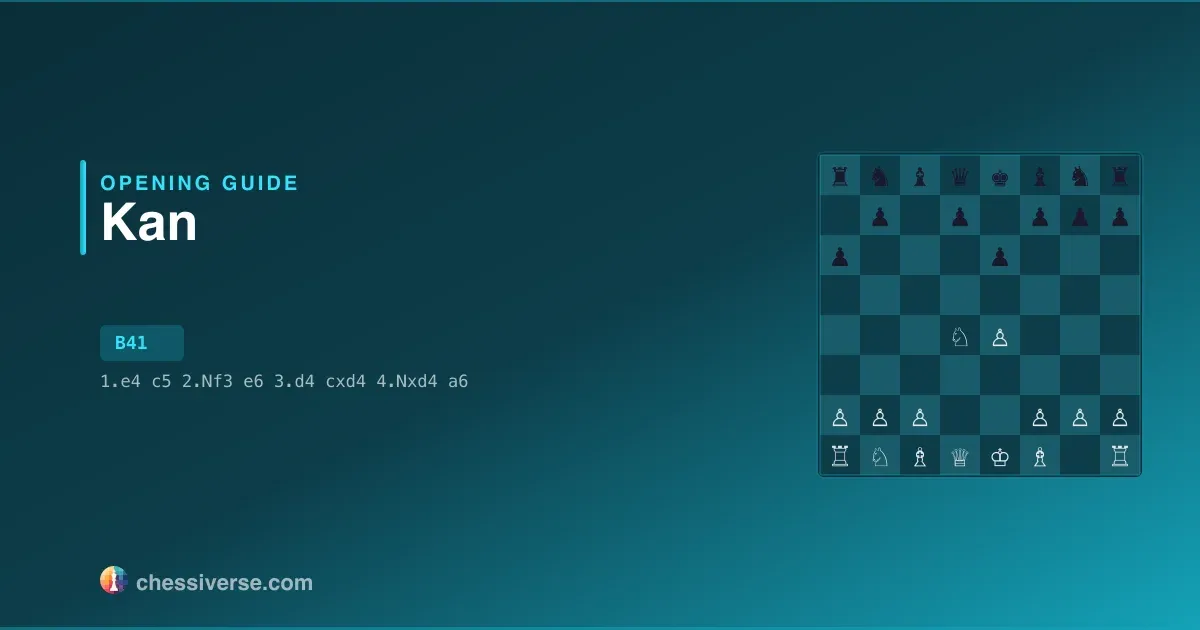
The Sicilian Defense: Kan Variation arises after 1.e4 c5 2.Nf3 e6 3.d4 cxd4 4.Nxd4 a6 and falls under ECO code B41. With 4...a6, Black adopts a flexible setup that controls the b5 square and keeps options open for piece development and pawn structure choices in the moves ahead. With 7.6 million Lichess games across all rating levels, it is a well-established opening choice.
- Black typically puts pawns on light squares and lets the pieces control the dark squares, developing only once White has committed.
- A main White try is 5.c4, the Maroczy Bind, also known as the Reti variation.
History and Notable Players
It arises from the Sicilian Defense (2.Nf3). Among the most prolific practitioners on the White side are Mladen Palac (51 games), Oleg Korneev (49 games), Herman C Van Riemsdijk (49 games). On the Black side, notable exponents include Normunds Miezis (244 games), Florin Gheorghiu (174 games), Petar Velikov (151 games).
Louis Paulsen played the line in the 19th century, which is why it also carries his name; the opening theory work of Soviet IM Ilya Kan centred on 4...a6, and the variation now bears his name. Since 1950 it has been a frequent guest at top level, with players like Karpov and Tony Miles among its adopters.
Named after: Named after Ilya Kan (1909-1978), a Soviet International Master, arbiter and chess writer who developed the line; it is also called the Paulsen Variation.
Notable players: Ilya Kan, Anatoly Karpov, Tony Miles, Louis Paulsen
Statistics
Based on 7.6 million Lichess games across all rating levels:
- White wins: 44.7%
- Black wins: 50.6%
- Draws: 4.6%
Interestingly, Black scores well in this opening, suggesting it offers strong counterplay.
Main Lines and Variations
After 1.e4 c5 2.Nf3 e6 3.d4 cxd4 4.Nxd4 a6, the main continuations include:
Each of these lines leads to distinct types of positions and requires its own understanding of the resulting pawn structures and piece placements.
Practice on Chessiverse
The best way to learn the Sicilian Defense: Kan Variation is through practice. On Chessiverse, you can play chess against computer opponents that specialize in this opening. Our AI bots range from beginner to grandmaster level, each with unique playing styles — from aggressive attackers to solid defenders. Choose a bot that matches your rating and work your way up as you master the opening's key ideas.