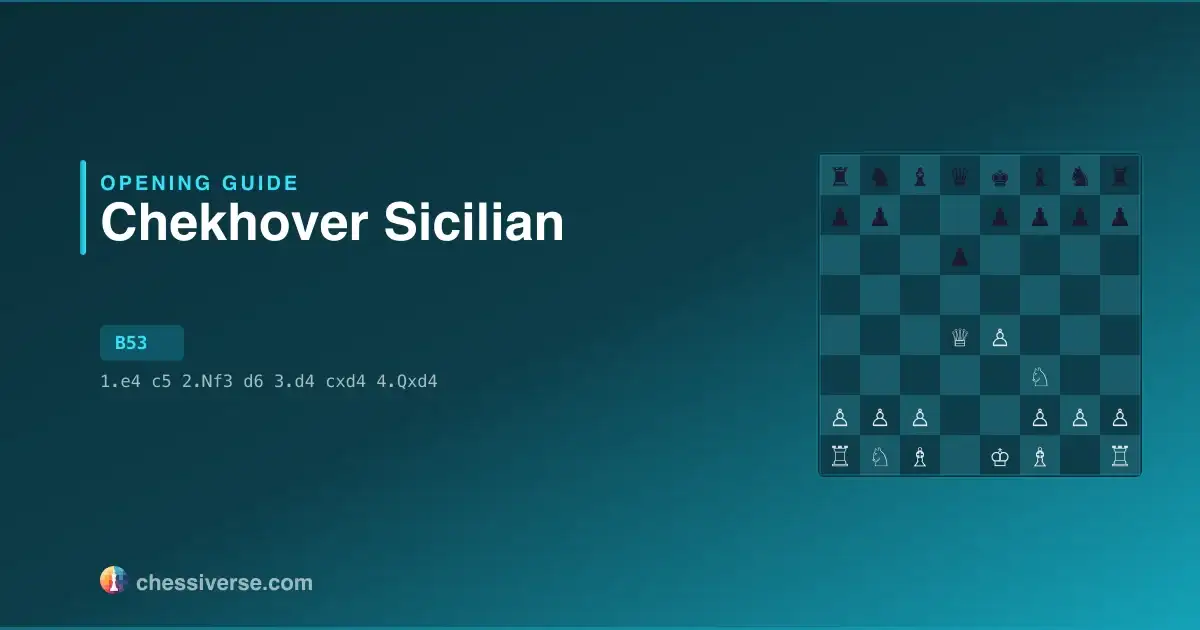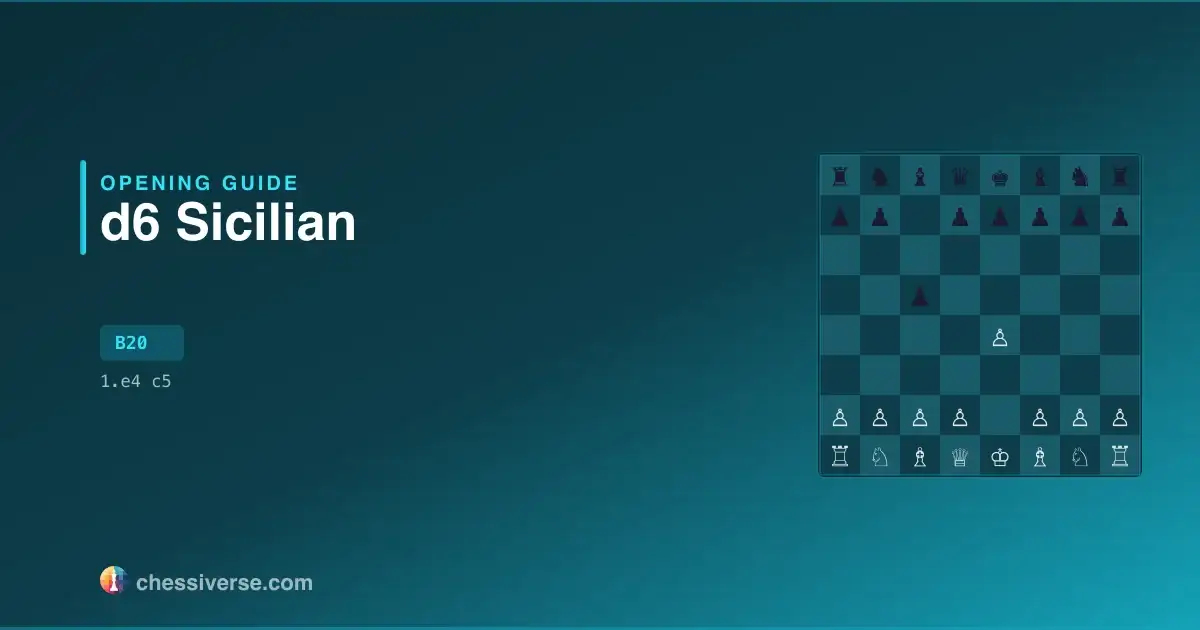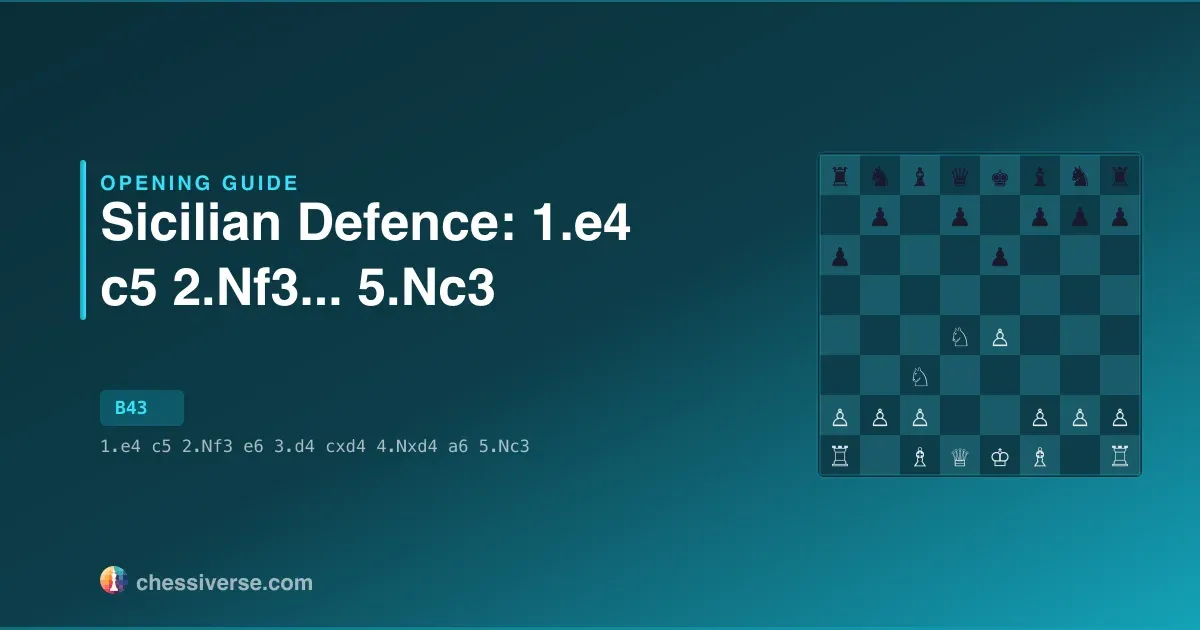
1.e4 c5 2.Nf3 e6 3.d4 cxd4 4.Nxd4 a6 5.Nc3 opens the Sicilian Defense: Kan Variation, Knight Variation, ECO B43. Black has played the Kan with an early ...a6, keeping development flexible and refusing to commit a knight to c6 yet. White develops normally and waits to see Black's structure.
History and Notable Players
It arises from the Sicilian Defense: Kan Variation. Among the most prolific White practitioners are Robert Zelcic (42 games), Herman C Van Riemsdijk (39 games), Ruben Felgaer (36 games). Black-side regulars include Normunds Miezis (84 games), Aloyzas Kveinys (75 games), Petar Velikov (67 games).
Performance Across Rating Levels
Popularity and results vary sharply by rating level. Among 1200-rated players, it appears in 0.02% of games — 127,798 of them on record — with White winning 45.5% and Black 51.4%. By 1800, popularity is 0.19% and White's score is 43.6% to Black's 52.2%. At the top end (2500+ Elo), popularity is 0.28% with 7.4% draws — a clear sign of how much theory rules the line at master level.
Time Control Patterns
Time control matters here: blitz players reach for this opening more than others. In bullet, it appears in 0.12% of games (3,129,737); White wins 43.8%. Blitz shows 0.12% adoption across 4,365,991 games, White scoring 44.2%. In rapid, the share rises to 0.07% — 762,862 games, White 44.4%.
Move Diversity and Theory Depth
Looking at move selection shows how forcing — or not — the position really is. At 1200 Elo (127,798 games), the top reply is Qc7, played 29.4% of the time. Five other moves each take at least 5% of games, and the top three moves account for 68.3% of games. Entropy: 2.90. By 2500 (38,411 games), Qc7 dominates at 57.7% of replies; only two other moves still reach 5% and the top three moves account for 93.4% of games. Entropy drops to 1.62. The narrowing is significant — strong players consolidate around a small set of best moves, while amateurs scatter across many plausible-looking options.
Common Mistakes
- Drifting away from main theory — At 400 Elo, the three most-played moves cover 61.6% of games, against 90.2% at 2000. The most popular deviation is Nc6 (played 23.4% of the time at 400, much less so up top). It looks fine but quietly hands the better-prepared side an edge.
- Neglecting development — It can feel productive to make extra pawn moves early, but falling behind in piece development is what loses most amateur games — especially in open positions where active pieces find squares fast.
- Ignoring the kingside attack — In sharp Sicilian lines, White typically castles long and pushes the h-pawn. Without your own counterplay on the queenside or in the centre, White's attack lands first.
Practice on Chessiverse
Ready to try the Sicilian Defense: Kan Variation, Knight Variation against a bot? Pick an opponent at your level and play a game.