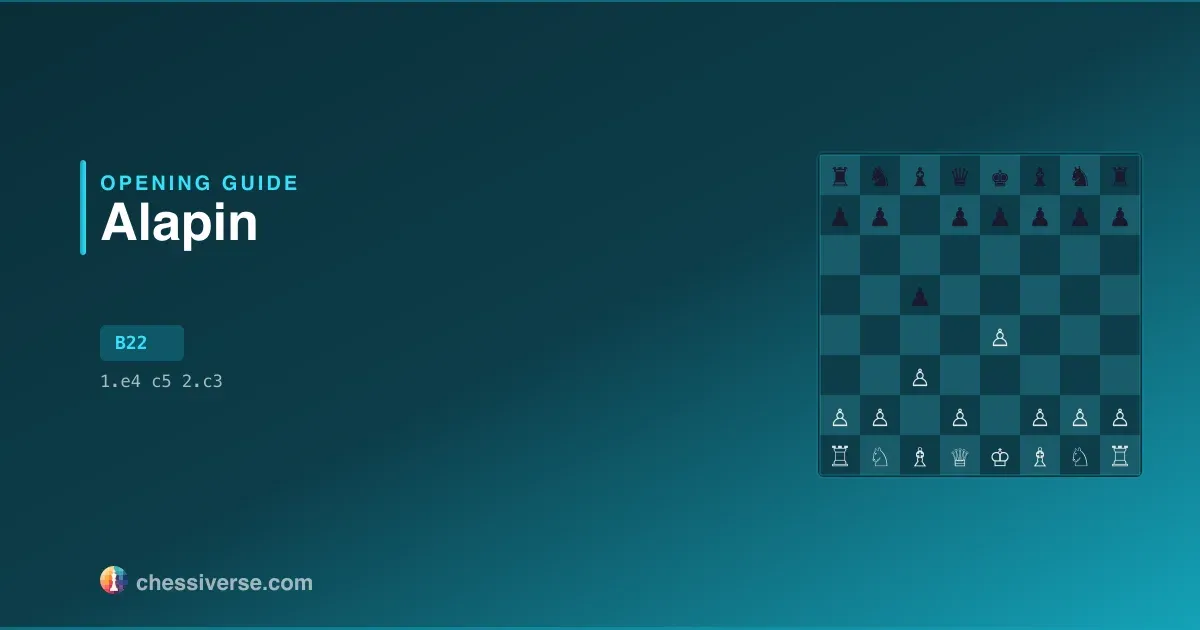
The Sicilian Defense: Alapin Variation arises after 1.e4 c5 2.c3 and falls under ECO code B22. White prepares to push d4, using c3 as support. This is one of the main "anti-Sicilian" systems, chosen by White to bypass the heavily theoretical main lines of the Open Sicilian. If Black responds with the common amateur move 2...Nc6!?, play continues 3. d4 cxd4 4. cxd4, and White achieves a two-pawn centre. Black's original idea of trading a less-important flank pawn for White's central d-pawn is neutralized because White recaptured with the c-pawn. The line typically continues 4...d5 5. exd5 (since 5. e5?! lets Black set up an improved French structure with ...Bf5 and ...e6) Qxd5 6. Nf3 e5 7. Nc3 Bb4 8. Bd2 Bxc3 9. Bxc3 e4 10. Ne5 Nxe5 11. dxe5 Ne7 with a slight White edge. The former standard reply, 2...d5, threatens 3...dxe4 and after 3. exd5 Qxd5 (the Barmen Defense) White can still play 4. d4 but no longer gets two centre pawns and Black enjoys a lead in development. Because the c3 square is occupied, White cannot develop Nc3 with tempo against the queen, and Black tries to delay ...cxd4 until White has placed the knight elsewhere to prevent c3 from becoming available again. With 27.6 million Lichess games across all rating levels, it is a well-established opening choice.
- White prepares d4 with c3 support, aiming to build a strong pawn centre
- Black strikes back at the centre right away, most often with 2...d5 or 2...Nf6
- A solid Anti-Sicilian choice championed by several grandmasters
History and Notable Players
It arises from the Sicilian Defense. Among the most prolific practitioners on the White side are Evgeny Sveshnikov (342 games), Drazen Sermek (250 games), Dusko Pavasovic (243 games). On the Black side, notable exponents include Zdenko Kozul (68 games), Miso Cebalo (68 games), Ognjen Cvitan (51 games).
Early theorists were dismissive: Tarrasch thought 2...d5 gave Black a good game, and Modern Chess Openings still rated it poorly in 1972. Opinion later turned around completely, and today it is regarded as one of White's soundest and most reputable Anti-Sicilian systems.
Named after: Semyon Alapin (1856-1923), a Russian master.
Notable players: Evgeny Sveshnikov, Sergei Tiviakov, Eduardas Rozentalis, Magnus Carlsen
The Deep Blue computer played the Alapin against Kasparov in their 1996 match, and Carlsen chose it in his 2023 FIDE World Cup final tiebreak against Praggnanandhaa.
Statistics
Based on 27.6 million Lichess games across all rating levels:
- White wins: 49.5%
- Black wins: 45.7%
- Draws: 4.8%
The statistics show a roughly balanced opening where both sides have equal chances.
Practice on Chessiverse
The best way to learn the Sicilian Defense: Alapin Variation is through practice. On Chessiverse, you can play chess against computer opponents that specialize in this opening. Our AI bots range from beginner to grandmaster level, each with unique playing styles — from aggressive attackers to solid defenders. Choose a bot that matches your rating and work your way up as you master the opening's key ideas.
Performance Across Rating Levels
The picture changes a lot as you climb the rating ladder. The 1200 bracket has 1,929,048 games (0.29% of all games at that level); White wins 50%, Black 46.5%, 3.5% are drawn. By 1800, popularity is 0.87% and White's score is 49.5% to Black's 45.7%. Among 2500-rated players the line appears in 1.06% of games and draws spike to 10.6%, indicating tight preparation.
Time Control Patterns
The Sicilian Defense: Alapin Variation skews toward blitz chess. In bullet, it appears in 0.47% of games (12,528,320); White wins 50.8%. Blitz shows 0.61% adoption across 21,932,292 games, White scoring 49.7%. In rapid, the share rises to 0.51% — 5,619,443 games, White 49%.
Move Diversity and Theory Depth
Looking at move selection shows how forcing — or not — the position really is. At 1200 Elo (1,929,048 games), the top reply is Nc6, played 41% of the time. Four other moves each take at least 5% of games, and the top three moves account for 76.7% of games. Entropy: 2.47. By 2500 (144,773 games), Nf6 takes over as the top reply at 38.8%; four other moves reach 5% and the top three moves account for 79.9% of games. Entropy drops to 2.33.
Historical Trends
Tracking the Sicilian Defense: Alapin Variation year over year shows a clear story. Adoption peaked in 2015 at 0.66% (145,448 games). By 2025 it sits at 0.64%, 3% below the peak but still 58% above its 2013 level, so the line is up over the full period despite easing from the high.