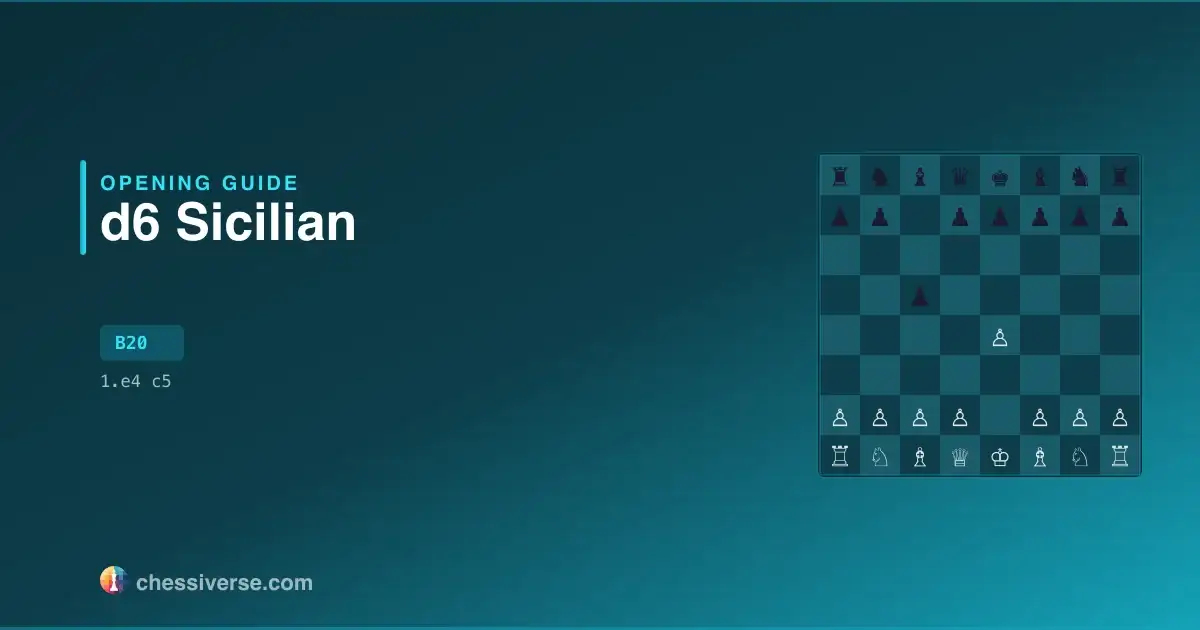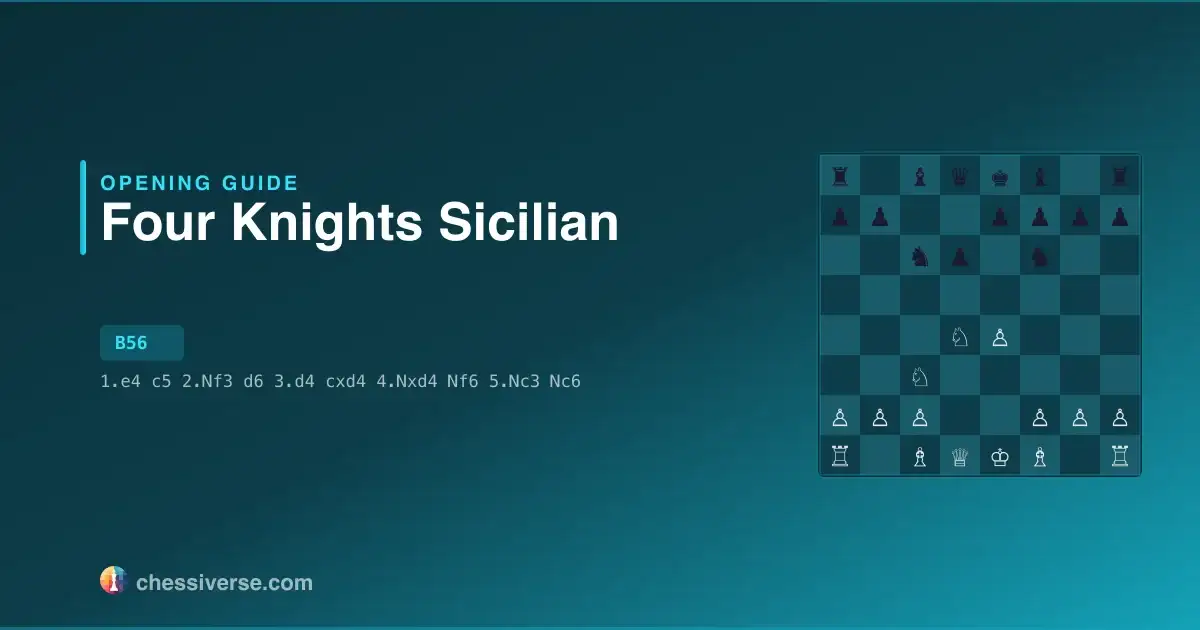


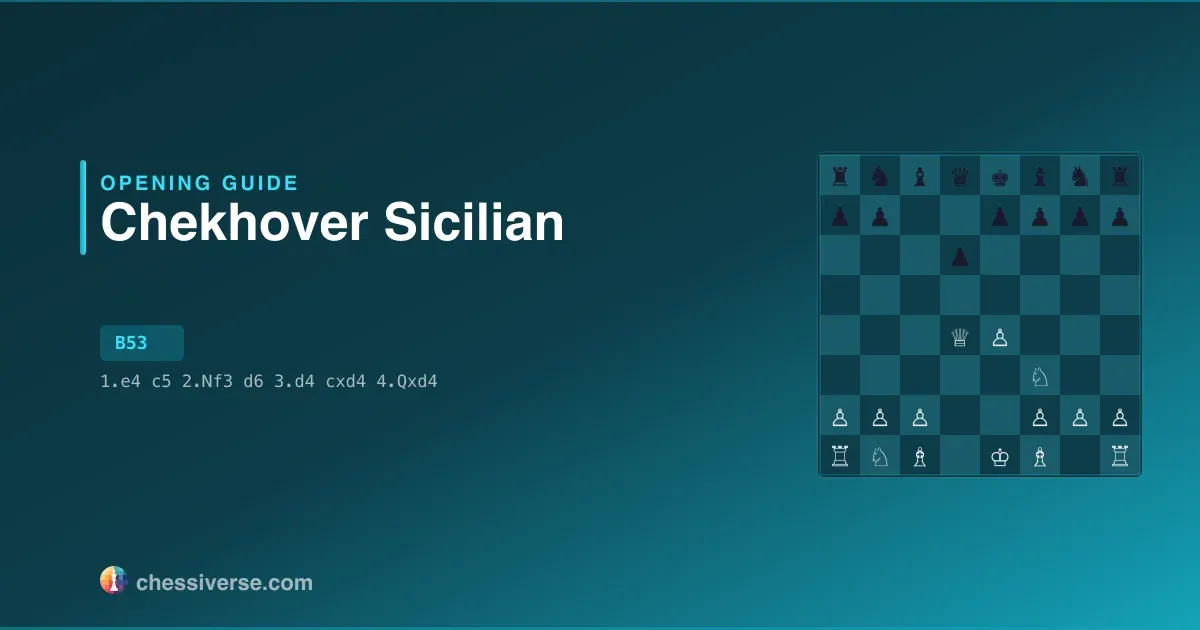
1.e4 c5 2.Nf3 d6 3.d4 cxd4 4.Qxd4 opens the Chekhover Sicilian, ECO B53. White breaks the rules and brings the queen out early to d4. Against a normal Sicilian it'd be a beginner mistake — against ...d6 it's a serious sideline that's been kicking around for decades.
Strategic Overview
The Chekhover sidesteps the entire Open Sicilian theoretical battlefield by recapturing on d4 with the queen instead of the knight. The whole question is whether the queen is exposed to harassment or whether Black's ...d6 move means the queen actually stands well. After 4...Nc6 attacking the queen, White's standard response is 5.Bb5 — pinning the knight and preparing a clean trade with 6.Bxc6. The follow-up 6...Bxc6 7.Nc3 Nf6 8.Bg5 e6 9.0-0-0 Be7 10.Rhe1 0-0 leads to an unbalanced middlegame where White has a structural slant and good attacking chances along the central files. Black's other main reply is 4...a6, which prepares ...Nc6 without allowing Bb5 to gain a tempo. White can answer with 5.c4 to set up a Maroczy-style bind with the queen anchoring d2, or trade queens with 5.Be3 Nc6 6.Qb6 and 7.Bxb6 leading to a slightly inferior endgame for Black. The Chekhover is a practical weapon — it dodges main-line preparation, leads to positions where White's plans are clear, and rewards good middlegame play over deep theory. It's not the most ambitious opening choice, but it's perfectly playable and a useful surprise.
Key Ideas
A few ideas come up again and again in this opening:
- Early queen with a purpose — Normally bringing the queen out on move four loses tempo, but Black's ...d6 means White's queen on d4 is hard to harass. The whole opening is built on this single positional exception.
- Bb5 and the c6-trade — After 4...Nc6, White's main idea is 5.Bb5 pinning the knight, with the clear plan of trading on c6 to inflict structural damage. The bishop pair often becomes Black's compensation.
- 4...a6 dodges Bb5 — By preparing ...Nc6 with ...a6 first, Black removes the pinning bishop from the equation. White then has to choose between a Maroczy-style setup with c4 or trading queens with Be3-Bxb6.
- Sidesteps the theory dump — The Chekhover skips all the Najdorf, Dragon, and Scheveningen preparation. It's not objectively dangerous, but it forces Black to think for themselves rather than recall memorized lines.
History and Notable Players
It arises from the Sicilian Defense: d6 Systems. On the White side, Sergei Zhigalko (43 games), Evgeny Alekseev (40 games), Valeri Yandemirov (37 games) top the database. Notable Black exponents: David Navara (14 games), Qian Huang (12 games), Wenjun Ju (12 games).
The line is named for Chekhover's 1938 Leningrad game against Lisitsin. It stays rare at grandmaster level, though the quiet 5.Qe3 setup has recently brought Pentala Harikrishna good results with White, and is now known as the Harikrishna System.
Named after: Takes its name from Vitaly Chekhover and his 1938 Leningrad game against Lisitsin.
Notable players: Vitaly Chekhover, Pentala Harikrishna
Also called the Szily or Hungarian Variation, it is seldom seen at grandmaster level yet turns up regularly in amateur games.
Performance Across Rating Levels
Popularity and results vary sharply by rating level. The 1200 bracket has 265,048 games (0.04% of all games at that level); White wins 47.7%, Black 48.4%, 3.9% are drawn. Move up to 1800 Elo and the share shifts to 0.08%, with White winning 50.4% versus Black's 44.3%. Among 2500-rated players the line appears in 0.28% of games and draws spike to 9.8%, indicating tight preparation. Positions also become less sharp as level rises (sharpness 0.96 → 0.90).
Time Control Patterns
The Chekhover Sicilian skews toward blitz chess. In bullet, it appears in 0.05% of games (1,325,426); White wins 49.6%. Blitz shows 0.07% adoption across 2,442,162 games, White scoring 49.8%. In rapid, the share rises to 0.05% — 523,554 games, White 48%.
Move Diversity and Theory Depth
Move choice is far from uniform in the Chekhover Sicilian. At 1200 Elo (265,048 games), the top reply is Nc6, played 69.2% of the time. Two other moves each take at least 5% of games, and the top three moves account for 93.5% of games. Entropy: 1.48. By 2500 (37,898 games), Nc6 is still the top reply, at 40.9%; two other moves reach 5% and the top three moves account for 93.6% of games. Entropy rises to 1.84. Even elite players don't fully agree on the best continuation here, which keeps the position dynamic.
Historical Trends
Year-over-year data tells you whether this opening is a contemporary fixture or a fading one. Adoption peaked in 2016 at 0.07% (45,371 games). By 2025 it sits at 0.05%, 29% below the peak and 14% under its 2013 level, leaving the line in decline.
Common Mistakes
- Neglecting development — Extra pawn moves in the opening are tempting, especially when you "know the moves". Developing a piece each turn is the simple correction.
- Ignoring the kingside attack — In sharp Sicilian lines, White typically castles long and pushes the h-pawn. Without your own counterplay on the queenside or in the centre, White's attack lands first.
Practice on Chessiverse
Ready to try the Chekhover Sicilian against a bot? Pick an opponent at your level and play a game.