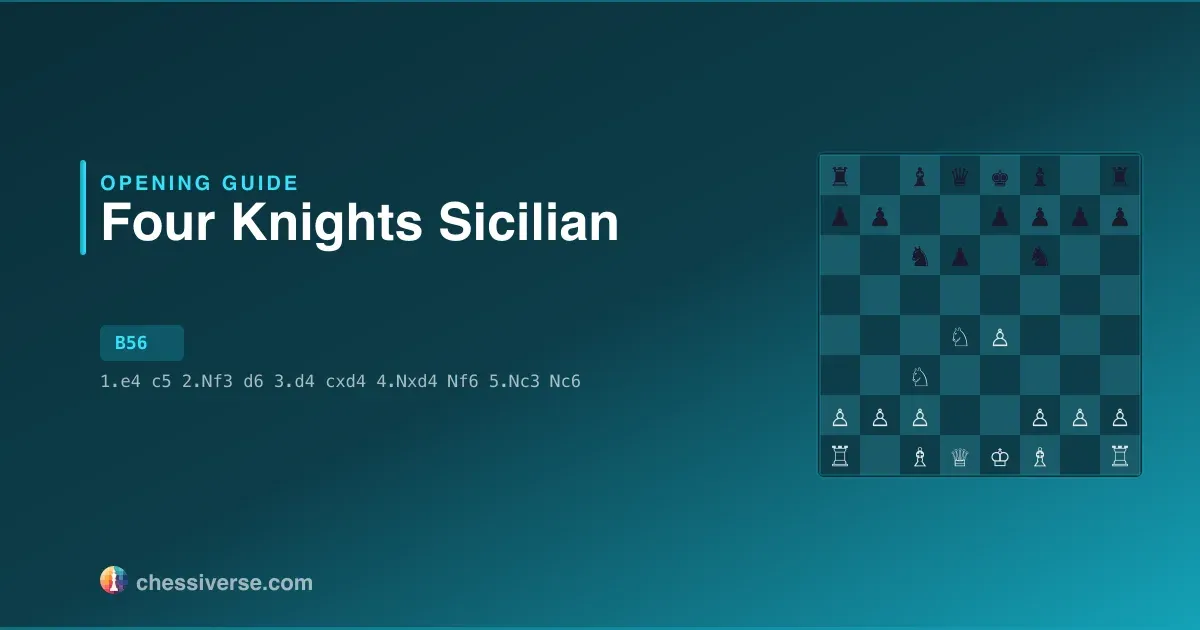
The Sicilian Defense: Four Knights Variation arises after 1.e4 c5 2.Nf3 Nc6 3.d4 cxd4 4.Nxd4 e6 5.Nc3 Nf6 and falls under ECO code B45. The same position also comes from the Taimanov move order, 2...e6 3.d4 cxd4 4.Nxd4 Nc6 5.Nc3 Nf6. Black develops both knights and leaves the d-pawn at home. That keeps two options open: ...Bb4, pinning the c3 knight and adding pressure on e4, and ...d5 in a single move. The cost is the d6 square. With no pawn on d6, White's d4 knight can jump to b5 and aim at d6, and that idea shapes the main lines. With 4.4 million Lichess games across all rating levels, it is a well-established opening choice.
History and Notable Players
It arises from the Sicilian Defense: Open. In the 2...e6 move order it is one of Black's main answers to 5.Nc3 in the Sicilian Defense: Taimanov Variation (5.Nc3), alongside 5...a6 and 5...Qc7 (Bastrikov). Among the most active players in ECO B45 games are Jonny Hector (80 games), Michael Adams (70 games) and Alexei Shirov (67 games) with White, and Mark E Taimanov (181 games), Vlastimil Jansa (141 games) and Pavel V Tregubov (137 games) with Black.
Statistics
Based on 4.4 million Lichess games across all rating levels:
- White wins: 44.6%
- Black wins: 50.1%
- Draws: 5.3%
Black scores well here, and the edge holds in bullet, blitz and rapid. It shrinks as the rating goes up. Black wins about 51-53% of games up to the 1800 bracket, 46.3% against White's 45.8% at 2200, and at 2500 and above White is slightly ahead, 45.3% to 44.1%, with 10.6% draws.
Main Lines and Variations
After 1.e4 c5 2.Nf3 Nc6 3.d4 cxd4 4.Nxd4 e6 5.Nc3 Nf6, the main continuations include:
- 6.Ndb5: the most direct test, aiming the knight at d6. The main line is 6...Bb4 7.a3 Bxc3+ 8.Nxc3 d5 9.exd5 exd5, where White has the bishop pair and Black has an isolated d-pawn with free piece play. 7.Nd6+ Ke7 8.Nxc8+ Rxc8, the American Attack, also takes the bishop pair; Black gives up castling but gets the rook to the c-file at once. 6...d6 7.Bf4 e5 8.Bg5 a6 9.Na3 transposes to the Sicilian Defense: Sveshnikov Variation, and 6...Bc5 is the Cobra Variation.
- 6.Nxc6 bxc6 7.e5 Nd5 8.Ne4: the Exchange Variation. White's e5 pawn gains space and Black's c6 pawn supports the knight on d5. Black usually hits e5 with ...Qc7, and White supports it with f4.
- 6.Be3 Bb4: the bishop pins the c3 knight, the only piece guarding e4, so Black threatens ...Nxe4.
- 6.Be2 and 6.a3: quieter moves. After 6.Be2, 6...d6 gives a Scheveningen structure; 6.a3 rules out ...Bb4 before it happens.
White's choice depends heavily on rating. In the 1600 and 1800 brackets, 6.Be3 and 6.Bg5 are the two most played moves. From 2200 up, 6.Ndb5 and 6.Nxc6 take over and account for more than half of White's games.
Common Mistakes to Avoid
- Forgetting the d6 square: After 6.Ndb5, the natural-looking 6...a6? runs into 7.Nd6+ Bxd6 8.Qxd6, and White's queen settles on d6 with the bishop pair. Answer 6.Ndb5 with 6...Bb4 or 6...d6.
- Forgetting about ...Bb4 as White: With Black's d-pawn still on d7, the f8 bishop can pin the c3 knight at any moment. After a quiet move such as 6.Be3, 6...Bb4 leaves e4 without a working defender, and ...Nxe4 is threatened.
Practice on Chessiverse
The best way to learn the Sicilian Defense: Four Knights Variation is through practice. On Chessiverse, you can play chess against computer opponents that specialize in this opening. Our AI bots range from beginner to grandmaster level, each with unique playing styles — from aggressive attackers to solid defenders. Choose a bot that matches your rating and work your way up as you master the opening's key ideas.
Performance Across Rating Levels
The picture changes a lot as you climb the rating ladder. Among 1200-rated players, it appears in 0.02% of games — 116,557 of them on record — with White winning 44.9% and Black 51.7%. Move up to 1800 Elo and the share shifts to 0.15%, with White winning 44.1% versus Black's 51.2%. Among 2500-rated players the line appears in 0.53% of games and draws spike to 10.6%, indicating tight preparation.
Time Control Patterns
Look at the same opening across time controls and blitz stands out. In bullet, it appears in 0.10% of games (2,680,720); White wins 46.1%. Blitz shows 0.10% adoption across 3,737,553 games, White scoring 44.8%. In rapid, the share rises to 0.06% — 670,308 games, White 43.3%. White's score swings 2.8pp across formats, so time control isn't just a stylistic choice here — it shifts the actual results.
Move Diversity and Theory Depth
Move choice is far from uniform in the Sicilian Defense: Four Knights Variation. At 1200 Elo (116,557 games), the top reply is Nxc6, played 30.5% of the time. Four other moves each take at least 5% of games, and the top three moves account for 65.3% of games. Entropy: 2.95. By 2500 (72,393 games), Ndb5 takes over as the top reply at 43.9%; only three other moves still reach 5% and the top three moves account for 82.3% of games. Entropy drops to 2.25. The narrowing is significant — strong players consolidate around a small set of best moves, while amateurs scatter across many plausible-looking options.
Historical Trends
Long-term, the trajectory of this opening is informative. Adoption peaked in 2020 at 0.11% (620,687 games). By 2025 it sits at 0.09%, 21% below the peak but still 31% above its 2013 level, so the line is up over the full period despite easing from the high.