




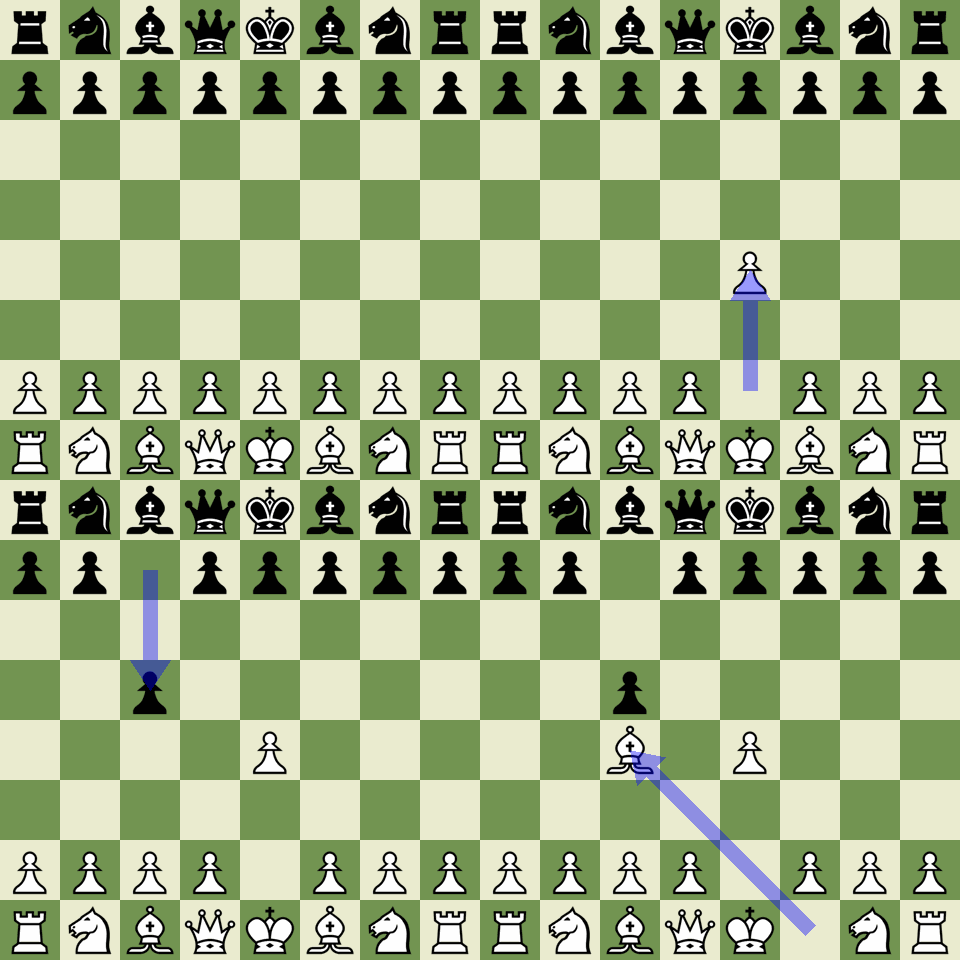
The Sicilian Defense: Bowdler Attack arises after 1.e4 c5 2.Bc4 and falls under ECO code B20. This bishop development is considered inaccurate because it allows Black to equalize comfortably. Black's strongest plan is 2...e6 followed by an eventual ...d5, which challenges the bishop directly, wins a tempo, and secures a solid central presence. A typical sequence runs 2...e6 3. Nc3 Nc6 4. Nf3 Nf6 5. O-O d5 6. exd5 exd5 7. Bb3. It is important for Black to develop the knight to c6 before pushing ...d5, since an early ...d5 would leave the king exposed along the a4-e8 diagonal, inviting a check from White's light-squared bishop. The resulting positions bear a resemblance to certain Italian Game structures, but Black's pawn on c5 serves double duty: it discourages White from achieving d4 and makes b3 a less effective retreat for the bishop, since ...c4 becomes a possibility. With 54.6 million Lichess games across all rating levels, it is one of the most popular openings.
- White puts the bishop on its Italian-style c4 diagonal, but with ...c5 already played Black can blunt it and White struggles to achieve d4.
- Black's simplest plan is ...e6 followed by ...d5, hitting the bishop, gaining a tempo and taking over the centre.
- Black should develop ...Nc6 before pushing ...d5 so the king is not left exposed along the a4-e8 diagonal.
History and Notable Players
It arises from the Sicilian Defense. Among the most prolific practitioners on the White side are Vlastimil Jansa (661 games), Heikki MJ Westerinen (641 games), Oleg Korneev (608 games). On the Black side, notable exponents include Loek Van Wely (738 games), Miso Cebalo (592 games), Zdenko Kozul (590 games).
Named after: Thomas Bowdler (1754-1825), an English physician best known for his expurgated edition of Shakespeare, the origin of the word 'bowdlerise'.
Bowdler was a serious player in his day: in eight recorded games against Philidor, the era's strongest master, who took on handicaps like playing blindfold, Bowdler won two, drew three and lost three.
Statistics
Based on 54.6 million Lichess games across all rating levels:
- White wins: 45.5%
- Black wins: 50.7%
- Draws: 3.7%
Interestingly, Black scores well in this opening, suggesting it offers strong counterplay.
Practice on Chessiverse
The best way to learn the Sicilian Defense: Bowdler Attack is through practice. On Chessiverse, you can play chess against computer opponents that specialize in this opening. Our AI bots range from beginner to grandmaster level, each with unique playing styles — from aggressive attackers to solid defenders. Choose a bot that matches your rating and work your way up as you master the opening's key ideas.
Performance Across Rating Levels
The picture changes a lot as you climb the rating ladder. At 1200 Elo, the opening shows up in 1.26% of games (8,519,807 samples). White scores 46.3%, Black 50.5%, draws 3.3%. At 1800 the opening surfaces in 1.14% of games; White wins 45%, Black 50.7%, draws 4.3%. At 2500, 0.02% of games go into this opening; draws sit at 7.6% — the line is well-mapped at this level.
Time Control Patterns
Time control matters here: rapid players reach for this opening more than others. In bullet, it appears in 0.64% of games (16,892,698); White wins 46.4%. Blitz shows 1.09% adoption across 39,136,765 games, White scoring 45.9%. In rapid, the share rises to 1.40% — 15,469,802 games, White 44.5%.
Move Diversity and Theory Depth
Move choice is far from uniform in the Sicilian Defense: Bowdler Attack. At 1200 Elo (8,519,807 games), the top reply is Nc6, played 36% of the time. Two other moves each take at least 5% of games, and the top three moves account for 86.6% of games. Entropy: 2.22. By 2500 (2,981 games), e6 takes over as the top reply at 56.3%; two other moves reach 5% and the top three moves account for 91.9% of games. Entropy drops to 1.71. The narrowing is significant — strong players consolidate around a small set of best moves, while amateurs scatter across many plausible-looking options.
Historical Trends
Tracking the Sicilian Defense: Bowdler Attack year over year shows a clear story. Adoption peaked in 2013 at 1.76% (50,795 games). By 2025 it sits at 1.02%, down 42% from that high, leaving the line in decline.