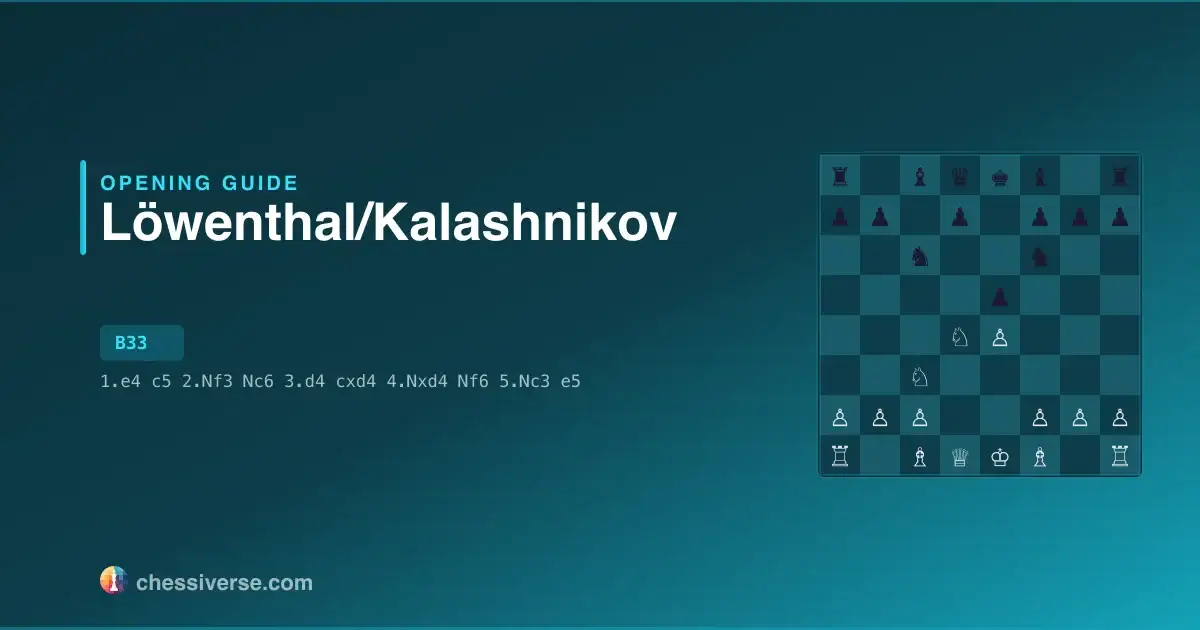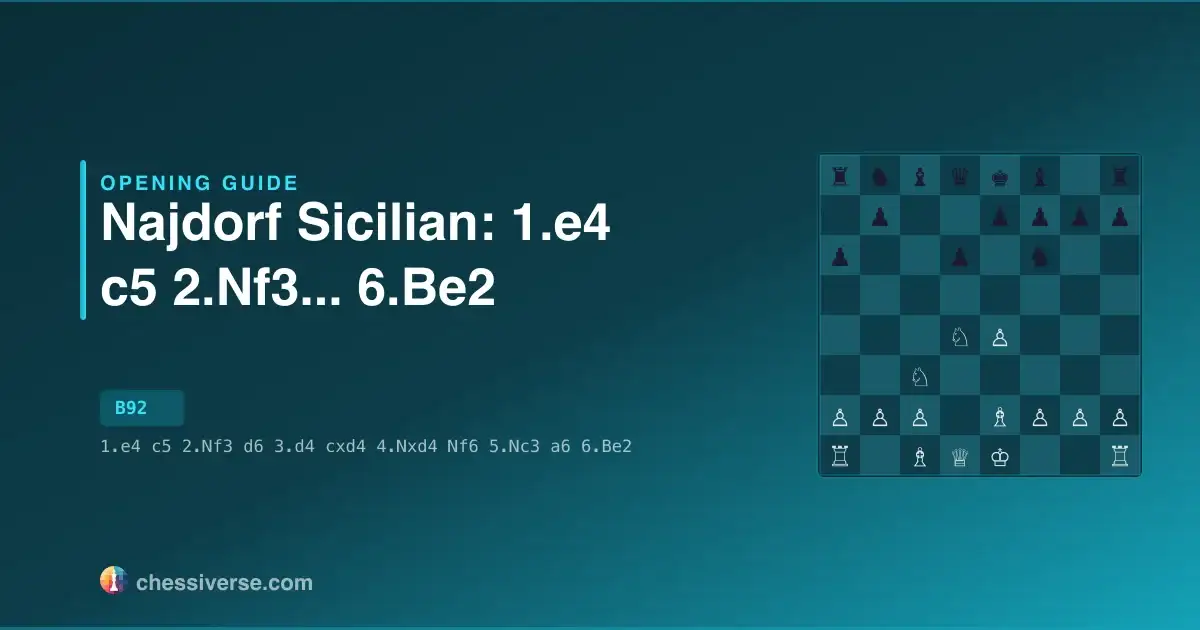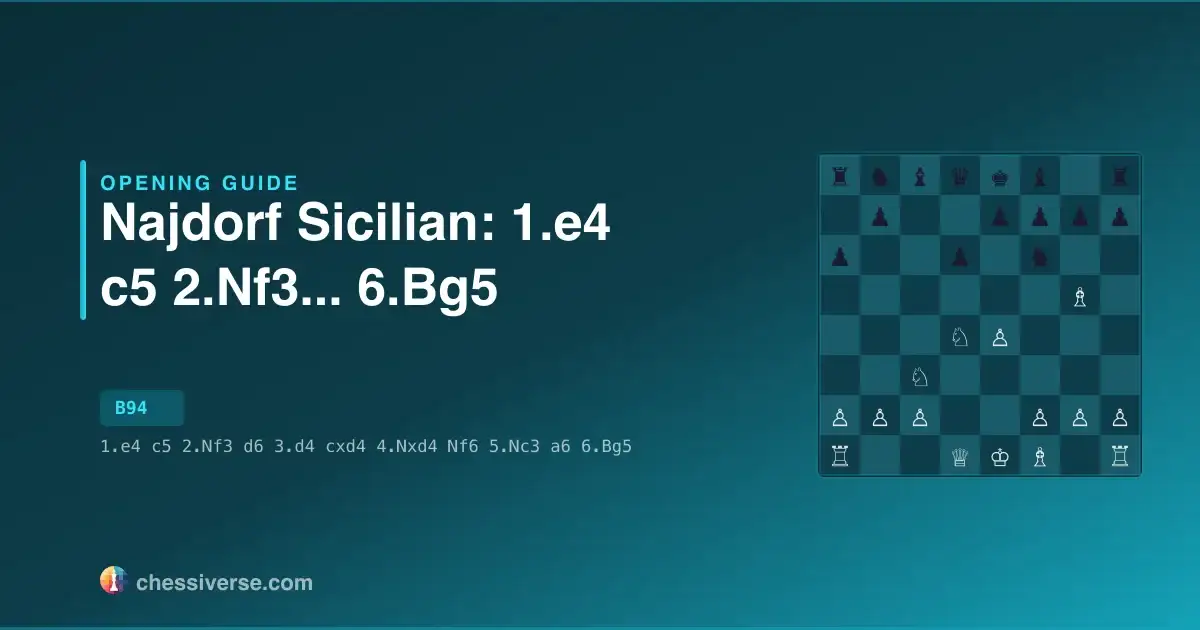



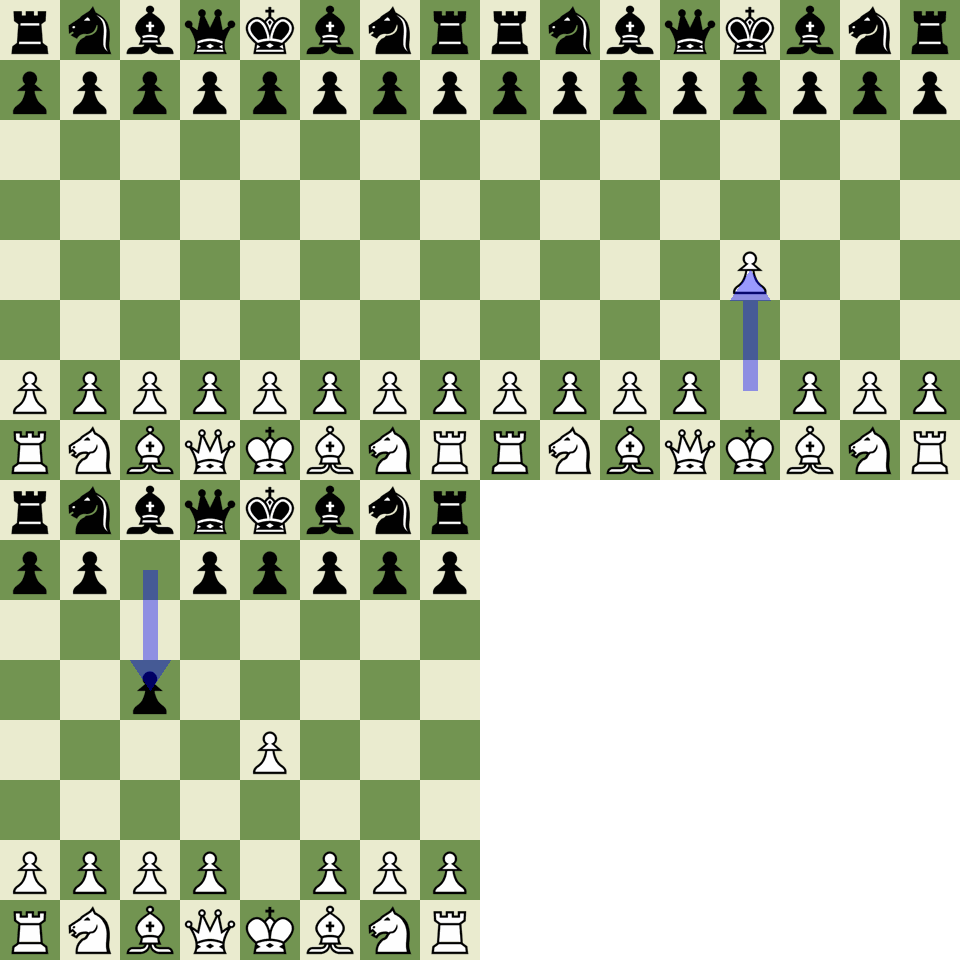
The Sicilian Defense arises after 1.e4 c5 and falls under ECO code B20. The Sicilian is a counter-attacking, asymmetric system in which Black uses a flank pawn to contest d4, banking on the idea that exchanging the c-pawn for White's d-pawn will yield a structural advantage, leaving Black with two central pawns against one. Black aims to eventually push ...d5 and make use of the half-open c-file. White's principal response is the Open Sicilian with 2. Nf3, intending 3. d4 to crack the position open, though because Black tends to be well-prepared for this, various "anti-Sicilian" systems also see regular play. A notable drawback of 1...c5 is that, unlike 1...e5, it does nothing for piece development and does not open any diagonals for the bishops, meaning Black will need at least one more pawn move before a bishop can enter the game. This gives White a development lead, which is best exploited by opening the position. After 2. Nf3 and the typical continuation 3. d4 cxd4 4. Nxd4, White obtains a well-placed knight in the centre, clear paths for all the minor pieces and the queen, and an attacking setup, while Black counters with a central pawn majority and pressure down the c-file. Following 2...Nc6 or 2...d6, White also has 3. Bb5, leading to the Rossolimo or Moscow variations. With 516.3 million Lichess games across all rating levels, it is one of the most popular openings.
- 1...c5 breaks the symmetry, and trading the c-pawn for White's d-pawn leaves Black a central pawn majority to play for a win, not just equality.
- The game often becomes a race: White attacks on the kingside with extra space and development, while Black counterattacks on the queenside.
- Black typically builds pressure down the half-open c-file as the engine of queenside counterplay.
History and Notable Players
Among the most prolific practitioners on the White side are Vlastimil Jansa (661 games), Heikki MJ Westerinen (641 games), Oleg Korneev (608 games). On the Black side, notable exponents include Loek Van Wely (738 games), Miso Cebalo (592 games), Zdenko Kozul (590 games).
Italian masters such as Giulio Polerio were analysing 1...c5 as early as the late 16th century, but the opening drifted in and out of fashion for 300 years and Capablanca dismissed it. A revival led by players like Najdorf and Boleslavsky in the 1940s and 50s restored its fortunes, and by 1990 it was the most played and analysed opening at every level.
Named after: The English name was fixed by Jacob Henry Sarratt in 1813, long after Italian analysts had studied the opening.
Notable players: Bobby Fischer, Garry Kasparov, Mikhail Tal, Magnus Carlsen
World champion Capablanca once wrote off the Sicilian as an opening riddled with holes in Black's position, yet Fischer and Kasparov later trusted it almost exclusively against 1.e4 for their entire careers.
Statistics
Based on 516.3 million Lichess games across all rating levels:
- White wins: 47.7%
- Black wins: 47.9%
- Draws: 4.4%
The statistics show a roughly balanced opening where both sides have equal chances.
Main Lines and Variations
After 1.e4 c5, the main continuations include:
- Bowdler Attack
- Sicilian Defense (2.Nf3)
- Alapin
- Closed Sicilian
- Sicilian Defense: McDonnell Attack
- Smith-Morra Gambit
Each of these lines leads to distinct types of positions and requires its own understanding of the resulting pawn structures and piece placements.
Common Mistakes to Avoid
- Ignoring the opponent's kingside attack: In many Sicilian lines, White will castle queenside and push pawns toward your king. If you don't create counterplay on the queenside or in the center, White's attack will arrive first.
Practice on Chessiverse
The best way to learn the Sicilian Defense is through practice. On Chessiverse, you can play chess against computer opponents that specialize in this opening. Our AI bots range from beginner to grandmaster level, each with unique playing styles — from aggressive attackers to solid defenders. Choose a bot that matches your rating and work your way up as you master the opening's key ideas.
Performance Across Rating Levels
How well the Sicilian Defense works depends on what level you're playing at. Among 1200-rated players, it appears in 7.33% of games — 49,471,054 of them on record — with White winning 47.5% and Black 49%. By 1800, popularity is 14.65% and White's score is 47.9% to Black's 47.5%. At 2500, 16.99% of games go into this opening; draws sit at 9.3% — the line is well-mapped at this level.
Time Control Patterns
Time control matters here: blitz players reach for this opening more than others. In bullet, it appears in 9.23% of games (245,326,791); White wins 48.6%. Blitz shows 11.42% adoption across 410,500,344 games, White scoring 47.9%. In rapid, the share rises to 9.56% — 105,776,922 games, White 46.8%.
Move Diversity and Theory Depth
Move choice is far from uniform in the Sicilian Defense. At 1200 Elo (49,471,054 games), the top reply is Nf3, played 47% of the time. Three other moves each take at least 5% of games, and the top three moves account for 74.7% of games. Entropy: 2.51. By 2500 (2,316,411 games), Nf3 dominates at 72.4% of replies; only two other moves still reach 5% and the top three moves account for 90.7% of games. Entropy drops to 1.52. The narrowing is significant — strong players consolidate around a small set of best moves, while amateurs scatter across many plausible-looking options.