



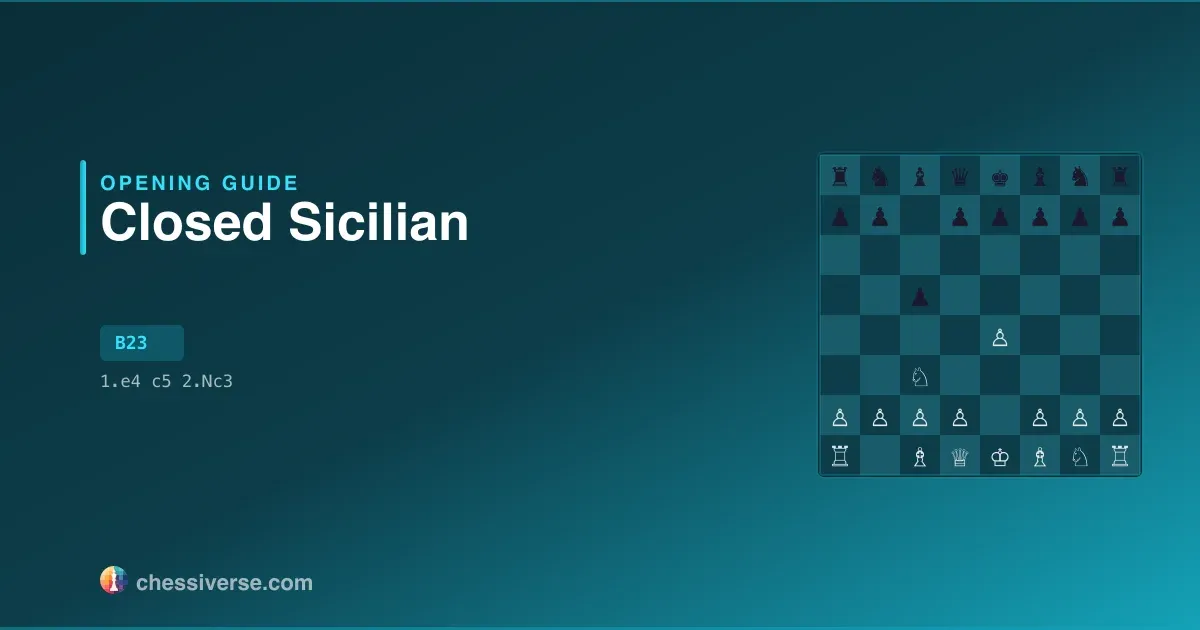
The Sicilian Defense: Closed Variation arises after 1.e4 c5 2.Nc3 and falls under ECO code B23. As the primary "anti-Sicilian," this is the main alternative to 2. Nf3, allowing White to sidestep the deeply theoretical Open Sicilian lines that follow 2. Nf3 and 3. d4. While White retains the option of opening the position later, the knight on c3 signals the possibility of a slower, more positional approach. The move supports both f4 and g3 plans while controlling d5, an advantage over playing 2. f4 or 2. g3 directly, where the critical reply 2...d5! is available. The most popular response is 2...Nc6, which develops a piece, covers d4 and e5, and avoids committing to a pawn structure until White reveals their plan on move 3. For example, Black may opt for ...g6 and ...Bg7 against the traditional Closed Sicilian setup with 3. g3 and 4. Bg2, but switch to ...e6 and ...d5 if White plays the Grand Prix Attack with 3. f4. With 44.1 million Lichess games across all rating levels, it is a well-established opening choice.
- White's classic setup is g3, Bg2, d3 and Be3, castling short and then pushing f4-f5 to attack the black king
- Black takes the other wing: while White builds on the kingside, Black generates queenside counterplay
- 2.Nc3 keeps a grip on d5 and sidesteps mountains of Open Sicilian theory, leaving White free to choose the pawn structure
History and Notable Players
It arises from the Sicilian Defense. Among the most prolific practitioners on the White side are Nikola Mitkov (210 games), Ilmars Starostits (130 games), Herbert Bastian (118 games). On the Black side, notable exponents include Loek Van Wely (71 games), Boris Gelfand (53 games), Ognjen Cvitan (49 games).
One of the first players to try 2.Nc3 was Louis Paulsen, who turned to it during his 1862 encounters with Adolf Anderssen. By the twentieth century a number of leading players had taken it up with White, Boris Spassky among them, and it stayed popular with those who would rather not wade into main-line Sicilian theory.
Named after: Not named for a person: 'Closed' marks White keeping the centre closed by skipping the early d4 that defines the Open Sicilian.
Notable players: Louis Paulsen, Boris Spassky
Bent Larsen questioned whether the Open Sicilian's trade of White's central d-pawn for Black's c-pawn is a positional error - the Closed Sicilian keeps that centre pawn on the board.
Statistics
Based on 44.1 million Lichess games across all rating levels:
- White wins: 48.6%
- Black wins: 46.9%
- Draws: 4.5%
The statistics show a roughly balanced opening where both sides have equal chances.
Main Lines and Variations
After 1.e4 c5 2.Nc3, the main continuations include:
Each of these lines leads to distinct types of positions and requires its own understanding of the resulting pawn structures and piece placements.
Common Mistakes to Avoid
- Ignoring the opponent's kingside attack: In many Sicilian lines, White will castle queenside and push pawns toward your king. If you don't create counterplay on the queenside or in the center, White's attack will arrive first.
Practice on Chessiverse
The best way to learn the Sicilian Defense: Closed Variation is through practice. On Chessiverse, you can play chess against computer opponents that specialize in this opening. Our AI bots range from beginner to grandmaster level, each with unique playing styles — from aggressive attackers to solid defenders. Choose a bot that matches your rating and work your way up as you master the opening's key ideas.
Performance Across Rating Levels
The picture changes a lot as you climb the rating ladder. The 1200 bracket has 3,649,793 games (0.54% of all games at that level); White wins 46.8%, Black 49.6%, 3.6% are drawn. By 1800, popularity is 1.26% and White's score is 49.6% to Black's 45.9%. Among 2500-rated players the line appears in 2.06% of games and draws spike to 8.7%, indicating tight preparation.
Time Control Patterns
Time control matters here: bullet players reach for this opening more than others. In bullet, it appears in 1.27% of games (33,784,367); White wins 50.1%. Blitz shows 1.00% adoption across 36,130,490 games, White scoring 49%. In rapid, the share rises to 0.72% — 7,984,398 games, White 47%. White's score swings 3.1pp across formats, so time control isn't just a stylistic choice here — it shifts the actual results.
Move Diversity and Theory Depth
Looking at move selection shows how forcing — or not — the position really is. At 1200 Elo (3,649,793 games), the top reply is Nc6, played 43.5% of the time. Two other moves each take at least 5% of games, and the top three moves account for 84.6% of games. Entropy: 2.22. By 2500 (281,145 games), Nc6 is still the top reply, at 43.9%; four other moves reach 5% and the top three moves account for 82.6% of games. Entropy drops to 2.10.
Historical Trends
Tracking the Sicilian Defense: Closed Variation year over year shows a clear story. Adoption peaked in 2020 at 1.05% (6,010,611 games). By 2025 it sits at 0.90%, 14% below the peak but still 65% above its 2013 level, so the line is up over the full period despite easing from the high.