



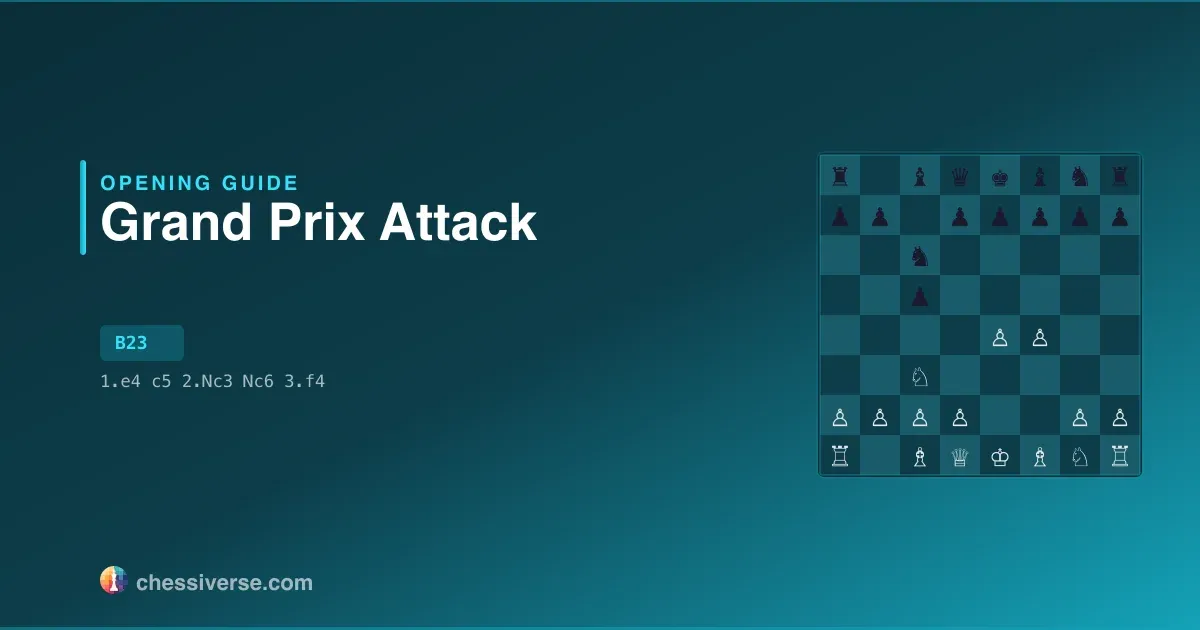
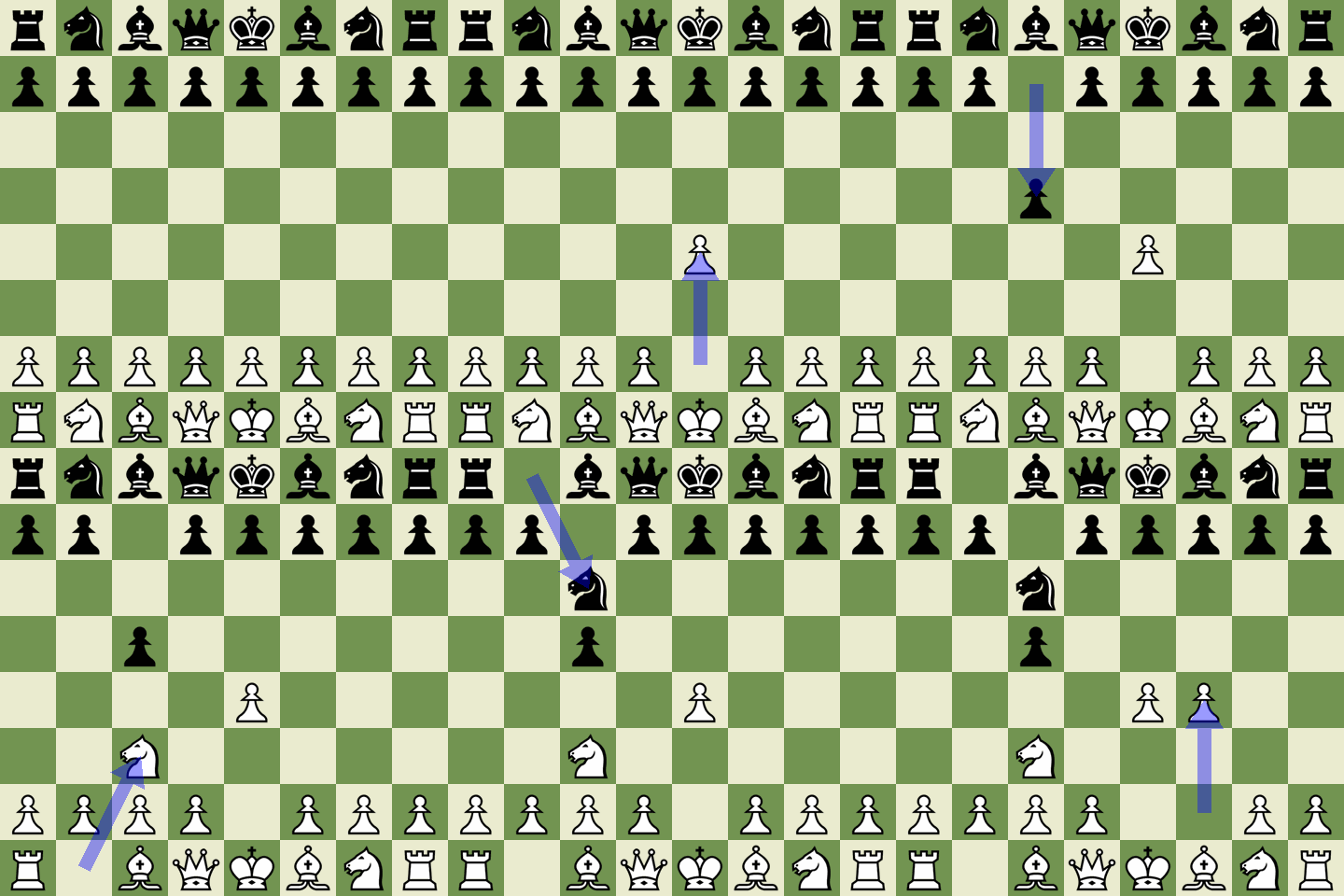
The Sicilian Defense: Grand Prix Attack arises after 1.e4 c5 2.Nc3 Nc6 3.f4 and falls under ECO code B23. Rather than contesting the centre with d4 or focusing on minor piece development, White uses the f-pawn to control central squares and initiate a direct kingside pawn storm, making this one of the sharper anti-Sicilian weapons. Black can respond by fianchettoing the bishop or launching queenside counterplay, a plan facilitated by the c5 pawn already being in place. Games frequently feature opposite-side castling, with both players racing to weaken the enemy king with pawn and bishop advances. An early 3...d5 is also a viable way for Black to challenge the centre directly. After 3. f4, White typically develops the bishop to c4 or b5, then plays d3 to activate the dark-squared bishop. With 4.4 million Lichess games across all rating levels, it is a well-established opening choice.
- White skips an early d4 and instead uses the f-pawn to spearhead a direct pawn storm against Black's king.
- The light-squared bishop chooses between b5, a positional plan that can saddle Black with doubled pawns, and c4, aiming straight at the kingside.
- Games often feature opposite-side castling and mutual pawn storms; Black counters with a ...g6 fianchetto, queenside play, or a central ...d5 break.
History and Notable Players
It arises from the Sicilian Defense: Closed Variation. Among the most prolific practitioners on the White side are Nikola Mitkov (210 games), Ilmars Starostits (130 games), Herbert Bastian (118 games). On the Black side, notable exponents include Loek Van Wely (71 games), Boris Gelfand (53 games), Ognjen Cvitan (49 games).
The 2.f4 form is also known as the McDonnell Attack, after the 14th game of the 1834 London match between Alexander McDonnell and La Bourdonnais. The Tal Gambit (2...d5 3.exd5 Nf6) later made the immediate 2.f4 unattractive, so modern players reach the attack by playing 2.Nc3 first and only then f4.
Notable players: Alexander McDonnell
One way of declining the Tal Gambit, 2.f4 d5 3.Nc3, is called the Toilet Variation, reputedly named after the place where the idea was invented.
Statistics
Based on 4.4 million Lichess games across all rating levels:
- White wins: 50.2%
- Black wins: 45.4%
- Draws: 4.4%
The statistics show a roughly balanced opening where both sides have equal chances.
Practice on Chessiverse
The best way to learn the Sicilian Defense: Grand Prix Attack is through practice. On Chessiverse, you can play chess against computer opponents that specialize in this opening. Our AI bots range from beginner to grandmaster level, each with unique playing styles — from aggressive attackers to solid defenders. Choose a bot that matches your rating and work your way up as you master the opening's key ideas.
Performance Across Rating Levels
How well the Sicilian Defense: Grand Prix Attack works depends on what level you're playing at. Among 1200-rated players, it appears in 0.03% of games — 170,157 of them on record — with White winning 49.5% and Black 47.4%. At 1800 the opening surfaces in 0.15% of games; White wins 50.7%, Black 45.1%, draws 4.3%. Among 2500-rated players the line appears in 0.17% of games and draws spike to 8.6%, indicating tight preparation.
Time Control Patterns
Look at the same opening across time controls and bullet stands out. In bullet, it appears in 0.11% of games (2,981,704); White wins 51.6%. Blitz shows 0.10% adoption across 3,773,361 games, White scoring 50.4%. In rapid, the share rises to 0.06% — 622,675 games, White 49.2%. White's score swings 2.4pp across formats, so time control isn't just a stylistic choice here — it shifts the actual results.
Move Diversity and Theory Depth
Looking at move selection shows how forcing — or not — the position really is. At 1200 Elo (170,157 games), the top reply is e6, played 30.4% of the time. Three other moves each take at least 5% of games, and the top three moves account for 73.4% of games. Entropy: 2.58. By 2500 (22,816 games), g6 takes over as the top reply at 68%; only two other moves still reach 5% and the top three moves account for 96.4% of games. Entropy drops to 1.35. The narrowing is significant — strong players consolidate around a small set of best moves, while amateurs scatter across many plausible-looking options.
Historical Trends
Long-term, the trajectory of this opening is informative. Adoption peaked in 2020 at 0.11% (611,199 games). By 2025 it sits at 0.09%, 13% below the peak but still 161% above its 2013 level, so the line is up over the full period despite easing from the high.